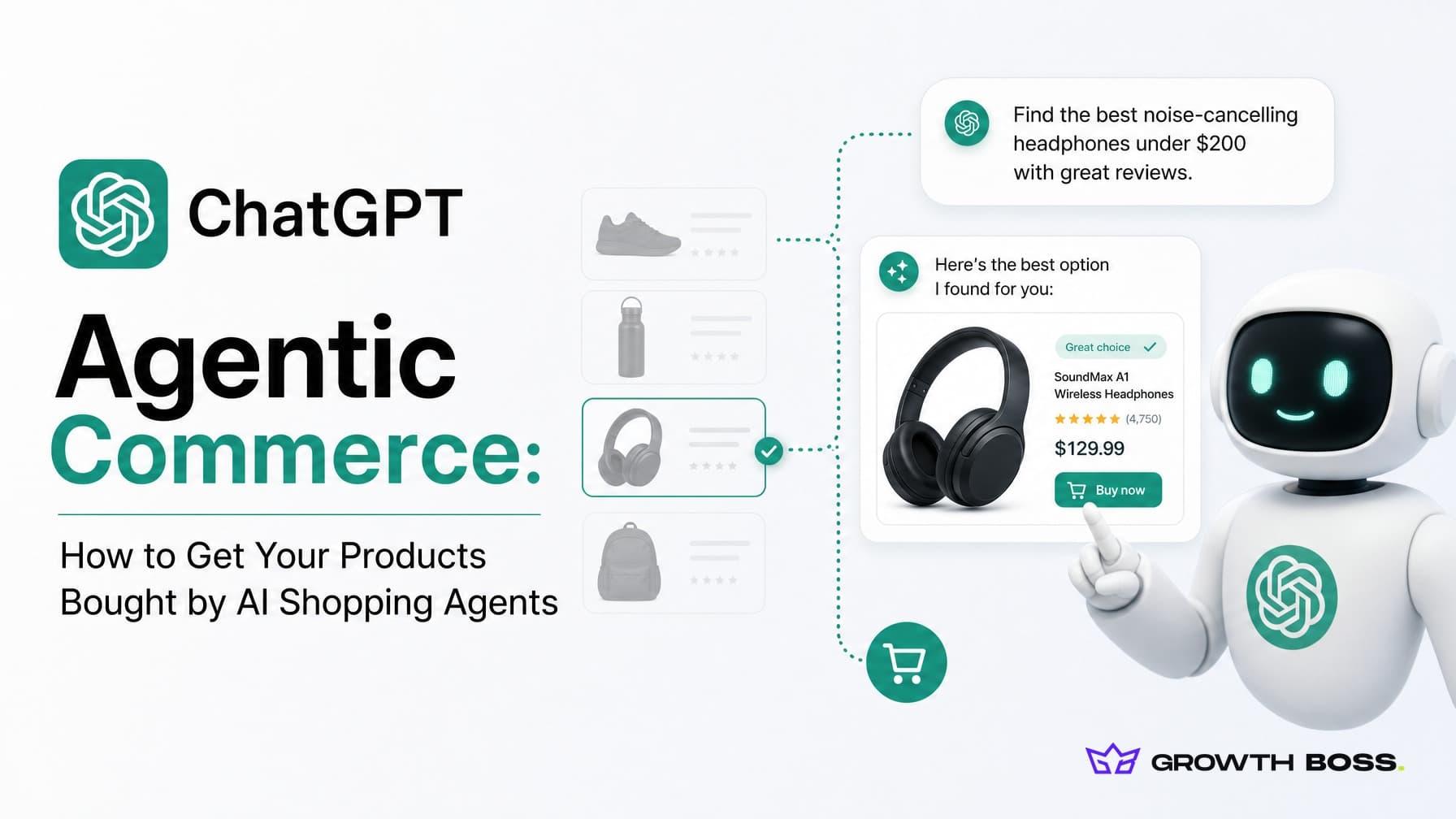
Why ChatGPT Recommends Your Competitor (and the Product-Feed Fixes That Change That)
ChatGPT sources 83% of product picks from your Google Shopping feed, not your site. Learn the feed and schema fixes that get you recommended.

Type your own product category into ChatGPT and watch what happens. You'll get a tidy carousel of three or four recommendations, complete with prices and little star ratings. And there's a decent chance your product isn't in it, but your competitor's is.
That stings more than a bad Google ranking. When someone searches Google, they at least scroll past ten options and make up their own mind. When they ask ChatGPT "what's the best [your product] under $100," they get a shortlist that feels like an answer, not a menu. Being left off that list isn't losing a click. It's never entering the conversation.
Here's the part most store owners get wrong: they assume ChatGPT is "reading their website" and judging their copy. It isn't. It's reading something far more boring, and far more fixable.
ChatGPT Isn't Reading Your Website. It's Reading Your Feed.
A 2026 study analyzed 43,000 products across ChatGPT's shopping carousels in 10 different verticals. The finding that should reshape how you think about this: 83% of the products ChatGPT recommends come directly from Google Shopping data. Not your homepage. Not your beautifully written product descriptions. Your feed.
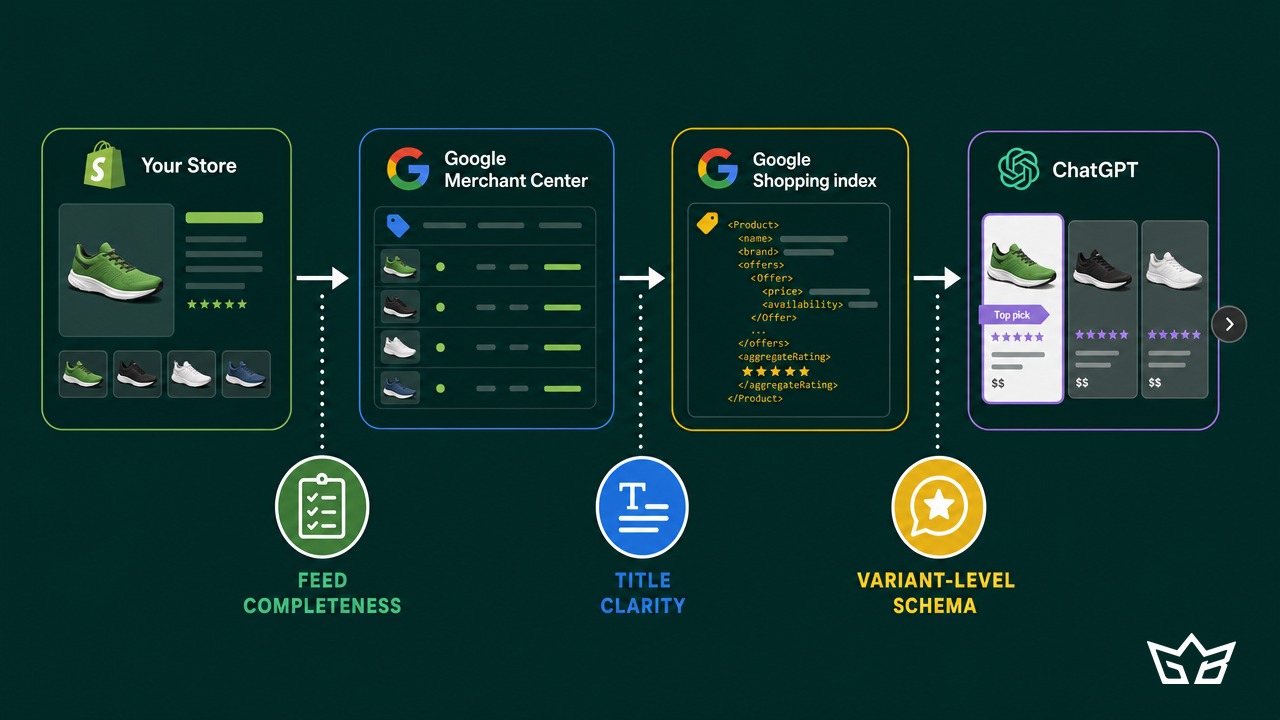
ChatGPT's product carousel is basically a structured retrieval layer sitting on top of Google Shopping's organic index. It doesn't crawl your HTML and form an opinion. It pulls machine-readable product data, the same feed your Shopify store already pushes to Google Merchant Center, and picks from it based on a few specific signals.
Those signals are more predictable than you'd think:
- Feed completeness: how many fields you've actually filled in
- Title clarity: whether your product title tells a machine exactly what the thing is
- Schema at the variant level: structured data for each size, color, or SKU, not just the parent product
- Review quality: volume, recency, rating, and how specific the reviews are
The good news buried in that research: products get selected on relevance and data quality alone. There's no ad auction, no bidding war, no "sponsored" badge. It's one of the rare level playing fields left in marketing. The store that understands the signals wins, whether it's doing $500K or $50M.
The Two Places You're Actually Getting Judged
There are exactly two arenas where ChatGPT decides whether you exist. Most brands obsess over neither and pour energy into the thing that doesn't move the needle (their website copy).
1. Your Google Shopping feed. This is where ChatGPT pulls your price, availability, title, product attributes, variant data, and ratings. You control it directly through your Merchant Center feed and your product schema.
2. Third-party citations. This is where ChatGPT pulls the Reddit threads, YouTube reviews, roundup articles, and review sites that back up its pick. You control it only by earning a presence in conversations you don't own.
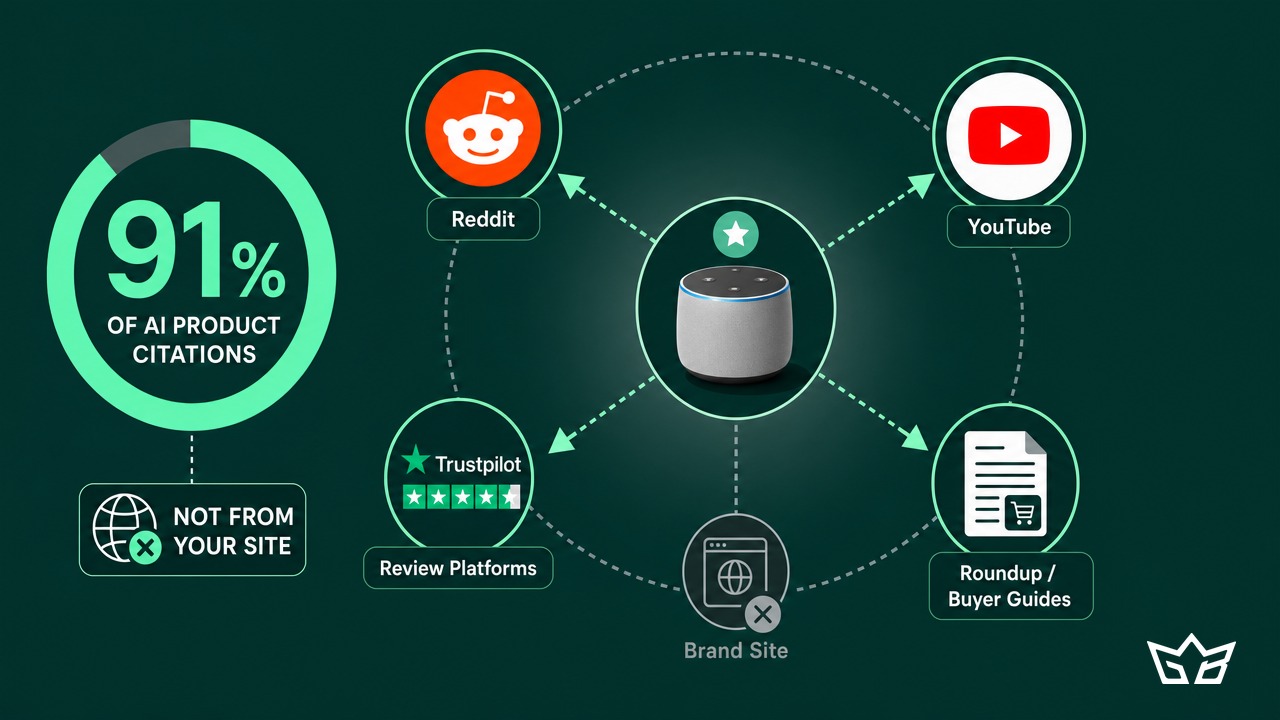
That second arena is the one that surprises people. When ChatGPT explains why it's recommending a product, the domains it cites most are YouTube (19% of responses), Reddit (19%), and RTINGS (16%), then Forbes, PCMag, CNET, and Tom's Guide. A Novi study of 10.7 million citations across beauty prompts found that a full 91% of AI citations come from third-party sources, not brand websites.
Read that again. Nine out of ten times ChatGPT backs up a recommendation, it's pointing at someone talking about the product, not the brand talking about itself. Your site is table stakes for the feed. Getting discussed is what gets you cited by AI engines.
Fix #1: Make Your Feed Complete and Honest
Start here because it's the highest-impact fix and you probably already have the infrastructure. If you sell on Shopify and run Google Shopping, your feed exists. It's just half-empty.
Walk through your Merchant Center feed and check these against every product:
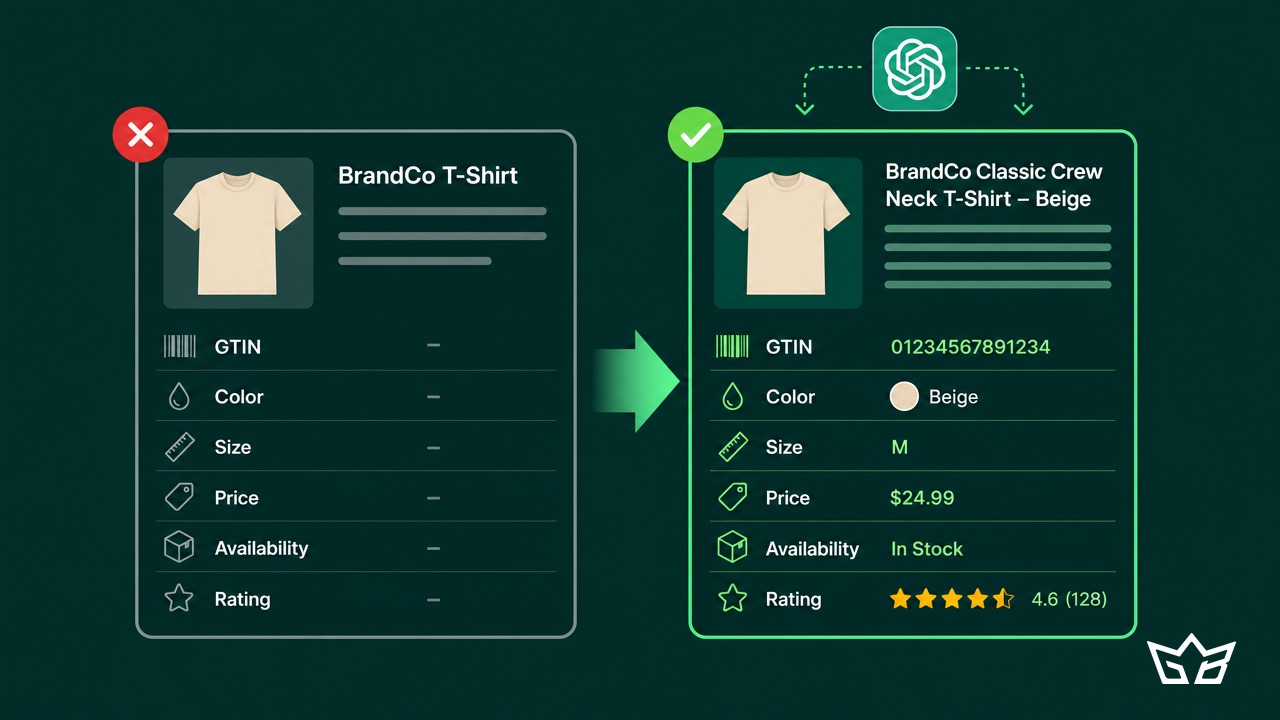
- Titles that describe, not brand. "Aurora Serum" tells a machine nothing. "Aurora Vitamin C Brightening Serum, 30ml, Fragrance-Free" tells it everything. Front-load the category and key attributes.
- Every optional field filled. Brand, GTIN, color, size, material, age group, gender where relevant. Machines reward completeness because completeness signals a legit, well-managed catalog.
- Variant-level data. Don't lump all sizes under one entry. Each variant should carry its own price, availability, and identifiers.
- Accurate, current availability. "In stock" that's actually out of stock is a fast way to get quietly demoted.
None of this is glamorous. That's exactly why it works. Most of your competitors won't do it because it feels like data entry, not marketing. It's both.
Fix #2: Get Your Schema Right (Boring, and It Works)
Structured data is the second lever, and the numbers make the case better than we can. 71% of pages cited by ChatGPT include structured data. For Google's AI Mode, it's 65%. Schema markup is no longer an SEO nice-to-have. It's the format AI reads your product in.
Use JSON-LD (Google recommends it, and it's the easiest to maintain because it drops into the page head without touching your HTML structure). At minimum, every product page needs Product schema carrying:
- name, image, description
- brand, sku, gtin
- offers with price, priceCurrency, and availability
- aggregateRating (this is what powers the little stars)
The overlooked win: Add FAQPage schema to your product pages. Pages with it are 3.2x more likely to appear in AI Overviews. Your customers already ask the same handful of questions about every product, so you're not inventing content, you're structuring what's already in your inbox.
That aggregateRating field matters more than it looks. Google shows star ratings in results when you have valid Product + AggregateRating schema, and a listing with stars pulls more clicks than one without, even when it ranks a position lower. AI engines lean on the same signal to decide who's credible.
Fix #3: Show Up Where ChatGPT Actually Looks
This is the fix that separates brands that dabble from brands that dominate the carousel. Remember: 91% of citations point away from your site. So being findable on your own domain, while necessary, will never be sufficient.
To get discussed in the places ChatGPT trusts:
- Get real reviews, and keep them coming. Recency counts. A product with 200 reviews from this quarter beats one with 500 reviews from two years ago. Set up a post-purchase flow that asks for a review at the moment of peak satisfaction.
- Get into roundups and buyer guides. The "best [category] for [use case]" articles are prime ChatGPT fuel. Pitch the writers who already rank for those terms.
- Show up on Reddit and YouTube honestly. Not with astroturfed shill posts (Reddit's own AI now flags roughly 25,000 poisoned marketing posts a day, so that game is over). Get your product into the hands of creators and genuine community members who'll talk about it because it's good.
- Encourage specific reviews. "Love it!" does nothing. "Cleared my texture in three weeks and doesn't pill under sunscreen" is the kind of specific, useful language AI extracts and repeats.
We've seen this play out with dozens of clients: the ones who treat review generation and creator seeding as an always-on system, not a one-time campaign, are the ones who show up when a buyer asks an AI for a recommendation six months later.
The Pricing Trap That Silently Demotes You
One last thing that trips up more stores than any of the above, because it's invisible. AI shopping agents cross-check your feed against your live checkout page on every crawl. If your schema says $79 and your cart says $89, the bot doesn't flag an error. It just quietly trusts you less and demotes the listing.
Inconsistent pricing between your feed, your schema, and your checkout is the single fastest way to lose an agent's trust. Audit it. Every discount, every currency, every regional price needs to line up across all three surfaces. Machines punish contradictions harder than humans do, because a human forgives a typo and a bot reads it as unreliability.
Why This Is Worth Doing Now
The window is open because most stores haven't moved yet. Consider where this is heading: 61% of consumers already use AI tools for shopping research, AI-referred visitors convert dramatically higher than traditional organic traffic, and AI shopping assistants are projected to mediate roughly a quarter of all online retail this year. AI Overviews jumped from almost nothing to 14% of shopping queries in four months. It's the same shift reshaping organic discovery, where AI-powered search is rewriting how customers find you.
The brands cementing their spot in the carousel today are the ones AI will keep recommending as usage compounds. This is a positioning race, and the early feed-and-schema work is cheap compared to what it'll cost to claw your way in once every competitor has figured it out.
Where to Start This Week
Don't try to do all of this at once. Do this, in order:
- Open your Merchant Center feed and audit 10 of your best-selling products against the completeness checklist above. Fix the titles first.
- Check one product page's schema with Google's Rich Results Test. If aggregateRating or Product schema is missing, that's your weekend.
- Turn on a post-purchase review request if you don't have one running. Reviews are the compounding asset here.
Do those three and you'll be ahead of most stores in your category, because most stores are still writing prettier product descriptions and wondering why the robot ignores them.
If you'd rather have someone audit your feed, schema, and AI visibility properly and hand you a prioritized fix list, that's exactly the kind of work our team does every day. Book a growth audit with GrowthBoss and we'll show you where you're leaking recommendations, and how to close the gap before your competitors do.
Reviewed by Gabriel Narsaik under our editorial policy.