Agentic Commerce: How to Get Your Products Bought by AI Shopping Agents
Agentic commerce is live. Optimize your product feed and schema so AI agents like ChatGPT and Gemini recommend your store. The 2026 playbook.
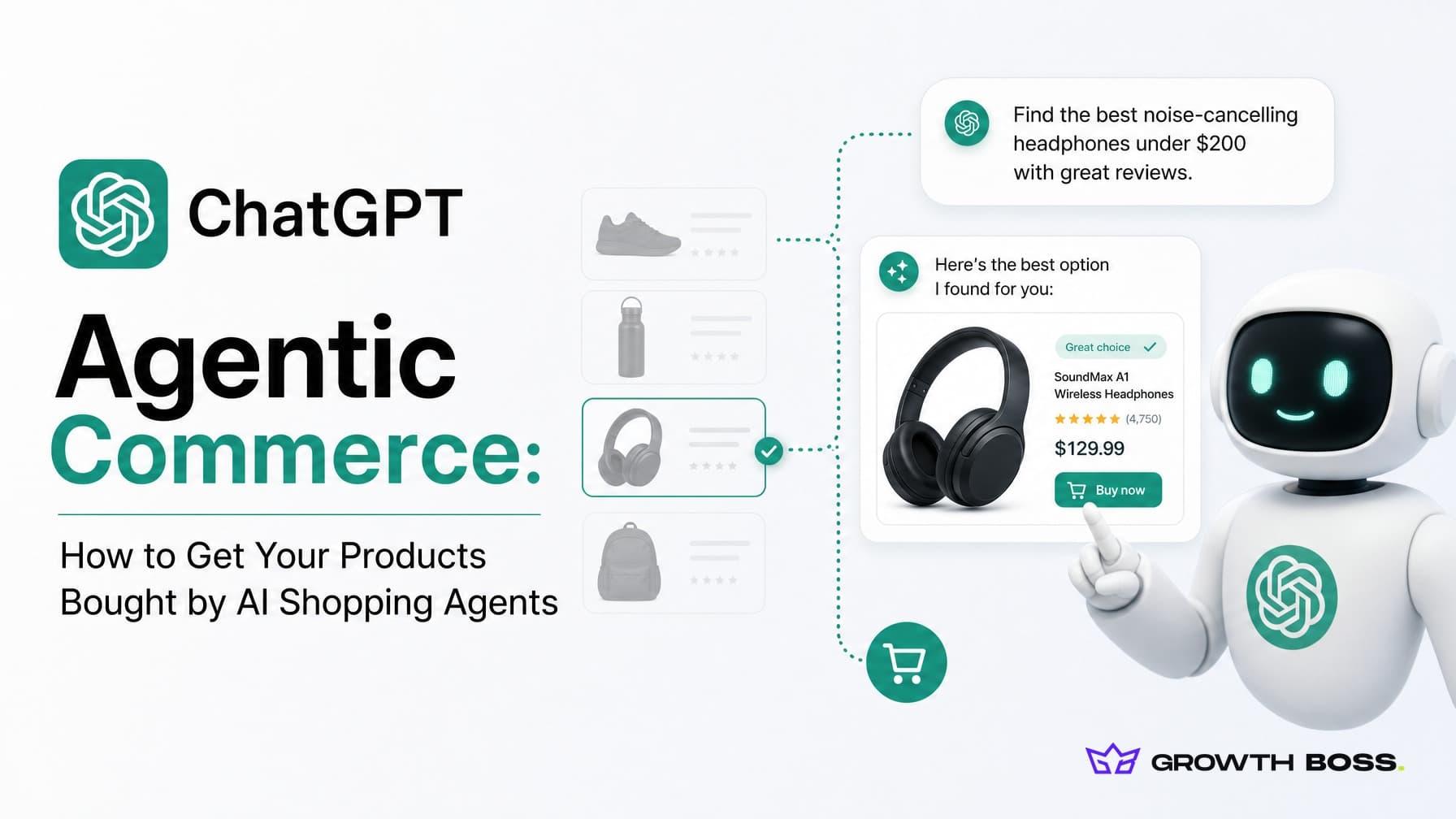
Right now, somewhere in the United States, a shopper is typing "best waterproof hiking boots under $200 for wide feet" into ChatGPT, and an AI agent is about to pick a winner. It will not pick the brand with the best photography. It will not pick the one with the cleverest tagline. It will pick whichever store handed it the cleanest, most complete machine-readable data, because that is the only thing the agent can actually read. This is the buying end of the same shift that already taught us how to get cited by ChatGPT, Claude, and Gemini in regular search.
This is agentic commerce, and it stopped being a 2027 prediction sometime around February. On February 16, 2026, OpenAI flipped on "Buy it in ChatGPT" for every U.S. user, including the free tier. Google answered with the Universal Commerce Protocol, backed by Shopify, Etsy, and Walmart. Perplexity, Amazon's Rufus, and Microsoft Copilot are all running their own shopping surfaces. Five AI engines are now recommending products to buyers who never see a search results page, never visit your homepage, and never read a single word you wrote. If your store is not feeding those agents properly, you are invisible at the exact moment a customer decides what to buy.
What "agentic commerce" actually means (and what it doesn't)
Strip away the buzzwords and the idea is simple. An AI shopping agent searches, compares, and increasingly purchases on a customer's behalf. The buyer describes what they want in plain language. The agent queries product feeds across the web, filters by the buyer's stated constraints, ranks the options, and surfaces a short list with a Buy button attached.
The customer's entire shopping journey, the part where they used to land on your site, browse your category pages, and get nudged by your copy, now happens inside a chat window you do not control.
Here is the part the hype cycle got wrong, and it matters. In late 2025, OpenAI and Stripe launched the Agentic Commerce Protocol with full native checkout, meaning ChatGPT would handle the cart and the payment end to end. By March 2026, OpenAI quietly pulled that back. They found native checkout was too rigid, so they handed checkout back to merchants and refocused ChatGPT on what it does best: discovery and intent.
That pullback is the single most useful signal for any business owner reading this. The battleground is not "will a robot take my customer's credit card." The battleground is discovery. Getting found, getting compared, and getting recommended inside the agent's answer. If you have been working on getting found in AI-powered search, this is the commerce version of the same fight. Win discovery and the customer still arrives at your checkout, often pre-sold. Lose discovery and nothing else matters, because you were never in the conversation.
Why your gorgeous website is now a secondary asset
This is uncomfortable, so let me say it plainly. The AI agent cannot see your website. It cannot admire your hero video, your custom typography, or the product photography you paid a studio four figures to shoot. None of that exists to a shopping agent. What exists is your structured data: the machine-readable feed of attributes that describes every product you sell.
We have watched clients spend months perfecting a homepage redesign while their product feed sat half-empty, missing GTINs, vague on materials, silent on dimensions. In an agentic world, that is backwards. The website is becoming the secondary asset. Your product data is the primary interface between you and a customer who will never see your brand until after the agent has already chosen you. We have been calling this shift zero-click commerce, and agentic shopping is its sharpest edge yet.
The data backs this up hard. Stores that hit what the industry now calls a "Golden Record," meaning roughly 99.9% attribute completion across their catalog, are seeing 3 to 4 times higher visibility in AI recommendations than stores with sparse data. Same products. Same prices. The only difference is one store told the machine everything and the other made it guess. Agents do not guess in your favor. When an attribute is missing or vague, the agent recommends the competitor whose data was complete.
The 7 data points that get you 70% of the way there
You do not need to boil the ocean. Most of the eligibility for AI shopping surfaces comes from a small set of clean, SKU-level attributes. Get these right on every product and you are roughly 70% of the way to showing up on every major engine at once:
- GTIN (the global trade item number, your barcode): the universal key agents use to match and compare products across stores
- Title: specific and descriptive, not stuffed with marketing fluff. "Men's Waterproof Leather Hiking Boot, Wide, Brown" beats "TrailMaster Pro 3000"
- Description: the real attributes a buyer asks about, written for a machine reading literally, not a human scanning emotionally
- Image: a clean, correctly tagged product image at the SKU level
- Price: accurate and current, matching what is live on your site
- Availability: true, real-time stock status (more on why this one can quietly kill you below)
- Brand and category: correctly assigned so the agent files you in the right comparison set
Notice what is not on that list: clever copy, brand storytelling, emotional hooks. Those still matter for the humans who land on your site after the agent sends them. But they do nothing to get you into the agent's answer in the first place.
Schema markup is the foundation, not an SEO afterthought
If you have ever treated schema markup as a box your SEO person ticks, it is time to promote it to a revenue priority. Schema.org/Product markup on every product page is how agents read your catalog directly from your site.
At minimum, every product page needs structured data covering:
- name and description
- GTIN and brand
- offers (price, currency, availability)
- aggregateRating (your review data, which heavily influences ranking)
- shippingDetails (agents increasingly factor delivery speed and cost into recommendations)
The brands winning AI visibility treat schema as a living asset that mirrors reality, not a static snippet pasted in once and forgotten. When your price changes, your schema changes. When you sell out, your schema reflects it within the hour.
The reliability score nobody warned you about
Here is the trap that catches even sophisticated stores, and it is worth slowing down for. AI shopping engines track whether transactions they route to you actually succeed. If your feed says "in stock" but the item is gone, the agent attempts the purchase, hits a MERCHANDISE_NOT_AVAILABLE error, and that failure goes on your record.
Rack up enough of those errors and the agent quietly demotes you. It shows your products less often, because from the machine's point of view you are unreliable. You are not penalized with a warning or an email. You just slowly disappear, and you will not know why.
This changes the stakes on inventory accuracy. A stale feed used to mean a mildly annoyed shopper and a lost sale. Now it means a damaged reliability score that suppresses your visibility across every future query. Your feed has to reflect actual stock levels, not approximate availability, and it has to update fast. This is no longer a back-office hygiene task. It is a ranking factor.
One feed will not win five engines
A tempting shortcut is to build one product feed and assume it satisfies everyone. It will not. Perplexity, Amazon Rufus, ChatGPT, Microsoft Copilot, and Google Gemini each weight attributes differently and accept data in different shapes. A feed tuned for Google Shopping is a starting point, not a finish line.
The practical move is to nail the universal core first, the seven attributes above plus clean schema, then layer engine-specific optimization on top. Think of it like the difference between speaking grammatically correct English everywhere versus knowing the local slang in each city. The grammar gets you understood. The slang gets you trusted.
Where to actually start on Monday
You cannot fix 5,000 SKUs this week, and you do not need to. Run the Pareto play.
- Pull your top 20% of SKUs by revenue. These products drive roughly 80% of your sales and deserve attention first.
- Audit their attribute completeness. Open your feed and look at those products with cold eyes. Is the GTIN there? Is availability live and accurate? Is the description written for a literal machine or a daydreaming human? Get these to 95% or higher completion.
- Add or fix Product schema on those same product pages, including offers, availability, and aggregateRating.
- Test a real query. Open ChatGPT or Gemini, ask for exactly the kind of product you sell the way a customer would, and see whether you show up. If a competitor appears and you do not, the gap is almost always in their data, not their marketing.
- Set up a feed-accuracy check so your stock status updates fast enough to protect your reliability score.
We have seen this play out with our own ecommerce clients over the last few months, including a retailer we took from brick-and-mortar to $84.6K online in 90 days. The ones who treated their product feed as marketing infrastructure, not a technical chore, started appearing in AI recommendations within weeks. The ones who kept polishing the website while ignoring the feed kept wondering where their traffic went. The traffic did not go anywhere. It just stopped passing through their homepage on the way to the buy.
The shopper typing into ChatGPT right now is not coming back to compare your site against three others. The agent already did that comparison, and it used the only thing it can read to decide. Your job for the next quarter is simple to say and real work to do: make your data the cleanest, most complete, most accurate answer to the question your customer is about to ask a machine.
Start with your ten best-selling products this week. Pull the feed, fill every gap, fix the schema, and run the query yourself. If you would rather have a team audit your full catalog and build the feed infrastructure that wins across all five engines, that is exactly the kind of growth system we build. Either way, do not let another month pass with a beautiful website and a feed full of holes.
Reviewed by Gabriel Narsaik under our editorial policy.