AI Agents vs. Chatbots vs. Automation: What Your Business Actually Needs
AI agents vs chatbots vs automation: what each one does, what they cost, and how to pick the right tool without overpaying. Get the 30-second framework.
Most businesses shopping for "AI" right now are about to overpay for the wrong thing. They've heard the word "agent," a vendor has quoted them five figures, and nobody stopped to ask whether the job in front of them needs an agent at all. A lot of the time, it doesn't.
The confusion is fair. Chatbots, automation, and AI agents get pitched as if they're the same product with different price tags. They're not. They're three different tools that solve three different problems, and picking the wrong one is how you end up with a $40,000 system that does what a $40-a-month tool already did.
Here's the cleanest way to think about AI agents vs chatbots vs automation, and how to know which one your business actually needs.
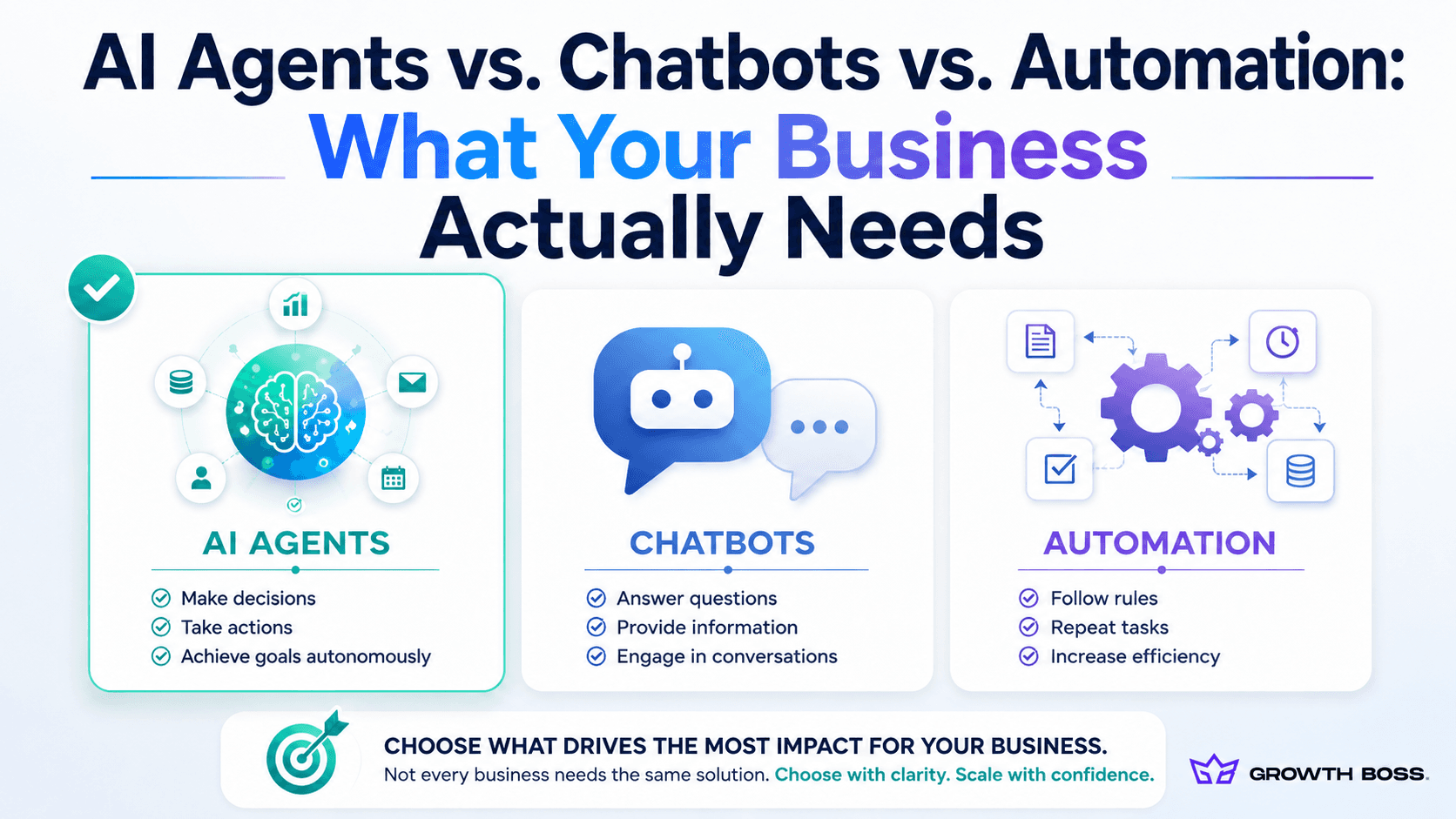
Chatbots answer. Automation follows a script. Agents decide and act.
A chatbot talks. You ask a question, it returns an answer. The good ones feel genuinely conversational and handle FAQs, order status, and "what are your hours" without a human ever touching it. But a chatbot waits for you to start, and it stops at information. It will happily tell a customer the return policy is 30 days. It will not return anything.
Automation runs a fixed sequence. When X happens, do Y, then Z. A new lead fills out a form, so it gets added to your CRM, tagged, and sent a welcome email. No conversation, no decision-making, just a reliable pipeline that fires the same way every single time. Most of what gets sold as "AI automation" is actually this, and that's fine. It's cheap, predictable, and it works. It just isn't intelligent. Change the conditions and it breaks.
An AI agent is the thing people mean when they say "agentic." It reasons about a goal, decides which steps to take, uses your actual tools to take them, and adapts when something doesn't go to plan. It doesn't wait for a script. Give it "resolve this refund request" and it can verify the order, check it against policy, issue the refund in your payment system, update inventory, and email the customer, then loop back and fix it if a step fails.
That refund example is the whole difference in one scene. Ask all three the same thing, "the customer wants their money back":
- The chatbot says, "Our return policy is 30 days, here's the link."
- The automation fires a pre-built refund flow, but only if the request arrives in exactly the format it expects.
- The AI agent reads the order, decides it qualifies, processes the refund across your systems, schedules the pickup, and notifies accounting, all in one pass.
Same request. Three completely different outcomes, and three completely different price points.
What this looks like with real tools
You don't have to build any of this from scratch, and the market has split along these same three lines.
On the chatbot end, you've got the website widgets and help-center bots that deflect routine questions. Automation lives in tools you probably already pay for: Zapier for simple connectors, or n8n if you want more control and lower long-term cost. The agent layer is newer and growing fast. Customer-support agents like Intercom Fin, Sierra, Ada, and Gorgias don't just answer, they resolve tickets end to end. On the task side, Zapier Agents and n8n's agent nodes let an LLM decide which tools to call and in what order, instead of you hard-coding every step.
The line between these blurs in the marketing, which is exactly why buyers get confused. A vendor will call a glorified chatbot an "AI agent" because the word sells. The test is simple: ask what it does when something goes wrong or off-script. A chatbot apologizes. An agent figures it out.
The part nobody quotes you on: what each actually costs
This is where the wrong choice gets expensive. Rough 2026 numbers, and what you're really paying for:
- Chatbot: $19 to $200 a month. Answers questions and waits for you to start the conversation. Best for FAQs, order status, and lead capture. Breaks the moment someone asks it anything off-script.
- Automation: usually bundled into tools you already own. Runs fixed, event-triggered flows with no decision-making. Best for repetitive, predictable handoffs. Breaks the second the conditions change.
- AI agent: $500 to $5,000 a month off-the-shelf, or $30k to $100k for a custom build. Reasons, decides, and acts across your systems toward a goal. Best for multi-step workflows that need judgment. Breaks less often, but it's harder to debug when it does.
A few honest notes on those numbers. Chatbot sticker prices lie. That $19 plan usually doubles or triples once you add real conversation volume, integrations, and removing the vendor's branding. And nobody warns you about integration work on agents. Connecting one to your CRM, helpdesk, and payment system is the real cost, and you should budget an extra 20% to 40% on top of any subscription to cover it. Teams underestimate this part every single time.
The upside, when you match the tool to the job, is just as real. Well-implemented AI agents commonly return 200% to 500% in their first year through labor savings and faster resolution. Customer-service deployments report 40% to 60% faster response times and 30% to 50% lower support costs within 90 days. We've seen a mid-sized operation hit payback in roughly 1.3 months on a hybrid setup. That number isn't typical, but it shows what happens when the tool actually fits the task.
How to actually choose (a 30-second framework)
Stop thinking about which technology is most advanced. Start with the job. We walk every client through the same three questions:
- Is the task a conversation, or a process? If people just need answers, you need a chatbot, not an agent. Don't pay agent prices to answer "where's my order."
- Does the process ever need judgment? If every case is identical and the steps never change, automation handles it for a fraction of the cost. If the path depends on context (this customer, this order, this exception), that's agent territory.
- Is the workflow worth automating end to end? A chatbot saves someone two minutes of reading. An agent saves the entire fifteen-minute workflow behind it. The math is brutal here: automating the reading is marginal, automating the execution is exponential. That's the line that decides whether an agent earns its cost.
Most businesses we work with end up with a mix, and that's the right answer. A chatbot on the website to deflect routine questions. Automation wiring your tools together in the background. An agent on the one or two high-value, multi-step workflows where judgment and execution actually move money: refunds, lead qualification, onboarding, support escalations. If you've already started handing routine marketing tasks to AI, the same logic applies to which tasks are safe to fully automate and which still need a person in the loop.
The mistake we see most
Two, actually, and they're opposite ends of the same error.
The first is buying agentic hype for a problem a chatbot solves. A company gets sold a custom "AI agent" to answer support questions, spends $50,000, and ends up with something a $99-a-month bot did just as well. The reasoning engine sits there unused, because the task never needed reasoning in the first place.
The second is the reverse: trying to script your way through a problem that genuinely needs judgment. You bolt together a dozen automation rules to handle returns, and it works right up until a customer does something slightly outside the rules, which is daily. Now you've got a brittle system and a human cleaning up behind it.
Here's the thing nobody selling you software will say plainly. The technology is the easy part. The hard part is mapping the workflow first, knowing exactly where a human's judgment is actually required, and only then picking the tool. Skip that and you'll overpay for an agent or underbuild with automation, every time.
The market is moving fast, so the pressure is real. Gartner expects 40% of enterprise apps to have task-specific AI agents built in by the end of 2026, up from just 5% in 2025. But "everyone's adopting it" isn't a strategy. 61% of leaders already feel more pressure to prove ROI on AI than they did a year ago. The ones who win aren't the ones who bought the fanciest tool. They're the ones who matched the tool to the job.
Where to start this week
Pick one workflow. Just one. Something repetitive that eats your team's hours, like inbound lead qualification or first-response support. Write down every step a human currently takes, and mark which steps need a real decision versus which are pure routine.
If there are no real decisions, you need automation, and you can probably build it this week. If the whole thing is just answering questions, start with a chatbot. If the workflow is multi-step and depends on judgment at each turn, that's where an AI agent pays for itself, and where it's worth doing properly.
That mapping exercise is exactly how we scope automation for clients, and it's the step that saves the most money, because it kills the wrong purchase before it happens. If you want a second set of eyes on which of your workflows are agent-worthy and which aren't, that's what our AI automation work is built around. Either way, map the workflow first. The tool is the last decision, not the first.
Reviewed by Keston Leader under our editorial policy.