Small Business Website Cost in Ontario (2026 Prices)
What a small business website really costs in Ontario in 2026: real price bands, the costs quotes leave out, and how to compare quotes fairly.

Ask three Ontario web designers what a small business website costs and you'll get $1,500, $8,000, and $25,000. All three are telling you the truth. None of them is describing the same thing.
That spread is why so many owners stall for a year before building anything. You can't tell whether you're being overcharged, undersold, or quoted for a project you never asked for, so you do nothing, and the outdated site keeps quietly losing you work.
Here are the actual numbers for 2026, what moves them, and the costs that almost never appear in the quote.
What a small business website costs in Ontario in 2026
These are the working bands across the Canadian market this year. Ontario sits at the higher end of them, because Toronto and the GTA carry the country's most expensive design labour, which is worth knowing before you compare a local quote against a national average. We've written separately about what shapes website development in Toronto specifically.
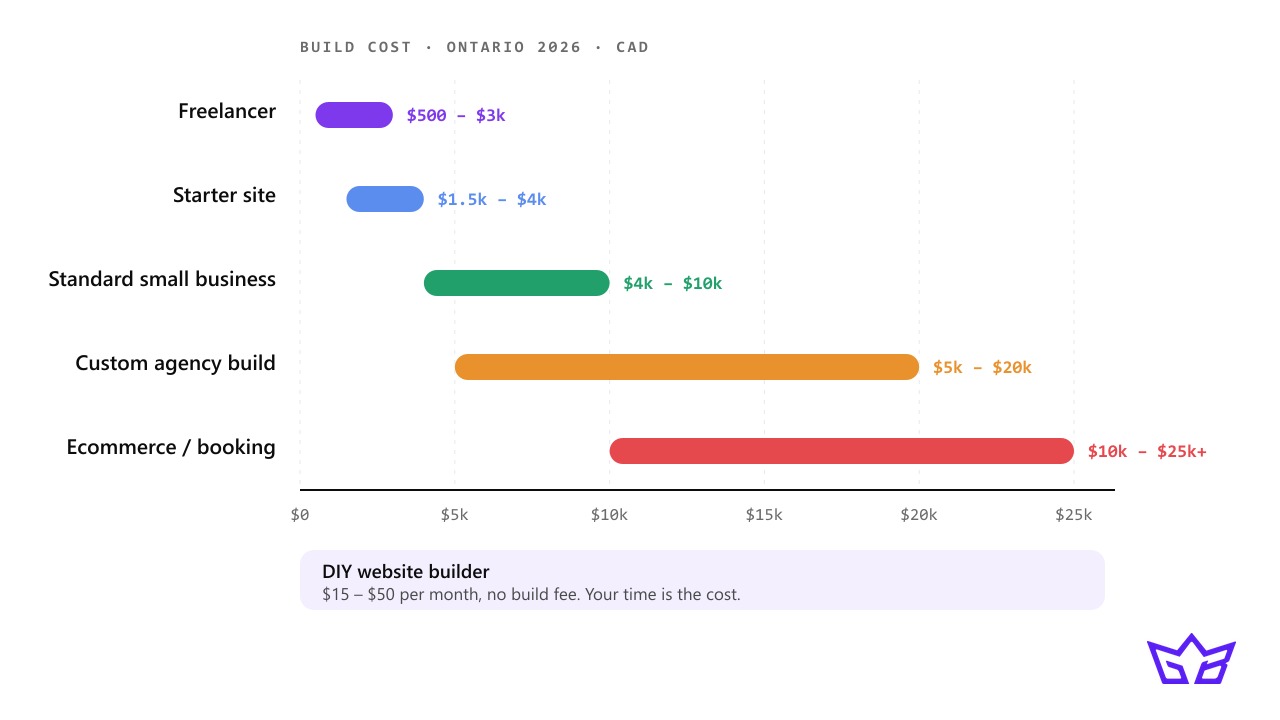
- DIY website builder: $15 to $50 per month. Squarespace, Wix, Shopify. No build fee, but your time is the cost, and most owners quietly abandon the project half-finished.
- Freelancer: $500 to $3,000. Enormous range in quality. A good freelancer at $2,500 beats a bad agency at $8,000. A cheap one disappears mid-project.
- Starter or brochure site: $1,500 to $4,000. Roughly 3 to 5 pages on a proven template, light customisation, a contact form.
- Standard small business site: $4,000 to $10,000. Around 6 to 12 pages, built to be found in search, with real lead capture.
- Custom agency build: $5,000 to $20,000. Bespoke design, custom development, strategy and copy included.
- Ecommerce or booking platform: $10,000 to $25,000 and up. Scales with catalogue size and how many systems have to talk to each other.
Most established small businesses land in the $1,500 to $5,000 build range. That's the honest middle of this market, and any quote far outside it deserves an explanation in either direction.
What actually moves the number
Nobody prices a website by the page, whatever the quote implies. Five things move the figure, in roughly this order of impact.
Scope, meaning how many distinct things the site has to do. A five-page site that shows your services and takes enquiries is a different animal from one with booking, member logins and a quoting tool. Pages are cheap. Functions are expensive.
Whether the design is custom or template-based. A proven template adapted properly to your brand is not a compromise, it's the sensible default for most local businesses. Fully bespoke design is a real cost and it's worth it when your brand is the product. For a plumber, it usually isn't.
Who writes the words. Copywriting is the single most commonly excluded line item. If you don't write it and it's not in the quote, someone is going to have to, and that conversation always happens after you've signed.
Photography. Stock is free and looks it. Real photos of your work, your team and your vans is often the difference between a site that converts and one that doesn't. Budget for it separately or plan to supply your own.
Integrations. CRM, booking, payments, inventory. Every system the site has to speak to adds build and testing time, and integrations are where fixed-price projects go over.
The costs that never make the quote
This is where owners get caught, because the build fee is the number everyone compares and the running cost is the number that actually recurs.
- Hosting and maintenance: $70 to $200 per month for a professionally managed site. Covers hosting, security patching, backups and small fixes.
- Domain: $15 to $30 a year. Trivial, but make sure it's registered in your name, not your agency's.
- SSL certificate. Should be free and included. If someone is billing you for it separately, ask why.
- Content edits after launch. Some agencies include a monthly allowance, others bill hourly at $75 to $150. Establish which before you sign, not after.
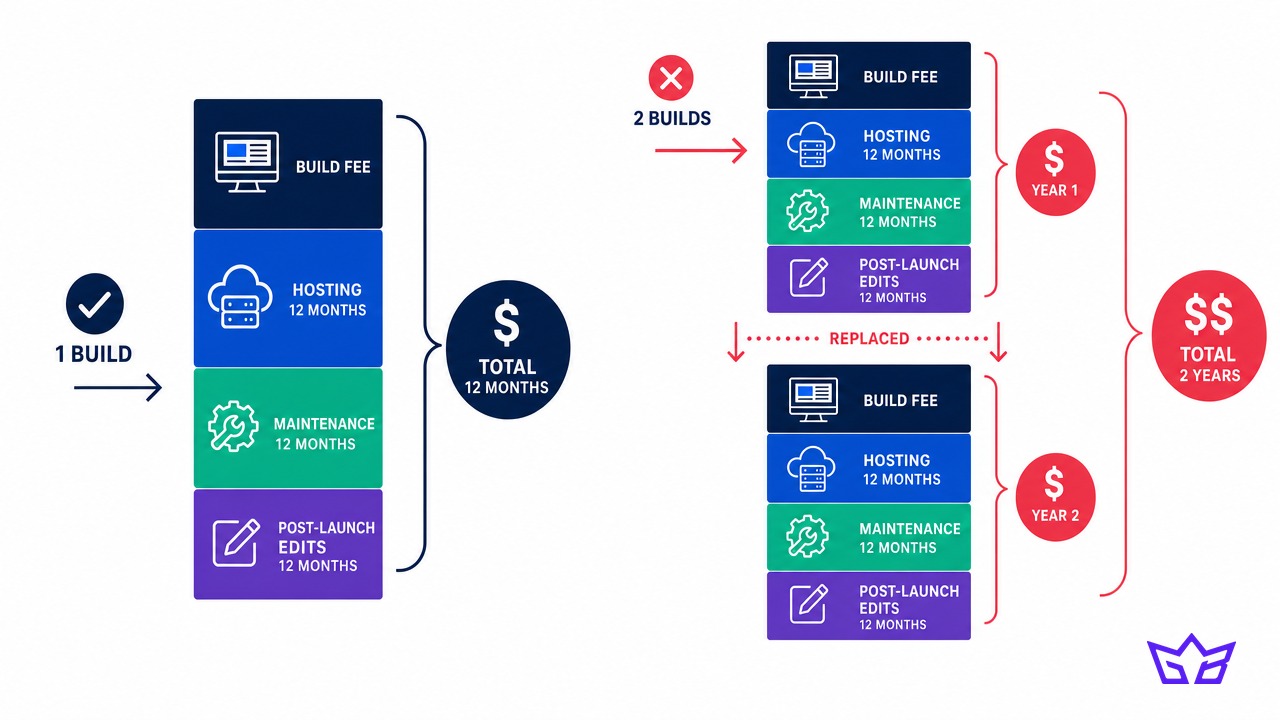
- The second build. The most expensive line item nobody quotes. A site bought too cheaply, that doesn't convert, gets replaced inside two years, and you pay twice.
Add it up and a $4,000 site with $120 a month attached is really a $5,440 first year. That's the number to compare between quotes, not the build fee.
DIY, freelancer, or agency
DIY makes sense when you're pre-revenue, testing an idea, or genuinely enjoy the work. The trap is opportunity cost: forty hours of your time is not free, and most DIY sites stall at seventy percent finished.
A freelancer makes sense when your needs are simple and you can judge quality. Ask for three live sites they built more than a year ago, then check whether those businesses are still using them. Sites that got replaced quickly tell you something.
An agency makes sense when the website has to produce leads rather than exist. You're buying accountability and a team that doesn't vanish, and you should expect to be asked about your customers and your margins, not just your colour preferences.
Where a fast, fixed-price build fits
There's a category the bands above miss: the business that needs a credible site on the internet soon, not a three-month project.
If you're a trade or local service business with a clear offer, a handful of services and no ecommerce, most of what drives cost in the list above simply doesn't apply to you. You don't need bespoke design, custom development or system integrations. You need a professional, mobile-ready site that ranks for your name, explains what you do and lets people contact you.
That's the reasoning behind our own website build from $2,499, covering up to five pages or a store with up to five products, with extra products at $100 each, usually live in three to six weeks. It is a standard scope, not a bespoke project, which is exactly why it is priced the way it is.
If you are starting closer to scratch and also want your first stretch of content handled, Business Starter bundles that same kind of build with your first eight weeks of content for $2,549 in advance or $915 a month. Neither is the right answer for everyone, and we say so on the call. If you need ecommerce, custom functionality, integrations or original copywriting, those are quoted separately, because pretending otherwise is how projects and relationships go wrong.
How to read a quote without getting burned
Four questions separate a real quote from a number someone made up.
- "What's excluded?" The answer tells you more than the price does. Copywriting, photography, integrations and post-launch edits are the usual gaps.
- "What does month two cost?" Get hosting, maintenance and edit rates in writing before you sign anything.
- "Who owns it?" You should own the domain, the content and ideally the site itself. Some cheap monthly plans mean you're renting, and leaving means starting over.
- "Can I see something you built two years ago?" Anyone can show you a launch. Fewer can show you a site that's still working, still ranking and still owned by a happy client.
If a quote is dramatically below the bands above, it's not automatically a scam, but something is different: a template, a smaller scope, an offshore team, or a monthly lock-in. Ask which. A straight answer is a good sign either way.
Frequently asked questions
How much does a small business website cost in Ontario? Most land between $1,500 and $5,000 to build, plus $70 to $200 a month for hosting and maintenance. Starter sites run $1,500 to $4,000, standard small-business sites $4,000 to $10,000, and custom agency builds $5,000 to $20,000.
Why are website quotes so different from each other? Because they're rarely for the same thing. Scope, custom versus template design, who writes the copy, photography and integrations move the number far more than page count does. Two quotes are only comparable once you know what each excludes.
Is a cheap website a bad idea? Not inherently. A cheap site with a clear, narrow scope can be excellent. A cheap site sold as a full custom build is the problem, because it gets replaced inside two years and you pay twice.
What are the ongoing costs of a website? Hosting and maintenance at $70 to $200 monthly, a domain at $15 to $30 a year, and content edits either included or billed at $75 to $150 an hour. SSL should be free.
How long does a small business website take to build? A typical agency project runs four to twelve weeks. A fixed-scope build on a proven structure, like our own website from $2,499, is usually live in three to six weeks, because the scope is agreed up front and most of the design decisions are already made.
Do I own my website? You should. Check that the domain is registered in your name and confirm what happens to the site if you stop paying. Some cheap monthly plans are rentals.
What to do this week
Stop comparing build fees. Take whatever quotes you're holding, add twelve months of hosting and maintenance to each, then ask every one of them what's excluded. The cheapest number on the page almost never survives that exercise, and the one that does is usually the honest one.
If your business is a local service with a straightforward offer, and the real problem is that you need to exist online properly and soon, see what a website from $2,499 gets you. If it's more complicated than that, tell us what you're actually trying to do and we'll price the real thing, which is what our web design and SEO work is built for.
Frequently asked questions
How much does a small business website cost in Ontario?
Most land between $1,500 and $5,000 to build, plus $70 to $200 a month for hosting and maintenance. Starter sites run $1,500 to $4,000, standard small-business sites $4,000 to $10,000, and custom agency builds $5,000 to $20,000.
Why are website quotes so different from each other?
Because they're rarely for the same thing. Scope, custom versus template design, who writes the copy, photography and integrations move the number far more than page count does. Two quotes are only comparable once you know what each excludes.
Is a cheap website a bad idea?
Not inherently. A cheap site with a clear, narrow scope can be excellent. A cheap site sold as a full custom build is the problem, because it gets replaced inside two years and you pay twice.
What are the ongoing costs of a website?
Hosting and maintenance at $70 to $200 monthly, a domain at $15 to $30 a year, and content edits either included or billed at $75 to $150 an hour. SSL should be free.
How long does a small business website take to build?
A typical agency project runs four to twelve weeks. A fixed-scope build on a proven structure, like our own website from $2,499, is usually live in three to six weeks, because the scope is agreed up front and most of the design decisions are already made.
Do I own my website?
You should. Check that the domain is registered in your name and confirm what happens to the site if you stop paying. Some cheap monthly plans are rentals.
Reviewed by Bahaa Zuraik under our editorial policy.