Website Development in Toronto: What It Costs and How to Choose (2026)
What web design and website development cost in Toronto in 2026, the four questions to ask any agency, and how to avoid paying twice for the same site.
Ask three Toronto agencies to quote the same website and you will get $4,000, $19,000, and $60,000. Same page count, same brief, same deadline. That spread is not a negotiating tactic, it is three companies quietly solving three completely different problems, and almost nobody explains which one you are actually buying.
So let's fix that. Here is what web design and website development in Toronto really cost in 2026, what separates the quotes, and the four questions that tell you within ten minutes whether a Toronto web development agency is worth its price.
What you are actually paying a Toronto web design agency for
A website has two halves that most quotes blur together.
Design is the part you can see. Layout, typography, the order information appears in, what the eye lands on first. Good design is not decoration, it is a series of decisions about where you want attention to go.
Development is the part you feel. How fast it loads, whether the forms work on a five-year-old Android, whether your team can update the pricing page without calling anyone, whether Google can read it. This is the half that gets cut when a quote comes in cheap, because it is the half a client cannot inspect at the demo.
That is the real difference between a $4,000 site and a $19,000 site in Toronto. Both can look good in a screenshot. Only one of them still works in eighteen months, when you have added three service pages, a blog, and a booking integration nobody planned for.
The cheapest website is rarely the one with the lowest invoice. It is the one you do not have to rebuild in two years.
What website development costs in Toronto in 2026
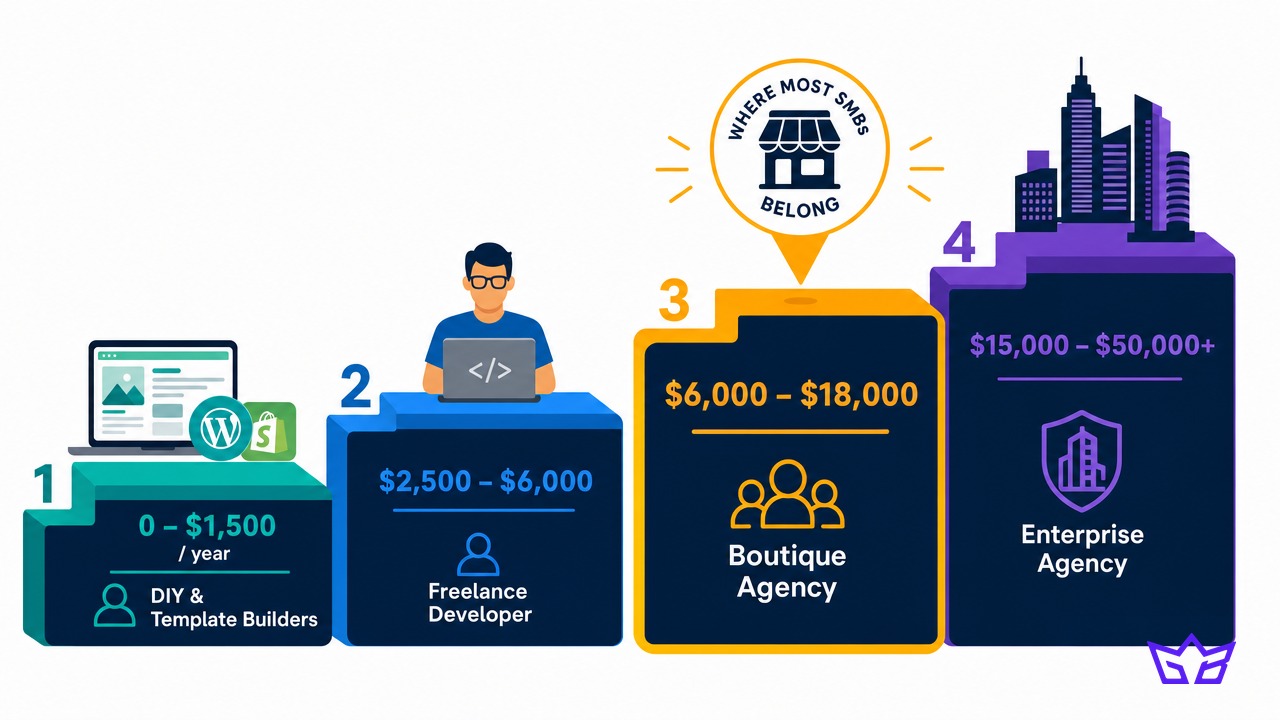
Toronto pricing sorts into four honest tiers. Ignore anyone who quotes outside their tier without explaining why.
DIY and template builders: $0 to $1,500/year. Squarespace, Wix, Shopify themes. Genuinely fine if you are pre-revenue and need a business card on the internet. You will hit the ceiling the moment you need custom functionality or serious speed.
Freelance website developers in Toronto: $2,500 to $6,000. An experienced solo developer doing custom design and basic SEO. Great value when the person is good and available. The risk is not skill, it is continuity. One person gets busy, gets a full-time job, or stops replying, and your site has no owner.
Boutique Toronto web design agencies: $6,000 to $18,000. This is the value tier for most Toronto small and mid-sized businesses, and it is where the majority of local businesses should be looking. You get a team, so nobody is a single point of failure, and the scope usually includes strategy, content help, and technical SEO rather than just pixels.
Mid-size and enterprise agencies: $15,000 to $50,000+. Full service, with strategy, content, design, development, SEO, and analytics. Worth it when the website is a genuine revenue engine with complex integrations. Overkill for a fifteen-page service business site, and you will feel that in the invoice.
Hourly rates follow the same shape. Toronto freelancers run $35 to $90 an hour, boutique agencies $75 to $150, and enterprise shops $150 to $300 and up. Across Canada, a custom website project averages $10,000 to $25,000, and Toronto sits at the higher end of that band because operating costs here are higher.
One number nobody puts in the proposal: hidden costs add 20% to 40% on top of the headline fee. Content writing, photography, stock licensing, hosting, third-party apps, and monthly maintenance. A $12,000 quote is realistically a $15,000 project. Ask for that number up front and watch how the agency reacts. The good ones already have it written down.
If you want a floor: $5,000 to $8,000 is roughly the minimum for a Toronto business website built well enough to generate organic leads rather than just exist.
The four questions that tell you everything
You do not need to evaluate code. You need to ask four questions and listen to how quickly the answers come.
1. "What is my Core Web Vitals score going to be, and will you guarantee it?"
An agency that builds fast sites answers this instantly with numbers. An agency that builds slow sites talks about how speed depends on many factors. The average webpage loads in 2.5 seconds on desktop and 8.6 seconds on mobile, which is a genuinely bad number, and it is bad because most agencies never treat it as their responsibility.
2. "Who owns the site, and can I leave?"
You should own the domain, the hosting account, the code, and the content. Some Toronto shops build on proprietary platforms you cannot export from, which converts your website into a subscription you can never cancel. Ask directly: if we part ways, what do I walk away with? Any hesitation is your answer.
3. "Can my team update it without you?"
If every text change is a billable ticket, you will stop making changes. Then the site goes stale, and a stale site stops ranking. You want a real CMS and a thirty-minute handover video.
4. "Show me a site you built two years ago."
Anyone can show you a launch. Ask for something with mileage on it. Is it still fast? Still ranking? Still being updated? A two-year-old site tells you what you are actually buying, because you are not buying a launch, you are buying the next three years.
Add one more if you are choosing between finalists: ask who does the work. Plenty of Toronto agencies sell you a senior team and staff the project with a subcontractor you never meet. Not automatically a problem, but you should know.
Design and SEO are the same project
Here is the mistake that costs Toronto businesses the most money: treating the website build and the SEO work as two separate purchases, six months apart.
The structural decisions that determine whether you can ever rank get made during development, not after. Your URL structure. Whether service pages exist as real pages or as sections of a single scrolling homepage. Whether images are compressed. Whether the site renders content for crawlers. Whether local business schema is in the markup. Whether each Toronto neighbourhood or service you target has a page that can actually earn a ranking.
Retrofit all of that later and you are paying twice, once to build it wrong and once to fix it.
This matters more in Toronto than almost anywhere in Canada. You are competing against agencies, contractors, clinics, and studios in one of the densest business markets on the continent. Ranking is not a bonus feature here, it is the whole reason the site exists. Our local SEO playbook for service businesses covers the ongoing side, but none of it works if the foundation is wrong.
The same logic applies to conversion. A beautiful site that does not convert is an expensive brochure, which is exactly why so many websites quietly fail.
What actually kills Toronto websites
Four failure modes, in the order we see them.
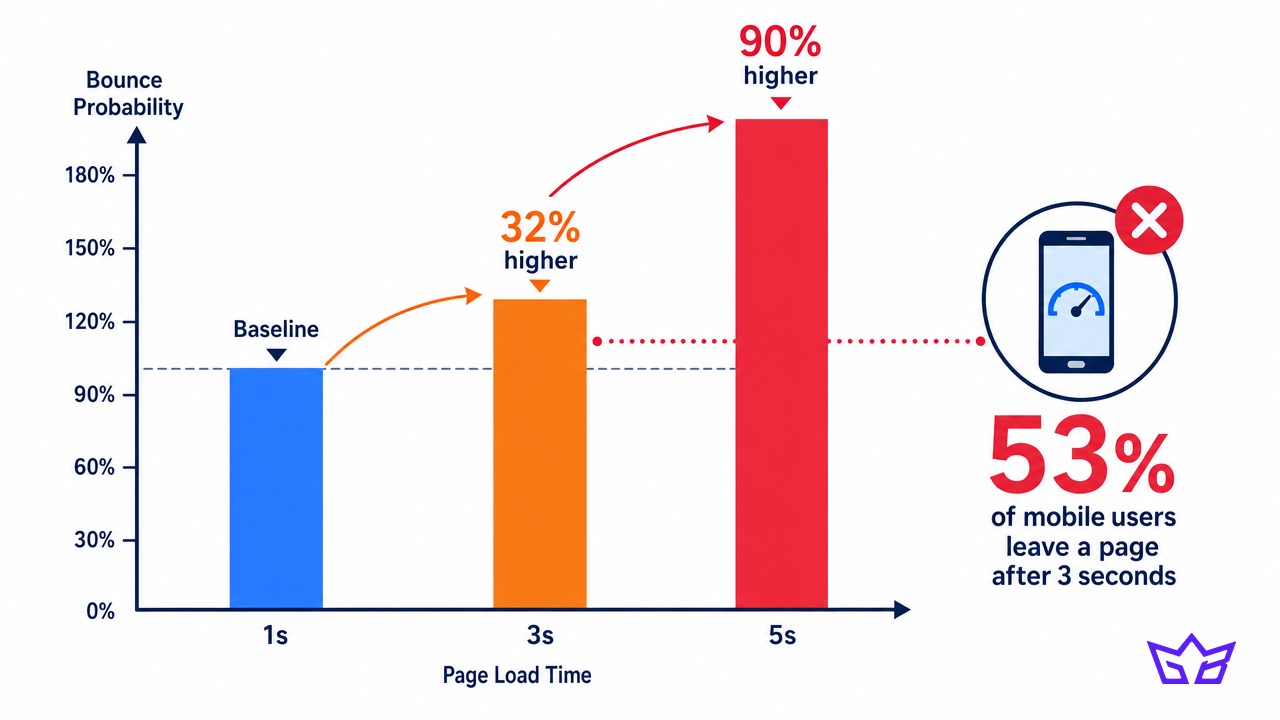
Speed. As load time goes from one second to three, the probability of a bounce rises 32%. From one to five seconds, it rises 90%. Over half of mobile visitors abandon a page that takes more than three seconds. A site loading in one second converts roughly five times better than one loading in ten. Even a 0.1 second mobile improvement lifts retail conversions 8.4%. Speed is not a technical nicety, it is the biggest single win your developer can hand you.
Mobile as an afterthought. Mobile pages take 70.9% longer to load than desktop, and mobile bounce rates average 56.8%. Most Toronto local searches happen on a phone, often outdoors, often on a mediocre connection. If the build was designed on a 27-inch monitor and squeezed down afterward, you will feel it in your lead count.
No conversion path. Traffic with nowhere to go. No visible phone number, a contact form buried three clicks deep, no obvious next step on a service page.
Nobody owns it after launch. The site ships, the agency moves on, and eighteen months later the content is stale, plugins are out of date, and rankings have quietly slid. Ongoing ownership is not upselling, it is the difference between an asset and a depreciating expense.
What the Toronto market rewards
Toronto website design is not a generic exercise, and a few things move the needle here specifically.
- Neighbourhood and suburb specificity. "Toronto" is one search. Etobicoke, Scarborough, North York, Liberty Village, and the surrounding GTA cities are dozens more, with far less competition. Sites built with room for location pages capture that. Sites built as one flat brochure do not.
- Proof over polish. Toronto buyers are agency-fatigued and skeptical. Real project photos, named client results, and Google reviews embedded on the page outperform stock imagery every time.
- Bilingual and multicultural readiness. More than half of Toronto residents were born outside Canada. Clean typography, translation-friendly structure, and pages that do not break with longer strings matter more here than in most markets.
- Speed on mobile networks. Transit riders, job sites, showroom floors. Your site gets loaded in bad conditions constantly.
If you sell to other businesses rather than consumers, the priorities shift, and we broke those out separately in our guide to B2B web design in Toronto.
Questions Toronto owners ask us most
How long does a website take to build? Six to ten weeks for a typical small business site with a competent team. Faster is usually a template. Much slower usually means content is the bottleneck, not development, and that bottleneck is almost always on the client side.
Is WordPress still the right choice in 2026? Sometimes. It is excellent when a non-technical team needs to publish constantly. It is a liability when it is running eighteen plugins nobody maintains. Modern frameworks are faster out of the box but need a developer for structural changes. The honest answer depends on who is touching the site weekly.
Should I hire a web design agency in Toronto or go remote and cheaper? Remote can work. What you lose is the local market knowledge, the ability to sit in a room when things get complicated, and time zone overlap. What you gain is price. For a straightforward site, remote is defensible. For a site that carries your lead generation, hiring web development companies in Toronto usually pays for itself.
Do I really need a redesign, or just a refresh? If the structure is sound and it loads fast, you likely need better content and conversion work, not a rebuild. If it is slow, unmanageable, or cannot support new pages, rebuild. Get an honest audit before spending anything.
What should I budget annually after launch? Plan for 15% to 20% of the build cost per year covering hosting, maintenance, security, and content updates. Websites are not furniture.
What to do next
Before you request a single quote, spend ten minutes on this:
- Run your current site through Google PageSpeed Insights on mobile. Write the number down. That one score tells you more about your website's real condition than any agency pitch.
- Open your site on your phone and try to contact yourself. Count the taps. If it takes more than two, that is your first fix and it has nothing to do with a rebuild.
- Search the exact phrase a customer would use, plus "Toronto," and find where you land. If you are not on page one, note who is and look at how their site is built.
Then get quotes from three places, one freelancer and two boutique web design agencies in Toronto, and ask each one the four questions above. The pricing will make sense the moment you know which problem each of them is solving.
If you want a straight read on where your current site stands before you spend anything, our Toronto team will run through it with you and tell you honestly whether you need a rebuild or just a few fixes. Sometimes the answer is that you do not need us yet, and that is a fine outcome too.
Reviewed by Keston Leader under our editorial policy.