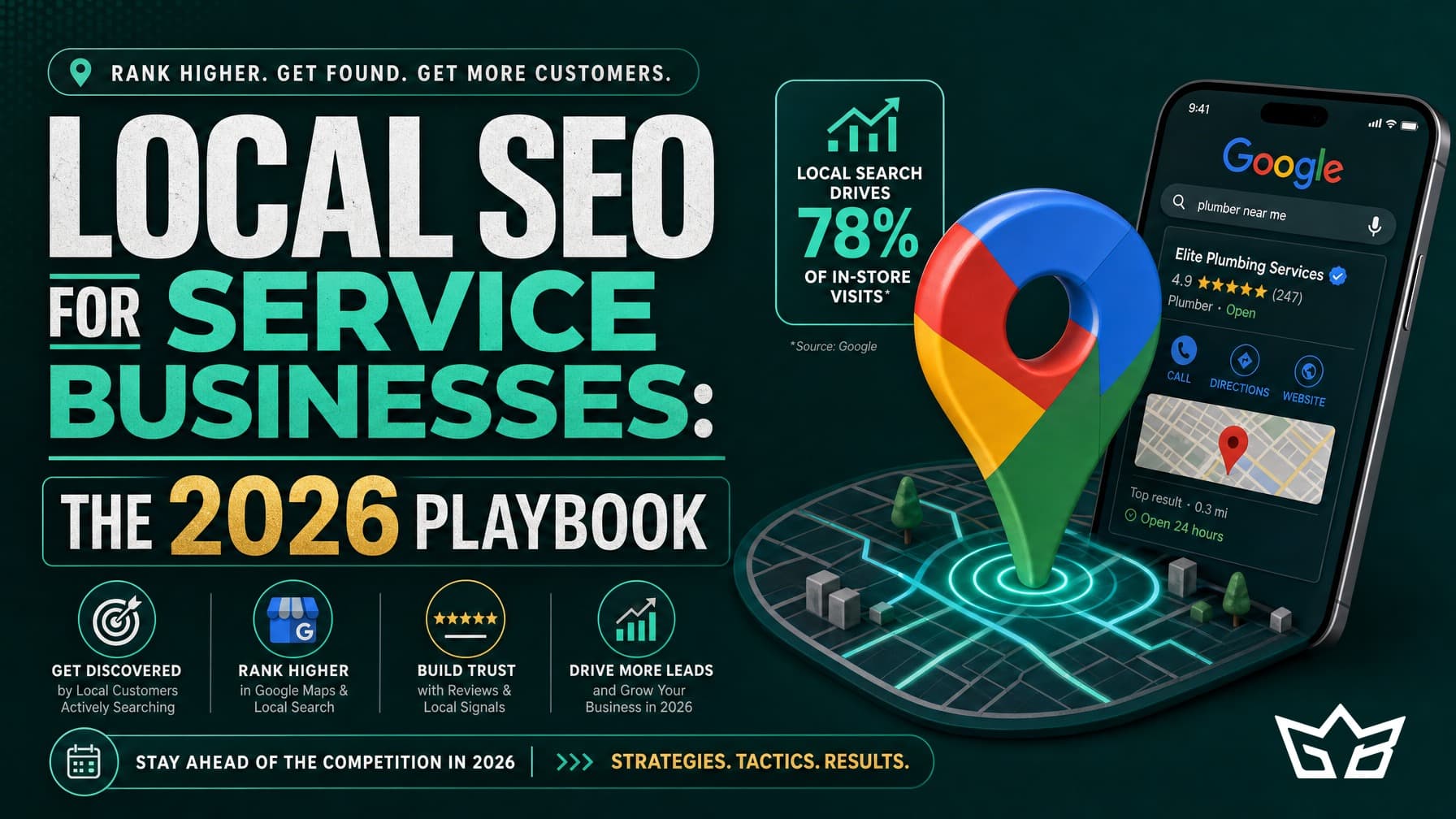
Local SEO for Service Businesses: The 2026 Playbook
The 2026 local SEO playbook for service businesses: own your Google Business Profile, reviews, and the local pack. Start with your free audit.
A roofer two towns over with worse work and uglier photos is booking your jobs. Not because he's better, but because when someone in your service area types "roof repair near me," Google shows him in the top three and you're buried on page two.
That gap is what local SEO for service businesses actually fixes. It isn't about ranking #1 for some national keyword you'll never win. It's about owning the few square miles where your customers live, the moment they're ready to call someone. And in 2026, with AI Overviews eating the top of the page and 50 million local searches happening every single day, the businesses that get this right are quietly taking work away from the ones that don't.
Here's the 2026 playbook we use with service clients, from plumbers to med spas to law firms.
Your Google Business Profile is the new homepage
Stop thinking of your website as the front door. For local search, your Google Business Profile (GBP) is. It's the panel that shows up when someone Googles your name, and it's the listing that feeds the local pack, that block of three map results sitting at the top of local searches.
The numbers back this up hard. Google Business Profile signals carry roughly 32% of the weight in local pack rankings, more than reviews, citations, or anything else. And 93% of local-intent searches trigger that local pack in the first place. If you're not in those three results, you're invisible to nearly everyone searching.
So treat the profile like a living asset, not a "set it and forget it" listing:
- Nail your categories. Your primary category should be as specific as Google allows ("Emergency Plumber," not just "Plumber"). Then add secondary categories for every real service you offer, up to nine.
- Set your service area correctly. If you go to customers instead of them coming to you, hide your address and define the exact cities or radius you cover.
- Photos move the needle more than people think. Profiles with 100+ photos see dramatically more calls, direction requests, and website clicks. Add real ones: trucks, crews, before-and-afters, finished jobs. Then keep adding a handful every month.
- Use the description, services, and attributes fields. Every empty field is a ranking signal you're throwing away.
A complete profile makes customers 2.7x more likely to consider you reputable. That's a trust multiplier you get for free, just by filling things in properly.
Reviews are your ranking engine and your sales pitch
Reviews do double duty: they help you rank, and they close the sale before you ever pick up the phone. Review signals make up around 16% of local pack ranking weight, and 87% of consumers read reviews for local businesses before choosing one.
Here's the part most service businesses get wrong. They chase a big number once, get to 40 reviews, then stop. But the underrated factor in 2026 is recency and velocity, not the total count. A competitor earning two or three fresh reviews every month often outranks the shop sitting on 200 reviews that all dried up two years ago. Google reads steady new reviews as a sign you're active, busy, and trusted right now.
Build a simple system:
- Ask every happy customer, same day. The job's done, they're thrilled, that's your window. Wait a week and the moment's gone.
- Make it one tap. Text them a direct Google review link. Friction kills follow-through.
- Respond to every review, good or bad. Response quality is itself a signal, and a calm, specific reply to a one-star review sells future customers harder than any five-star ever will.
- Never buy or fake them. Google's getting sharper at spotting patterns, and a purge can wipe your visibility overnight.
We've seen a single client go from a trickle of reviews to a consistent five-a-month habit and watch their map rankings climb across an entire metro in under three months. No new ad spend. Just a process for asking.
NAP consistency: boring, and quietly costing you
Name, Address, Phone. NAP. Google cross-checks your business details across the web (your site, directories, Yelp, industry listings) to decide whether to trust you. Citation consistency carries real ranking weight, and inconsistency is the silent killer most owners never check.
The classic mess: you moved offices three years ago, changed your phone number once, and now there are four versions of your business floating around the internet. Google sees the conflict and hedges by ranking you lower.
Audit your top 15 to 20 citations, fix the conflicts, and lock them down. It's tedious work that pays off precisely because your competitors can't be bothered to do it.
Build pages for the places you actually serve
If you cover five cities, one generic "Service Areas" page won't cut it. You need real, useful pages for the locations that matter, the kind of work that lives on a strong website and SEO foundation.
The trap here is doorway pages: ten near-identical pages with the city name swapped out. Google penalizes that, and customers can smell it. Instead, make each location page genuinely local:
- A real project you completed in that city, with photos
- Specifics about that area (neighborhoods you cover, local permitting quirks, response times)
- Reviews from customers in that location
- Directions, parking, or service-radius details that only apply there
If you serve the GTA, separate pages for Toronto and Oakville will always beat one bloated catch-all, because each one can rank for its own "near me" searches and speak to that community directly. You can see how we structure this across our own service locations.
The 2026 shift: AI Overviews are sitting above the map
Here's the change you can't ignore. Zero-click searches have climbed past 60% of all Google searches, and AI Overviews now appear for a growing share of local queries, sometimes above the local pack itself. People are getting answers without clicking anything, and AI assistants are recommending businesses conversationally.
That sounds scary. It's actually an opportunity, because most service businesses haven't adjusted at all.
When Google's AI assembles a local answer, it pulls heavily from structured data first, specifically LocalBusiness schema (the JSON-LD markup on your site that tells Google your hours, services, area, and reviews in a language machines read cleanly). Sites with proper schema are far more likely to be the business the AI names.
So the 2026 add-ons to the classic playbook:
- Add LocalBusiness schema to your site. This is the single most overlooked technical move for local visibility right now.
- Write content that answers real questions. "How much does emergency furnace repair cost in Toronto?" is the kind of query that feeds both AI Overviews and old-fashioned rankings.
- Keep your GBP impeccable. AI summaries lean on it constantly, so a complete, active profile is now doing more work than ever.
The businesses winning in 2026 treat visibility, not just ranked position, as the goal. Showing up in the AI answer, the map pack, and the organic results means you're unavoidable.
Why this matters more for service businesses than anyone
Local search converts like nothing else. Roughly 78% of local mobile searches lead to an offline purchase within 24 hours. Someone searching "emergency electrician near me" isn't browsing, they're in pain and ready to pay. That's the highest-intent traffic on the internet, and it's sitting right in your backyard.
The flip side: when your conversion rate is weak, even great rankings leak money. If you're not sure how much each ranking improvement is actually worth to you, run your numbers through our conversion rate calculator before you spend another dollar on visibility. Sometimes the fastest win isn't more traffic, it's catching more of the calls you're already getting.
Here's the honest truth most agencies won't say: local SEO for service businesses isn't complicated. It's just a lot of small, unglamorous things done consistently while your competitors do them once and quit.
Your first move this week
Don't try to do all of this at once. Pick the one move with the biggest payoff and start today.
Open your Google Business Profile and fix the three biggest gaps right now: complete every empty field, add 10 fresh photos, and text your last five happy customers a review link. That alone will put you ahead of most of your local competition by Friday.
When you're ready to turn these one-off fixes into a system that compounds month after month, that is exactly what our local SEO services are built to run. Tell us about your business and we'll map out exactly where you're losing local search traffic and how to take it back.
Reviewed by Keston Leader under our editorial policy.