SEO Company in Mississauga: What It Costs and How to Choose
What an SEO company in Mississauga really costs, where local rankings actually come from in 2026, and the five questions to ask before you sign.

Most businesses that hire an SEO company in Mississauga are paying for the wrong thing. They buy keywords and blog posts, then wonder why they still cannot be found when someone two neighbourhoods over searches for what they sell. The uncomfortable truth is that in local search, roughly a third of what decides your ranking has nothing to do with your website at all.
Here is the number that should reframe how you think about this. In 2026, Google Business Profile signals account for about 32% of local pack rankings, and eight of the top ten local pack ranking signals originate from your Google Business Profile rather than your site. On-page work is 19%. Reviews are 16%. If your SEO company in Mississauga is spending every hour on your website and none on the profile that Google actually reads first, you are funding the smaller half of the job.
This is a guide to what that work costs here, what it should include, and how to tell a company that will move your rankings from one that will send you a nice-looking report every month.
What an SEO company in Mississauga actually charges
Local SEO in Canada runs roughly $500 to $2,500 per month. Most small businesses land between $800 and $1,500. That range is wide because the label covers wildly different amounts of work, so it helps to know what each tier genuinely buys.
- $500 to $800 per month. Profile maintenance. Someone keeps your Google Business Profile current, posts occasionally, and responds to reviews. Useful if your listing is a mess, but it is upkeep, not growth.
- $800 to $1,500 per month. The real starting point. A technical audit, ongoing Google Business Profile management, citation cleanup, and one or two pieces of content a month. This is where most Mississauga businesses in the $500K to $10M range should be.
- $1,500 to $2,500 per month. Add serious content production, link acquisition, and multi-location or multi-service targeting. Worth it when you are fighting for competitive terms or covering several neighbourhoods.
- Under $400 per month. Be careful. At that price nobody is doing custom work. You are usually buying automated citation submissions and a template report.
Most agencies will ask for a six to twelve month commitment. That is reasonable, and you should be suspicious of anyone who does not, because meaningful local movement rarely shows inside 90 days. What is not reasonable is a twelve month lock-in with no performance milestones written into it.
A useful test before you sign: ask what happens in month one, specifically. A company with a real process will describe an audit, a profile rebuild, and a citation sweep. A company selling you a retainer will talk about "strategy" and "optimization" without naming a single deliverable.
Mississauga is geographically brutal for local SEO
This is the part that generic advice misses, and it is the single most important thing to understand about ranking here.
Mississauga is not a compact downtown. It is a sprawling city of roughly 14,600 registered businesses, about 80% of which have fewer than 20 employees. Port Credit, Streetsville, Meadowvale, Malton, Erin Mills and Square One are effectively separate markets. Someone standing in Clarkson and someone standing in Heartland are getting different local results for the same search.
That matters because proximity is not a tiebreaker, it is a primary factor. Around 70% of top local pack positions go to businesses within one to three miles of the person searching. Google has ranked the local pack on relevance, distance and prominence since 2016, and distance is the one input you cannot optimize your way around.
The practical consequence: a single office in Mississauga will not rank across all of Mississauga. Any company that promises you city-wide local pack coverage from one address is either misinformed or counting on you not checking. What you can actually do is win your own radius decisively, then extend reach through organic pages that are not bound by proximity the way the map pack is.
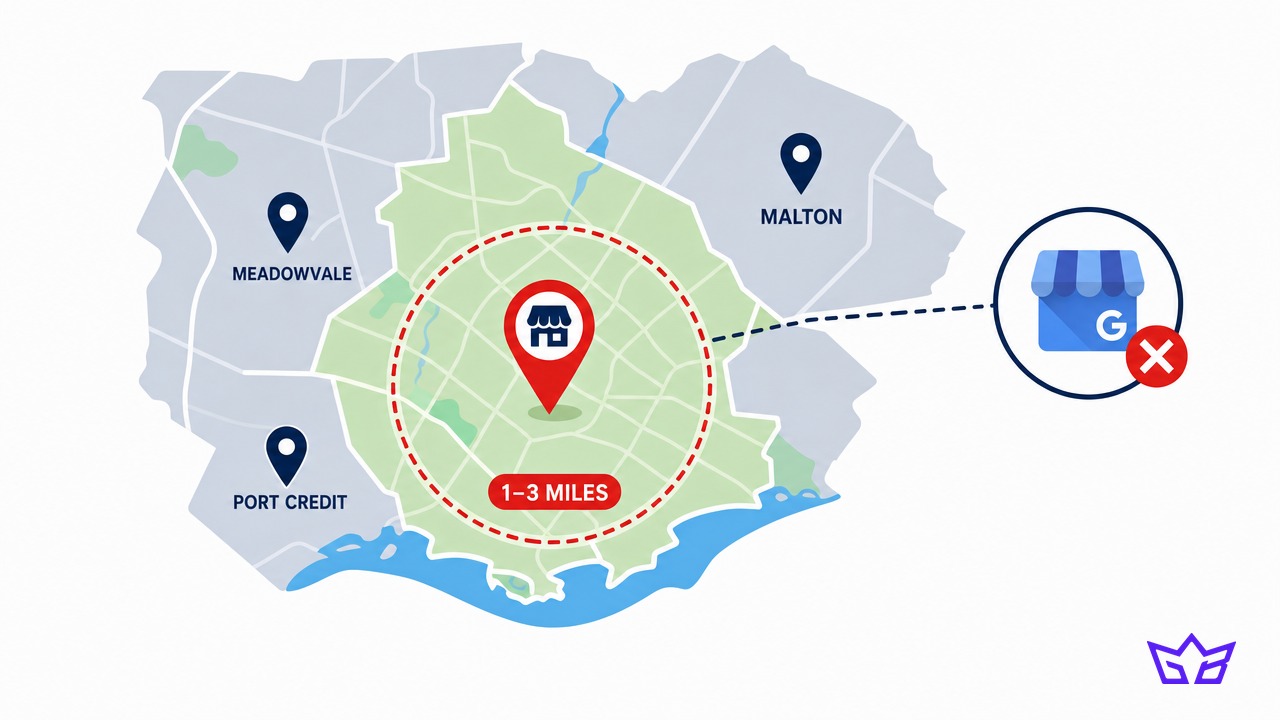
That distinction, map pack versus organic results, is where your budget decisions should come from. If most of your customers come from within a few kilometres, pour the money into the profile and reviews. If you serve the whole GTA and location matters less, weight it toward content and links.
Where local rankings actually come from in 2026
The signal mix is public and reasonably stable, and knowing it lets you audit any proposal in about five minutes. Rankings break down roughly like this:
- Google Business Profile signals, 32%. Categories, services, business description, photos, posts, attributes, hours, and how complete the whole thing is.
- On-page signals, 19%. Your site's content, titles, location relevance and internal structure.
- Review signals, 16%. Volume, average rating, recency, and whether you reply.
- Link signals, 15%. Who links to you, and whether any of them are local.
- Behavioral signals, 8%. Clicks, calls, direction requests, and how people interact with your listing.
- Citation signals, 7%. Consistent name, address and phone across directories.
Read that list against any proposal you receive. If a company's plan is 90% blog content, they are optimizing the 19% and ignoring the 32%. If the plan is entirely citation submissions, they are chasing 7% of the outcome. The right answer is weighted toward profile and reviews first, because that is where the fastest gains sit, with content and links compounding behind it.
Reviews deserve a specific mention because they are the most commonly neglected asset in this list. They are 16% of the ranking picture and close to 100% of the decision once a customer is looking at three options in the map pack. Volume and recency both matter, which means a business with 40 reviews from this year usually outperforms one with 120 reviews from 2022. If you have never built a systematic way to ask, that is the highest-return project on this page. Our guide to online reputation management covers the request mechanics in detail.
What the first 90 days should look like
A competent engagement follows a fairly predictable order, because some work has to happen before other work can pay off.
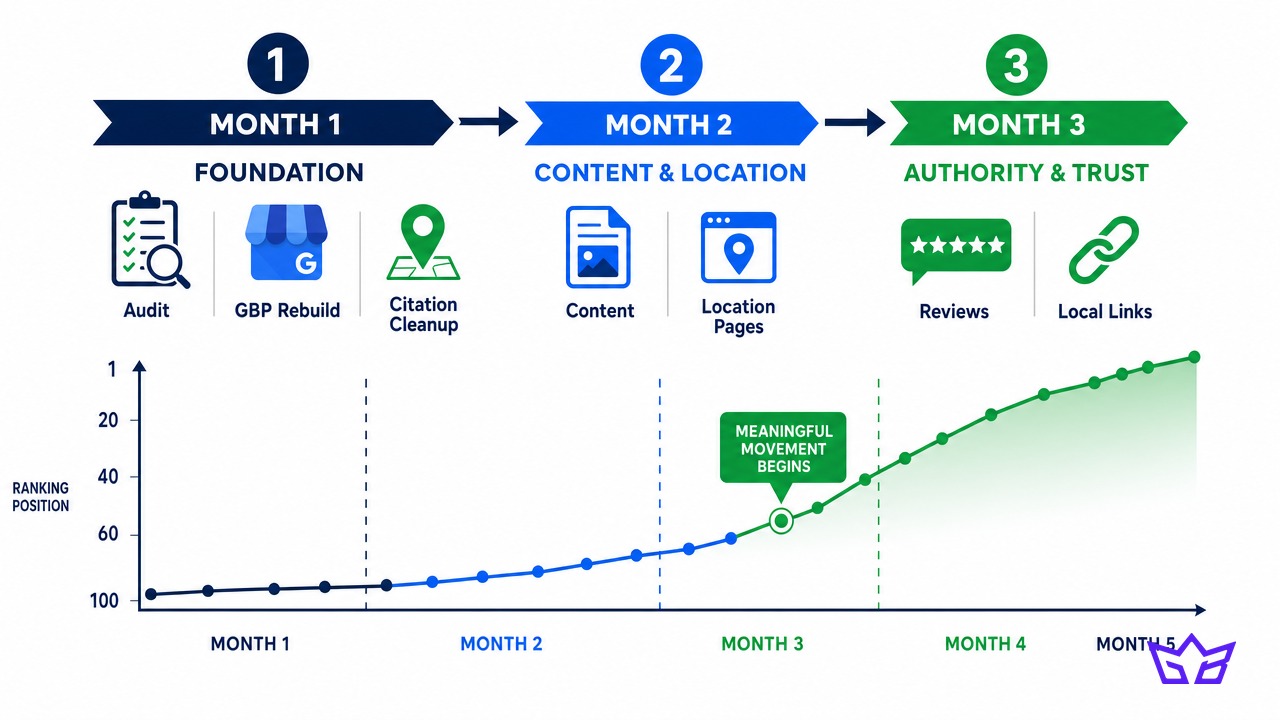
Month one is foundation. A full technical audit, a rebuilt Google Business Profile with correct primary and secondary categories, every service listed, real photos, and a citation sweep to fix name, address and phone inconsistencies across the major directories. Nothing here is glamorous and all of it is load-bearing. Our local business listings guide walks through the citation side.
Month two is relevance. Service pages and neighbourhood pages that actually say what you do and where you do it, plus the on-page fundamentals: titles, headings, internal links, schema. If your site is slow or awkward on mobile, this is when it surfaces, and it is worth reading our take on web design in Mississauga alongside this, because design and local SEO are the same project more often than agencies admit.
Month three is momentum. Review generation running as a repeatable system, local link acquisition through suppliers, associations, sponsorships and press, and the first content built around questions your customers actually ask.
Expect the first real movement somewhere in month three or four, and treat anything faster as a pleasant surprise rather than the plan. Rankings for lower-competition terms move first. The terms you care about most move last, because everyone else wants them too.
How to tell a real SEO company from an expensive one
Five questions separate the two, and you can ask all of them in a first call.
"What is my current position for the terms that matter?" They should have looked before the call. If they cannot tell you where you rank today, they cannot prove they moved you tomorrow. Ask them to show you in Google Search Console rather than a proprietary dashboard.
"Which of these do you do in-house?" Content, technical, links and profile management are different skills. Plenty of good agencies outsource one of them. The problem is not outsourcing, it is not knowing which parts are outsourced.
"What does month one look like, deliverable by deliverable?" Vague answers here predict vague work later.
"How do you report, and what do you report on?" Traffic is not the goal. Calls, direction requests, form fills and booked jobs are. A report full of impressions and average position, with no conversion data, is a report designed to look like progress.
"What would make you tell me to stop?" The best answer any agency can give you is an honest one about fit. If your business gets nearly all its work from referrals and you have no capacity for more, SEO may not be your best next dollar. Anyone who says every business needs SEO is selling, not advising.
The red flags run the other way. Guaranteed number one rankings are not a thing anyone can promise, because nobody controls the algorithm. Contracts that hold your website, domain or Google Business Profile hostage should end the conversation immediately, and you would be surprised how often ownership sits with the agency rather than the client. And any company that cannot name a client in your area is asking you to be their first local case study at full price.
Where to start this week
If you do nothing else, do this: open your Google Business Profile and check three things. Is your primary category the most specific accurate option available. Are all of your services listed individually. Have you replied to every review from the last six months.
Those three fixes cost nothing, touch the 32% and the 16% at the same time, and most Mississauga businesses fail at least one of them. If you are already paying an SEO company in Mississauga, they are also the fastest way to find out whether anyone is actually doing the work. If you want a second opinion on where you actually stand, we run free local visibility checks for Mississauga businesses: current rankings, profile gaps, and the two or three fixes that would move you fastest. You can see how we approach SEO and digital marketing in Mississauga, or read our broader SEO guide for small businesses if you would rather start on your own.
Either way, check the profile first. It is the highest-value hour you will spend on this all month. And when you would rather have the whole thing run properly than checked once, our local SEO services page sets out the scope and the pricing brackets.
Reviewed by Keston Leader under our editorial policy.