Web Design in London, Ontario: What Actually Ranks in 2026
What web design costs in London, Ontario, the new Google speed threshold that moved rankings, and five questions to ask before you hire a designer.
Search "web design London Ontario" from a desktop downtown and you get one page of results. Search it from a phone in Byron or Masonville and you get a different page entirely. That second page is the one that decides whether a local business gets the call, and it is the one almost nobody in this city is building for.
London is Canada's 11th largest city. More than 550,000 people live here, Western University and Fanshawe College add roughly 43,000 students to the metro area, and the hospital network around London Health Sciences Centre and St. Joseph's employs tens of thousands. It is a real market with real money moving through it. Most of the business websites serving it are still built like the city has 50,000 people and one main street.
That gap is the whole opportunity.
London Is Not Toronto, and Copying Toronto Tactics Will Cost You
The first mistake we see in London web design projects is borrowed strategy. A business owner reads a guide written for a Toronto agency, budgets for Toronto competition, and builds for a market that does not exist here.
Toronto's search results are a knife fight. Dozens of well funded agencies bid on every commercial term, and the cost of entry is brutal. London is genuinely different. Competition for "web design london ontario" sits at a keyword difficulty of 8 out of 100. For context, most Toronto web design terms sit between 40 and 72. The term has real volume, roughly 390 searches a month before you count the variants, and almost nobody is fighting properly for it.
Low difficulty does not mean no work. It means the work you do actually pays off inside months instead of years.
The second London-specific thing worth understanding: searchers here are unusually neighbourhood-driven. People do not search "dentist London Ontario." They search from where they are standing, and Google resolves the rest. Wortley Village, Old East Village, Richmond Row, Byron, Masonville, Hyde Park, Oakridge. If your site gives Google no signal about which of those you actually serve, you get averaged into the city-wide pile and lose to whoever was more specific.
The Search Behaviour Here Runs on a School Calendar
This is the part that generic web design advice never covers, and it is genuinely useful if you sell to consumers in this city.
London's demand curve has a shape most cities do not. Two large post-secondary institutions mean a predictable September surge and a May collapse across entire categories:
- Housing, furniture, and moving services spike in August and September, then again in April
- Restaurants and nightlife near Richmond Row and downtown track the academic year almost exactly
- Dental, optometry, and walk-in clinics see a September wave as students register with local providers
- Fitness and personal training get a January peak plus a second September peak that most owners never plan for
If your website is a static brochure, none of that matters because you cannot respond to it. If your site is built properly, you can put the right offer in front of the right season, and you can have landing pages already indexed and ranking before the surge arrives. A page published in August ranks in September. A page published in September ranks in November, which is to say, too late.
Meanwhile the other half of London's economy runs on an entirely different clock. The insurance and financial firms downtown, the legal practices, the manufacturers along the 401 corridor, and the medical device and biotech companies that made this city a health sciences hub all buy on business cycles, not semesters. Those buyers research quietly, compare carefully, and convert on credibility signals rather than urgency.
Serving both audiences from one homepage is why so many London websites feel vague. The fix is not a better homepage. It is separate, properly built pages for each intent.
In March 2026 Google Moved the Speed Line, and Most Sites Are Behind It
Here is the change that quietly reshuffled local rankings this year, and it is the single most common reason a decent looking London website is losing traffic it used to have.
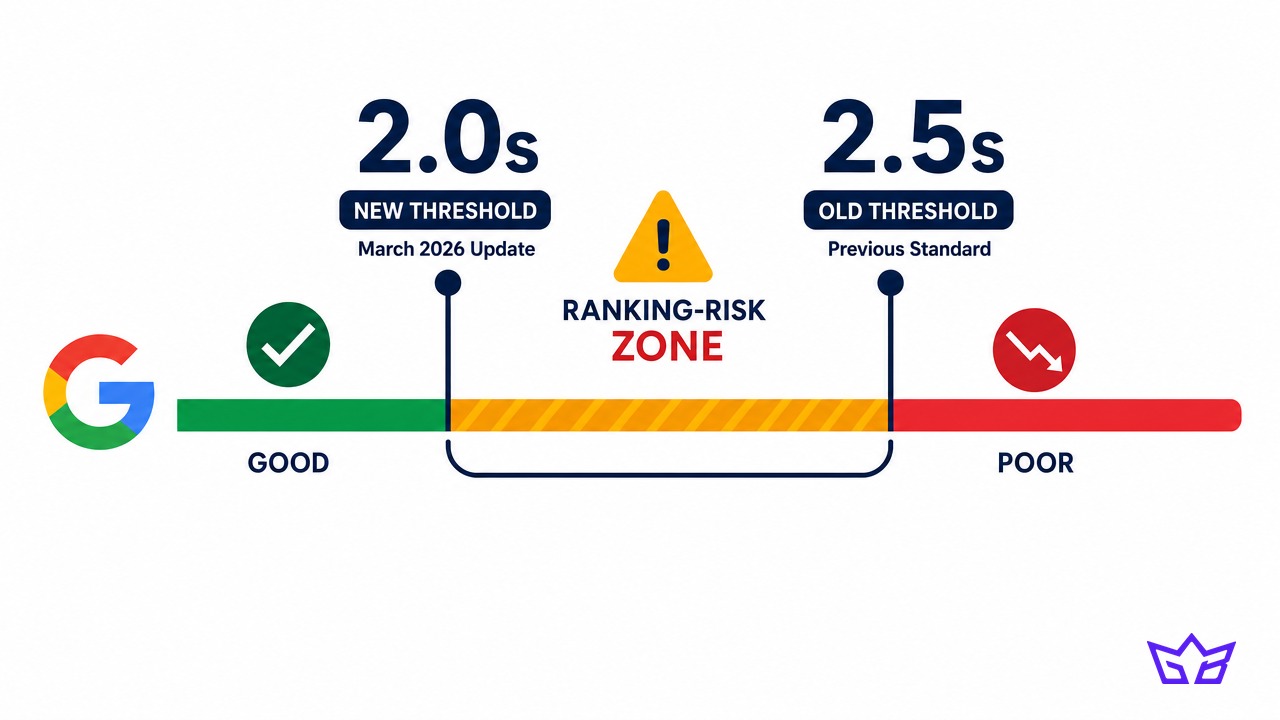
In the March 2026 core update, Google lowered the "good" threshold for Largest Contentful Paint from 2.5 seconds to 2.0 seconds. That sounds like a rounding error. It is not. Sites sitting above 2.5 seconds saw average ranking drops of two to four positions, and on a local search where the map pack already eats the top of the page, dropping two positions can mean dropping off the visible results entirely.
The wider numbers are worse than most owners expect:
- Only 42% of mobile sites pass all three Core Web Vitals
- Sites that pass all three see roughly 24% lower bounce rates than sites that fail
- Every 100ms of load time costs about 1% in conversions
- A one second delay cuts conversions by around 7%
We audit a lot of sites in southwestern Ontario, and the pattern is consistent. The culprit is almost never the content. It is a page builder loading eleven scripts before anything paints, a hero image exported at 4000 pixels wide, a chat widget that blocks rendering, and four tracking tags nobody remembers installing.
That is fixable in days, not months. It is also the cheapest ranking gain available to most London businesses right now, which is why we start there in most website and SEO engagements rather than opening with a redesign.
What Actually Belongs in a London Web Design Project
Strip out the deliverables that exist to pad a proposal and a website that performs in this market comes down to six things.
A page per service, not a services list. One page trying to rank for web design, marketing, and SEO ranks for none of them. Google needs a dedicated target per commercial term.
Real location signalling. Your city, your service areas, and your neighbourhoods in the copy where they belong, plus LocalBusiness structured data that states your address, hours, and service area in a format Google reads without guessing.
Speed as a build constraint, not a cleanup task. Performance decided at the architecture stage costs nothing. Performance retrofitted after launch costs a rebuild.
Conversion paths that assume a phone. Tap-to-call in the header, a form under four fields, and directions that open the map app. Most London service businesses get well over half their traffic from mobile and still design on a 27 inch monitor.
Proof placed where the decision happens. Reviews, project photos, and named client outcomes next to the call to action, not quarantined on a testimonials page nobody visits.
Something you can update yourself. If adding a seasonal offer requires emailing your developer and waiting three days, you will never do it, and the September surge will pass you by.
The Local Signals Most London Sites Never Send
Ranking locally is less about content volume than most people think. It is about being unambiguous.
Google is trying to answer one question: is this business genuinely relevant to someone searching from this location? Most London sites leave that question open. A few specific gaps come up again and again:
- No Google Business Profile link on the site, and no consistent name, address, and phone number between the two. Inconsistent details are read as uncertainty, and uncertainty loses to a competitor who is consistent.
- A generic contact page with a form and nothing else. No embedded map, no service area, no hours, no parking note.
- Zero neighbourhood language anywhere on the site, which makes it impossible to rank for the way people actually search.
- No content that proves local operation. A project write-up naming a real London street or landmark does more for local relevance than a thousand words of generic industry copy.
- "London" with no "Ontario." This one is genuinely costly. Google has to disambiguate you from a city of nine million in England. Say "London, Ontario" in your title, your headings, and your schema, and stop making the search engine guess.
That last point is the cheapest win on this list and the one most often missed. We have seen sites ranking for London, UK queries by accident, pulling traffic that will never convert.
What Web Design Costs in London, Ontario
Honest ranges, because the vague-quote game wastes everyone's time.
A simple brochure site, five to eight pages, no bookings or integrations: 2,500 to 4,000 dollars. Appropriate for a business that needs to look legitimate and be findable, and nothing more.
A custom small-business site with booking, CRM connection, or a service-area structure: 4,000 to 8,000 dollars. This is where most London service businesses should land, and where the SEO foundation actually gets built rather than promised.
Anything under 1,500 dollars is a template with your logo dropped in. That is not automatically wrong for a brand new business, but understand what you are buying: no strategy, no local optimization, and usually no ownership of the result.
Ongoing work runs a few hundred to a couple thousand dollars a month depending on whether you are maintaining or actively competing. Maintenance keeps the lights on. Competing means content, links, and technical work every month.
For a fuller breakdown of how these numbers move by project type, we wrote up what a small business website really costs in Ontario with the line items spelled out.
The uncomfortable truth: a 3,000 dollar site that ranks beats a 12,000 dollar site that does not, every single time. Design quality and search performance are different purchases, and plenty of agencies sell the first while implying the second.
How to Vet a London Web Designer Without Getting Sold
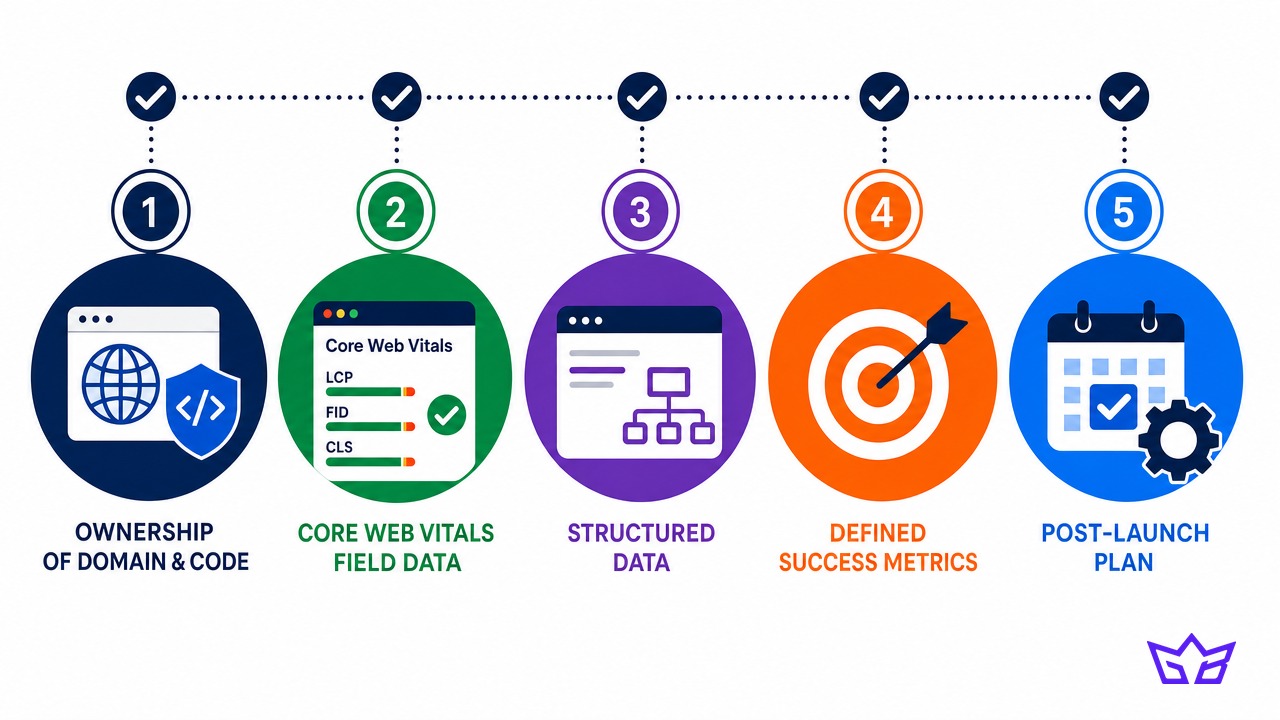
Five questions. Ask them in this order, and the answers will separate the operators from the order-takers fast.
"Who owns the domain, the hosting, and the code when we're done?" The only acceptable answer is you. If any part of it stays with the agency, you are renting your own business address.
"Show me Core Web Vitals for three sites you launched this year." Not a screenshot of a Lighthouse score from their own homepage. Real field data on real client sites. Anyone building properly can produce this in two minutes.
"What structured data will this site emit?" If the answer is a blank look, they are building a brochure. LocalBusiness schema is table stakes for local ranking in 2026.
"How will we know if this worked?" They should name specific metrics before you sign: calls, forms, ranked keywords, and organic sessions from the London area. "More traffic" is not a metric.
"What happens in month two?" A launch is not a growth plan. Ask what the ongoing work is and what it costs, and get it in writing before you commit to the build.
We ran this same play in Milton and Richmond Hill, and the pattern held in both: the businesses that won were not the ones with the prettiest sites. They were the ones whose sites were fast, specific about location, and clear about what to do next.
Questions London Business Owners Ask
What is web design, exactly, versus web development? Design is what the visitor sees and how they move through it: layout, hierarchy, copy placement, and the path to a conversion. Development is what makes it work, meaning the code, the performance, the integrations, and the structured data. You need both, and a project that treats design as decoration bolted onto a template will underperform no matter how good it looks.
What should I look for in a good web designer? Proof over portfolio. A portfolio shows what they can make look nice. Ask instead for field performance data, ownership terms in writing, and one client you can call. Those three answers together tell you more than any gallery of screenshots.
How does web design actually help my business make money? Through three mechanisms, and it is worth being specific. It gets you found, because speed and structured data are ranking inputs. It keeps people there, since passing Core Web Vitals correlates with 24% lower bounce rates. And it converts, because a form under four fields and a tap-to-call button in the header turn visits into calls. A website that only does the first is a brochure with good SEO.
Do I need a separate page for each London neighbourhood? Usually no, and doing it badly is worse than not doing it. Thin near-duplicate pages for fifteen neighbourhoods read as spam. If you genuinely serve three or four areas differently, with real content about each, then separate pages earn their place. Otherwise handle it with service-area content on one strong page.
How long until a new London site ranks? For a low-difficulty local market like this one, expect movement in six to ten weeks and meaningful positions in three to five months, assuming the technical foundation is right and you publish consistently. Anyone promising page one in thirty days is either lying or targeting terms nobody searches.
Where to Start
Do not start with a redesign. Start with a measurement, because you may not need the rebuild you think you need.
Run your homepage and your top service page through PageSpeed Insights on the mobile tab and look at one number: Largest Contentful Paint. If it is over 2.0 seconds, you now know exactly why your rankings slipped this spring, and you know the fix is technical rather than cosmetic. That single number will tell you whether you have a speed problem, a content problem, or a positioning problem, and those three have completely different price tags.
Then check whether your title tag says "London, Ontario" and not just "London." It takes thirty seconds, and no other single edit does more for a business in this city.
If you want a second set of eyes on what came back, tell us what you found and we will tell you straight whether it is worth fixing or worth rebuilding. We would rather talk you out of a project you do not need than sell you one you will not benefit from.
Reviewed by Gabriel Narsaik under our editorial policy.