Web Design in Milton: Costs and How to Choose
What web design costs in Milton, how to choose a designer, and why design and local SEO are one job. A practical 2026 guide for local owners.

Milton has spent two decades as one of the fastest-growing communities in Canada, and every one of those new rooftops came with plumbers, dentists, gyms, landscapers, and restaurants competing to serve it. When one of those new households pulls out a phone and searches for what you sell, your website is either winning that customer or quietly handing them to a competitor two results down. Web design in Milton is really a competition for that moment.
Good web design here is not about winning an award. It is about turning attention you already earned, from Google, from referrals, from your truck parked on a new street, into booked calls and paying customers. This guide covers what that takes in Milton, what it costs in 2026, and how to choose someone to build it without getting burned.
What "good web design" actually means for a Milton business
The websites that grow a local business share a few unglamorous traits, and none of them are about the colour palette.
- It loads fast on a phone. Around 88 per cent of "near me" searches happen on mobile, and most visitors give a slow local site about three seconds before they leave. A beautiful site that loads in eight is invisible in practice.
- It says what you do and where, in the first screen. A visitor should know within seconds that you serve Milton, what you offer, and why you are the safe choice. No scrolling required.
- It makes the next step obvious. One clear action, call, book, request a quote, repeated naturally down the page. Confused visitors do not convert, they bounce.
- It is built to be found. The structure, the page titles, and the code underneath either help you show up when someone searches "your service Milton" or quietly work against it.
- It meets Ontario's accessibility rules. Under AODA, Ontario businesses are expected to meet WCAG 2.1 Level AA. That is a legal obligation, and a surprising number of local sites quietly fail it.
That fourth point is where most Milton sites fall down. They were built to look good in a portfolio, not to rank and convert in a town where the customer base literally grows every month.
What web design costs in Milton
Web design in Milton spans a wide price range, and the number matters far less than what you get for it. Rough real-world brackets for the Halton market in 2026:
- DIY builders (Wix, Squarespace, Shopify): roughly $0 to $50 a month. Fine for testing an idea. The ceiling is low, they are hard to make genuinely fast, and your control over local SEO is limited.
- Freelance web designer: roughly $1,500 to $6,000 for a small business site. Quality swings enormously. A strong freelancer is excellent value. A cheap one leaves you with a pretty site nobody can find.
- Web design agency: roughly $5,000 to $25,000 and up depending on scope. You are paying for strategy, conversion design, real SEO foundations, and someone accountable for the result, not just the pixels.
The expensive mistake is not spending too much. It is spending anything at all on a site that looks fine but was never built to convert or rank, so it earns nothing back. A $3,000 site that books jobs beats a $15,000 site that just sits there looking expensive.
How to choose a web designer in Milton
Whether you hire a freelancer or an agency, the questions that protect you are the same. Ask these before you sign anything.
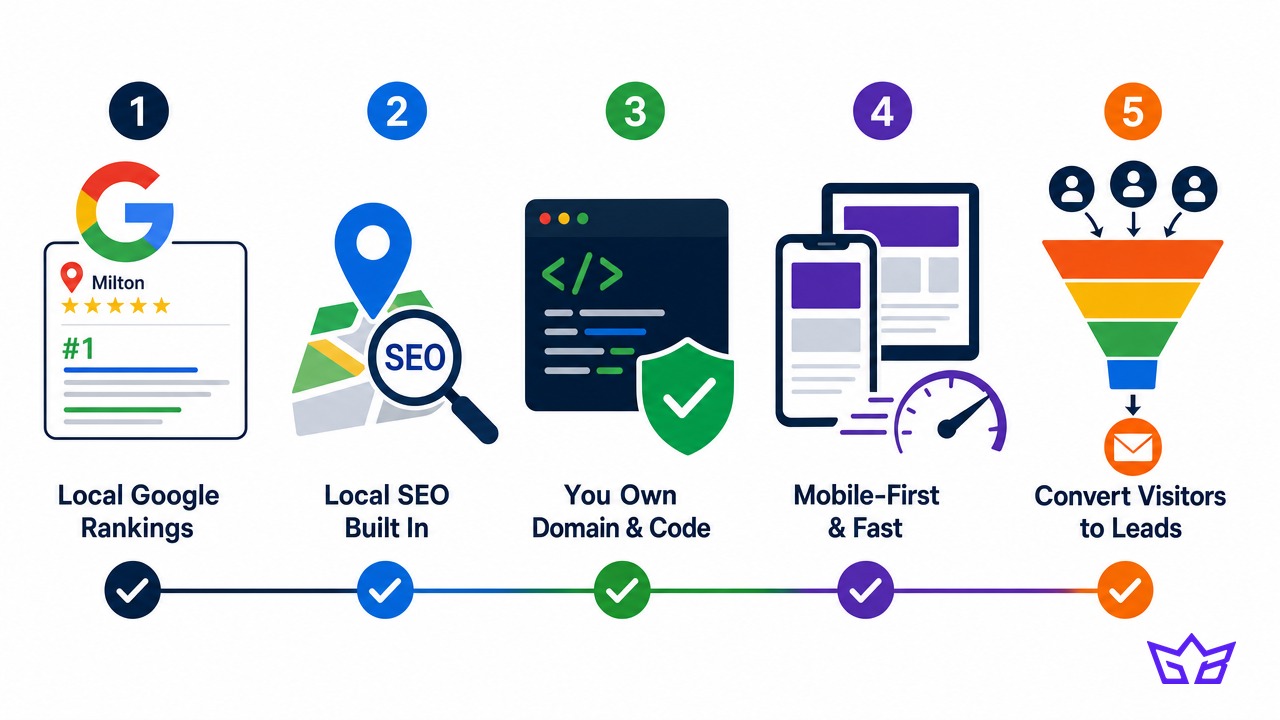
- "Can you show me local businesses you have ranked, not just designed?" Anyone can show pretty screenshots. Ask to see a client who genuinely shows up on page one of Google for a competitive local term. Design without visibility is half a job.
- "Is local SEO built in, or is it extra later?" The site's structure, page titles, and speed are all decided at build time. Bolting SEO on afterwards costs more and works worse.
- "Who owns the site and the domain when we are done?" You should. Some builders lock you into their platform so you can never leave. Make sure you own your domain, your content, and ideally your code.
- "What is your plan for mobile and speed?" If they never mention Core Web Vitals or real mobile performance, they are building for how the site looks on their monitor, not how your customer experiences it on data halfway through a school pickup. We covered the technical side in our piece on how slow sites quietly bleed conversions.
- "How does the site turn a visitor into a lead?" A good answer talks about clear calls to action, fast contact, trust signals, and reviews. A weak answer talks only about how modern it will look.
If a designer answers those five clearly, you are in good hands. If they dodge the SEO and ownership questions, keep looking.
Why design and local SEO are the same project
Here is the part Milton business owners get told least often: your web designer and your SEO are not two separate hires. When you split them, the design fights the ranking.
A great-looking site built with no SEO thinking ships with slow hero images, a structure Google struggles to read, and no local signals, so it never appears when someone searches for what you do in Milton. Meanwhile a technically clean but ugly site does not earn enough trust to convert the traffic it does get. You need both, decided together. That is the same case we made in our Toronto web design guide and our Mississauga guide, and it holds in a market where the map pack and reviews decide most local searches before anyone scrolls.
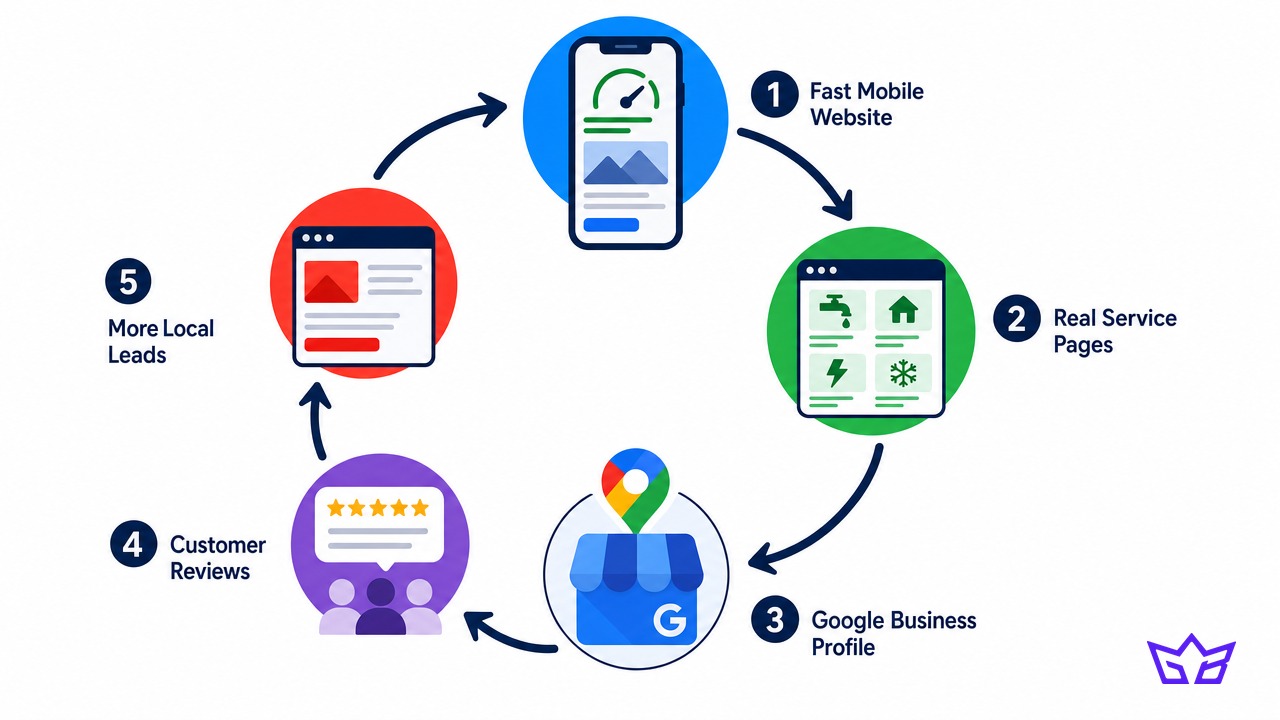
Practically, that means your site should ship with a keyword-aware page for every service you sell, a fast mobile experience, proper local business schema, and a Google Business Profile that reinforces all of it. Get found, then convert. In that order.
The mistakes that cost Milton businesses the most
We audit local sites constantly, and the same patterns show up every time.
- No local intent anywhere on the page. The site never says "Milton", never names Halton, never mentions the neighbourhoods it serves. Google is given no reason to show it locally.
- One generic services page. If you offer six services, you need six real pages. A single page listing everything ranks for nothing.
- Chasing trends over clarity. Autoplay video, animation on every scroll, tiny low-contrast text. It impresses other designers and confuses actual customers.
- Treating the site as finished. In a town growing this fast, the market you built the site for two years ago is not the market you serve today. The sites that win get updated as the town does.
- Ignoring the phone experience. Designed on desktop, reviewed on desktop, shipped, and then most visitors arrive on a phone to a cramped, slow mess.
None of these are hard to fix. They just need someone building the site who thinks like a marketer, not only like a designer.
What the Milton market specifically rewards
Milton is not a generic suburb, and a generic website underperforms here. This is a town that grew from under 32,000 people in 2001 to well over 130,000 today, with one of the youngest populations in the GTA. A few things follow from that.
Your customers are new here, and they search like it. A huge share of Milton households arrived within the last decade, which means they have no default plumber, dentist, accountant, or gym. They pick from Google, the map pack, and reviews. A business that shows up well online wins customers for life stages, not just transactions. That is a structural advantage older towns do not offer.
Young families set the tone. Milton's median age is among the lowest in the region, and the buying patterns show it: home services for first houses, kids' programs, clinics, meal spots that work with a stroller. Sites that load fast on a phone, show real prices, and let people book without a phone call convert this market. Sites that expect a desktop visitor and a patient reader do not.
Trades and logistics are their own economy. The employment lands along the 401 and James Snow Parkway have filled with distribution, manufacturing, and construction businesses, and every new subdivision feeds contractors, landscapers, and renovators. If you are B2B or trade, your site is your proof of professionalism: licensing, insurance, project photos, and service areas need to be visible in one scroll.
Old Milton and new Milton are different audiences. The Main Street core trades on character, walk-ins, and community reputation. The newer neighbourhoods south and east run on "near me" searches and reviews. Naming the areas you actually serve is one of the cheapest local SEO wins available, and most Milton sites skip it entirely.
You are being compared to Oakville, Burlington, and Mississauga. The 401 and the GO line mean Milton buyers see businesses from the whole west GTA in their search results. Your site has to hold up in that comparison. We are based in Oakville ourselves, twenty minutes away, and we see how quickly a dated site loses that fight.
Questions Milton owners ask us most
How much does a website cost in Milton? Most small business sites land between $1,500 and $6,000 with a freelancer, or $5,000 to $25,000 and up with an agency. DIY builders run $0 to $50 a month. The right number depends on how many services you sell, whether you need booking or payments, and how much local SEO work is built in.
How long does a new website take? A straightforward small business site is usually four to eight weeks from kickoff to launch. Bigger builds run two to four months. The slowest part is almost always content, so gather your photos, service descriptions, and reviews early.
Do I need a Milton web designer specifically? You can hire anyone technically. What matters is whether they understand local search, because ranking for Milton terms means naming real service areas, building local business schema, and connecting the site to your Google Business Profile. Working with someone who knows Halton helps, but local SEO skill matters more than a local address.
Will a new website actually get me on Google? Not on its own. A new site fixes speed, structure, and trust, which are prerequisites. Ranking still takes service pages targeting real searches, local signals, and reviews. Expect three to six months of steady work before local rankings move meaningfully.
Should I just use Wix or Squarespace? For testing an idea, sure. For a business that depends on local search in a market growing this fast, the ceiling is low. You get less control over speed and technical SEO, and migrating later usually costs more than building it properly the first time.
What to do next
Start with an honest look at what you already have. Open your site on your phone, on data rather than wifi, and time how long it takes to become usable. Then ask whether a stranger would know what you do, that you serve Milton, and how to contact you within five seconds. If the answer is no, that is your leak, and it is costing you more than a rebuild would.
From there the choice is simple: patch the site you have, or rebuild it around getting found and converting. Either way, insist on the five questions above and never separate the design from the SEO. If you would rather have one team handle the whole thing, design, build, local SEO, and the conversion work that ties them together, that is exactly what our Website and SEO service does. Run your site through our free website audit to see where it stands, or book a call and we will tell you honestly whether your current site is worth keeping for the Milton market.
Reviewed by Keston Leader under our editorial policy.