How to Choose a Web Design Agency in Toronto (2026)
Choosing a web design agency in Toronto? Compare scope, SEO, accessibility, ownership, and the questions that expose a weak proposal.

Choosing a web design agency in Toronto is not really a design decision. It is a revenue, operations, and risk decision wearing a design costume.
A glossy home page can hide an inquiry form that never reaches your team, a site that takes four seconds to become useful on a phone, or a platform nobody on staff can update without opening a ticket. Those problems do not show up in the first agency presentation. They show up six weeks after launch, when the deposit is spent and the leads are not coming.
The right agency should make your business easier to find, easier to trust, and easier to run. That is a higher bar than making it look modern. Here is how to tell the difference before you sign.
Start with the job the website has to do
Do not begin with colours, animations, or a list of competitor sites you like. Begin with the commercial problem the new site is meant to solve.
For a Toronto service business, that might mean turning more visitors into booked consultations. For a manufacturer, it could mean giving distributors the technical information they need without tying up sales. For an ecommerce brand, it may mean getting mobile shoppers from a product page to checkout with fewer exits.
Write down three outcomes you want the site to produce in its first 90 days. Make them observable. "More leads" is too vague. "Twenty qualified consultation requests a month, with source tracking on every form" gives an agency something real to design and build around.
Then give the same brief to every contender. A useful brief includes:
- The customer you want more of and what they need to believe before they contact you.
- The one or two actions that matter most, such as booking a call, requesting a quote, purchasing, or finding a location.
- The systems the site must connect with, from HubSpot and GoHighLevel to Shopify, inventory, calendars, or a CRM.
- The pages or content your own team needs to control after launch.
- The proof you already have, including reviews, case studies, certifications, before-and-afters, or client results.
If an agency jumps to a visual direction before asking these questions, it is selling a coat of paint. A good web design agency in Toronto should be able to explain what every major page is supposed to make a visitor do and why.
There is no shortage of Toronto website design studios that can make a credible first impression. The differentiator is whether the team can connect that impression to a measurable sales or service outcome.
A website is not a digital brochure. It is the part of your sales process that works after hours, answers the first objections, and hands the right inquiries to your team.
Judge the work like a customer, not a designer
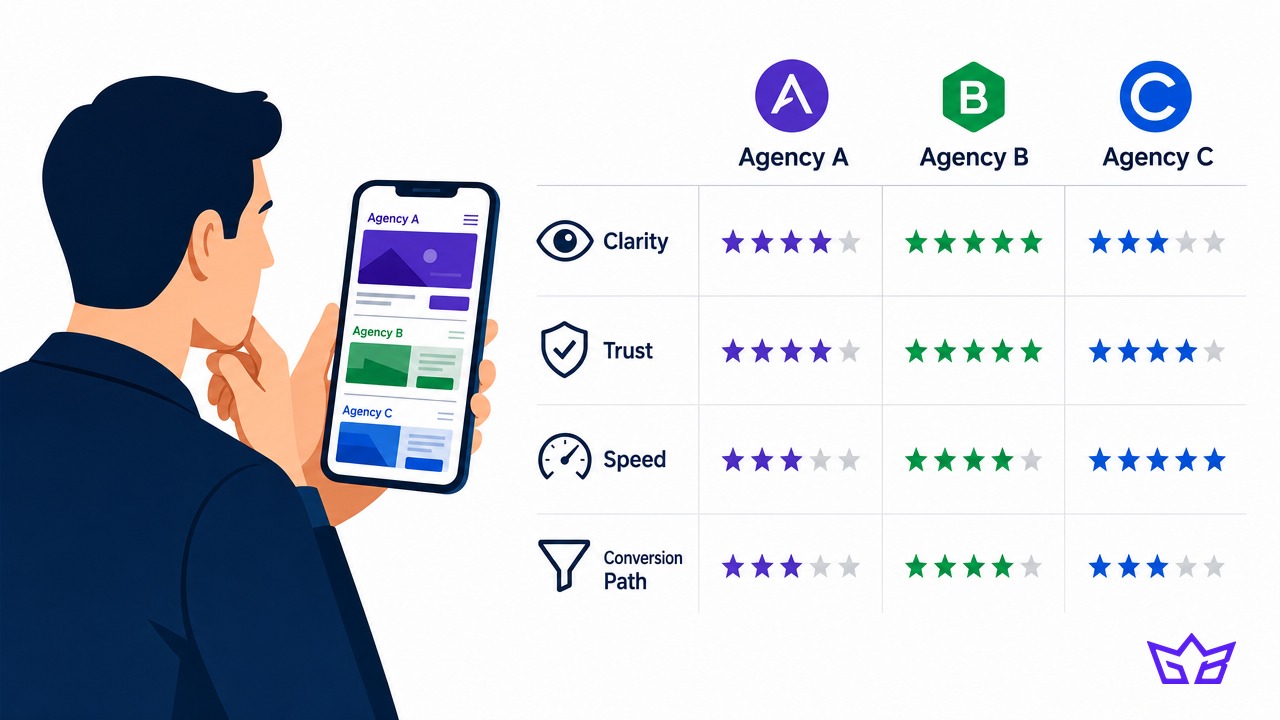
Portfolios are useful, but only if you inspect them like someone trying to buy from the client, not someone admiring a Dribbble shot. Ask for three live websites that resemble your project in complexity or audience. Open them on your phone. Then give yourself three minutes to complete the main action.
Can you find what the company actually sells? Can you get to a quote request without pinching, squinting, or closing a pop-up? Does the site answer the questions a cautious buyer will have before speaking to sales?
Look beyond the homepage. The real test is often a service page, product page, location page, or contact flow. A restaurant site and a B2B manufacturer site may both look polished, but their buying journeys have almost nothing in common. The agency should show experience with the type of decision your customer is making.
Ask what changed after launch as well. Did the client get more qualified inquiries? Did the marketing team publish pages without a developer? Did the agency fix a crawl, speed, or conversion problem that was holding the old site back? If the answer is only "the client loved it," you have a design testimonial, not evidence that the site did its job.
Make search, speed, and content part of the build
The most expensive website is one that launches cleanly and then cannot be found. SEO is not a plugin added during the final week. It starts with how the agency plans navigation, page templates, headings, internal links, redirects, metadata, images, and the CMS your team will use.
Ask a web design company in Toronto to walk you through a real launch plan. It should include a page inventory, keyword and intent mapping, an old-to-new URL redirect list if you are replacing an existing site, analytics configuration, and a post-launch crawl. If they cannot say who owns each step, it will probably become your problem later.
Performance belongs in that conversation too. Google evaluates real-user experience through Core Web Vitals, including loading, interaction responsiveness, and layout stability. The useful question is not whether an agency can run a one-time Lighthouse report on a fast office connection. Ask how it will check field data and Core Web Vitals once real visitors are using the site.
For example, a heavy video hero may look excellent in a presentation, but it can delay the message and call to action for someone on a busy mobile connection. The answer is not always to remove motion. It is to decide what is essential, load it intelligently, and make sure the first useful screen appears quickly.
Content ownership matters just as much. If you plan to publish location pages, case studies, product launches, or articles, ask to see the editor experience. Have the agency add a headline, replace an image, and publish a test page while you watch. A beautiful CMS that your team is afraid to touch becomes a bottleneck on day one.
For a view of how strategy, content, and technical decisions fit together, our Toronto digital marketing team approaches the site as part of the larger growth system, not a separate creative project.
Treat accessibility as a build requirement, not a final checklist
Accessibility is where weak process gets exposed. It is easy to promise an inclusive website. It is harder to design readable contrast, usable keyboard navigation, labelled forms, sensible focus states, descriptive image text, and components that still work when a visitor changes browser settings.
This is not a niche concern. WebAIM's 2025 review of one million home pages found that 94.8% had detectable WCAG 2 failures, with low contrast, missing alternative text, and unlabelled form inputs among the most common issues. The average home page had 51 detected errors. Those are basic misses, not exotic edge cases. Read the full WebAIM findings.
Ontario businesses should also ask what accessibility obligations apply to them. The province sets out web accessibility requirements under the AODA, including WCAG 2.0 Level AA requirements for applicable public websites and web content. The exact scope depends on the organization, so confirm it for your situation rather than accepting a generic promise of "AODA compliant." Ontario's accessibility guidance is a useful starting point.
Ask the agency which parts of accessibility it tests manually and which it checks with tools. Automated scans catch useful issues, but they cannot tell you whether a keyboard user can complete your booking flow or whether a screen-reader user can understand a price comparison. A real answer includes both.
Compare proposals by scope, not by the headline price
Two proposals can both say "$12,000 website" and describe entirely different purchases. One may include discovery, copy direction, custom design, development, migration, technical SEO, analytics, training, and a launch warranty. The other may be a theme, five pages, and a handoff. Neither is automatically wrong. They are not the same thing.
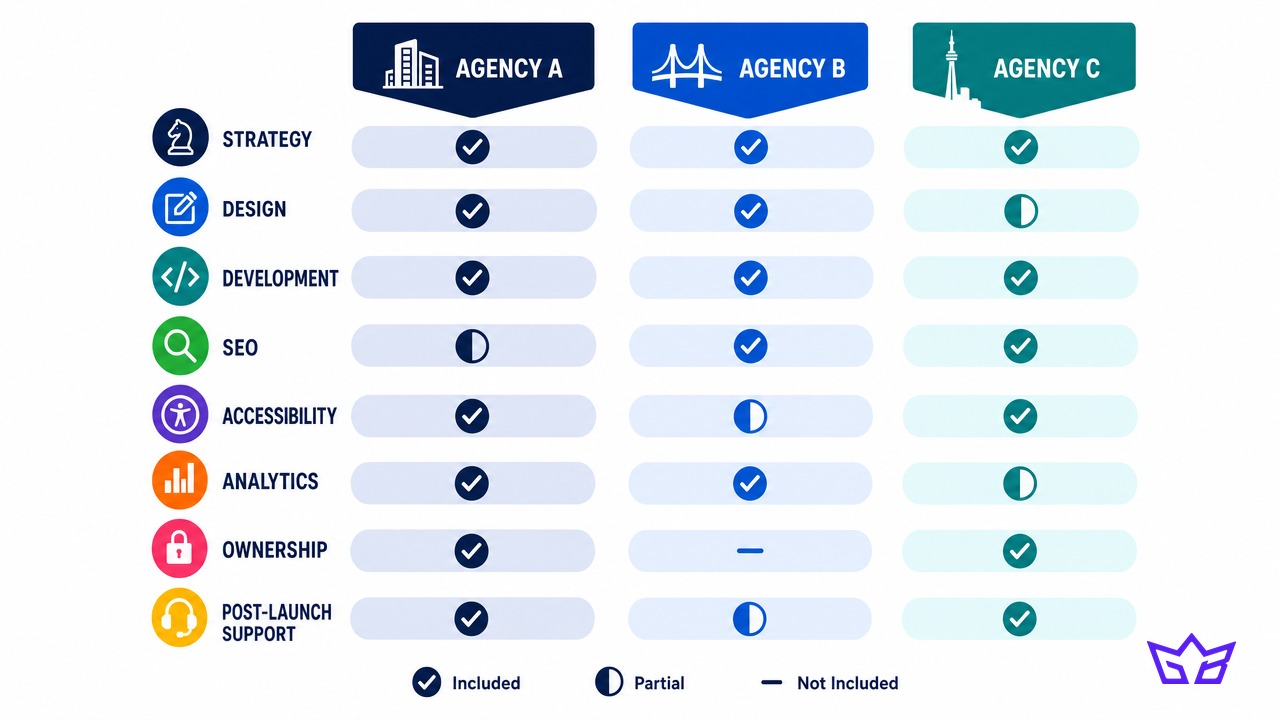
Put the proposals side by side and compare these lines:
- Strategy and content. Who interviews your team, maps the customer journey, writes or edits the copy, and decides what proof goes on each page?
- Design and build. Are you getting a custom system, an adapted template, or a combination? How many revision rounds are included, and who signs off?
- Technical work. Does the price include hosting setup, forms, CRM connections, tracking, redirects, schema, cookie consent, performance work, and QA across devices?
- Migration. If your old site has 80 pages or a library of resources, which pages move, which are redirected, and which are retired intentionally?
- After launch. What happens in the first 30 days if a critical issue appears? Is training included? What is the maintenance model once the project is complete?
Use a fixed example while comparing. Say you need a 15-page lead-generation site, two lead forms connected to your CRM, six existing service pages migrated, and marketing staff who can publish case studies. A proposal that has no answer for any of those requirements is not cheaper. It is incomplete.
If you need a benchmark for the investment itself, read our breakdown of small business website costs in Ontario. Then judge every quote against the work you need, not the lowest number in an inbox.
Keep ownership, data, and future changes in your hands
Before signing, settle ownership in writing. Your company should own its domain, hosting account, CMS account, source files, analytics properties, tag manager, ad pixels, image licenses, and every third-party subscription required to operate the site. Some web development agencies in Toronto handle these details well. Others create a dependency you only discover when it is time to make a change.
That does not mean you need to manage all of it yourself. It means you should be able to access it without negotiating a breakup. A web design agency in Toronto that keeps your domain or analytics under its own account may make future changes slower, more expensive, and needlessly tense.
Ask for a simple handoff list before work begins. It should name every account, the owner, the billing contact, and the credential-transfer process. If the build uses a paid template, font, stock photo library, or plugin, ask whether the licence travels with the site or needs to be renewed by you.
Data deserves the same treatment. Forms should state where submissions go, who can see them, how spam is handled, and whether the source and campaign are recorded. A form that sends an email is not automatically a lead system. If you spend on Google Ads or Meta, you need to know whether that person came from an ad, an organic search, a referral, or a returning customer.
Test the delivery process before you hire the team
The final site reflects the process that made it. Ask how the agency runs a project from kickoff through launch. You want a named project lead, a shared timeline, scheduled decision points, and a clear list of what the agency needs from you and when.
Listen for specifics. "We keep you in the loop" is pleasant but not useful. "You will approve sitemap and messaging in week two, design direction in week four, and staging content in week seven" tells you someone has done this before.
Pay attention to how the agency handles disagreement. A capable partner will explain why it thinks a requested feature is likely to hurt speed, clarity, or conversion, then offer an alternative. It will not simply agree to everything and bill for the result. The right team protects the outcome, even when that makes the conversation less convenient.
Before you choose, ask these six questions in the final call:
- What business result is this site designed to improve, and how will we measure it?
- Which live projects most closely resemble ours, and what changed after they launched?
- What is included in technical SEO, accessibility, analytics, redirects, and quality assurance?
- Who owns every account, asset, and data source when the project ends?
- What content can our team update without a developer, and can you show us that workflow?
- What happens if the site misses a launch requirement or a critical issue appears after launch?
Choose the partner that makes the next two years easier
The best agency is rarely the one with the loudest reel or the lowest quote. It is the one that understands how your customers decide, shows proof from similar work, gives you a complete scope, and leaves you with a site your team can improve instead of merely admire.
Start by putting your current site through the same test. Open it on your phone, try to complete its main action, and trace where the lead goes. If you cannot do that with confidence, you have the first item on your brief.
Then bring that brief to your shortlist. A serious agency will make it sharper before it makes anything pretty.
Reviewed by Gabriel Narsaik under our editorial policy.