AI Customer Service Chatbots: The Real ROI, and Why 74% Get Pulled Offline
AI customer service chatbots can return 340% for small businesses, yet 74% get pulled offline. The 5 decisions that separate wins from churn machines.
Here is a number that should make you cautious before it makes you excited: 74% of companies that rolled out an AI customer service agent have already pulled it offline or rolled it back. Not tweaked it. Shut it down. Usually after a customer had already hit the wall face-first.
Now here is the number that keeps the technology on the table anyway. The businesses that get it right are seeing $3.50 back for every $1 spent, and small businesses specifically are reporting first-year ROI around 340%. Same technology. Wildly different outcomes. The gap between those two numbers is not luck, and it is not budget. It is a handful of decisions you make before the bot ever answers a single ticket.
We have set these up for enough clients now to know exactly where the line sits. This is what actually separates the chatbot that pays for itself from the one that quietly bleeds you customers.
The AI customer service ROI is real, and bigger than most owners expect
Let me get the good news out of the way, because it is genuinely good.
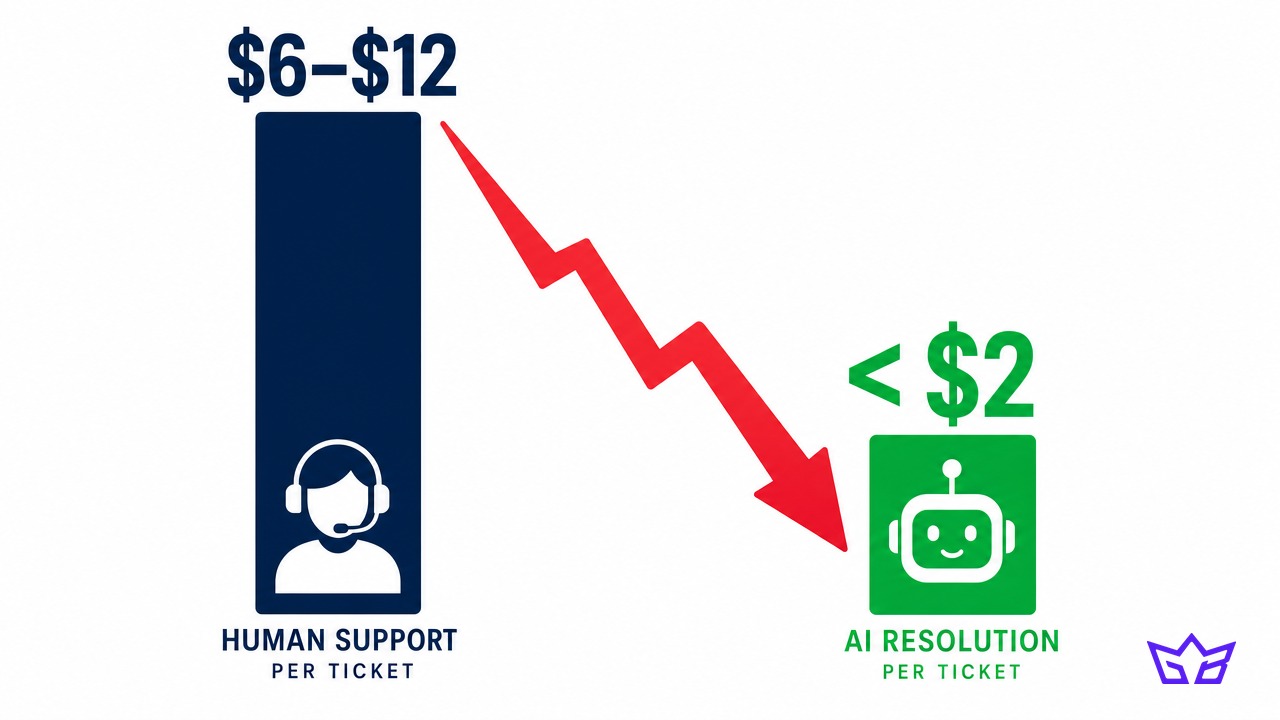
The math on customer support has always been brutal for small teams. A human-handled support ticket costs somewhere between $6 and $12 once you count wages, tools, and overhead. An AI resolution costs between $0.99 and $2.00. When a bot can actually close a ticket, the per-ticket economics do not improve a little. They collapse to a fraction.
One documented case tells the whole story: a company pushed its automation rate to 89%, cut cost per ticket from $5.50 to $2.00 (a 63% drop), and dragged response times down from hours to under a minute. That is not a marginal efficiency gain. That is the difference between needing to hire your next support rep and not needing to for another two years.
The returns compound over time, too. Across all business sizes, AI customer service investments average 41% return in year one, climb to 87% by year two, and pass 124% by year three as the system learns your product and your customers. The whole category is growing fast for a reason: the AI customer service market is projected to hit $15.12 billion in 2026, growing at nearly 26% a year. Money follows results, and the results are there.
Here are three real deployments that show what "results" looks like in practice:
- A B2B SaaS company automated 78% of its onboarding questions, cut time-to-value for new customers by 40%, and reduced churn by 18%. The bot did not just deflect tickets. It made customers successful faster, which is a retention play disguised as a support play.
- A clinic chain put a bot on appointment scheduling and FAQs and eliminated four hours of daily phone work per receptionist across 12 locations. That is 48 hours a day of human time handed back to higher-value work.
- A real estate agency used chatbot lead qualification to lift qualified appointments by 45%, with agents spending 30% less time chasing tire-kickers.
Notice none of those wins are "we replaced our support team." They are "we handed the machine the repetitive 70% and freed our people for the 30% that actually needs a human." It is the same pattern we see across every automation project: the biggest wins hide in the boring, repetitive work, which is exactly where the hours are. Hold onto that distinction. It is the entire game.
Why 74% of these things get yanked offline
So if the ROI is this good, why are three out of four getting shut down?
Because the failures are not quiet. When a support bot fails, it fails in front of the customer, at the exact moment they are already annoyed enough to have contacted you. And the damage is not evenly distributed. When companies were asked what actually happens when their AI agent breaks, the two biggest impacts were a spike in the support queue (35%) and reputational damage to the brand (34%). Roughly a third reported that the loss of customer trust was permanent or very hard to undo.
The specific failure modes are worth knowing, because they are avoidable:
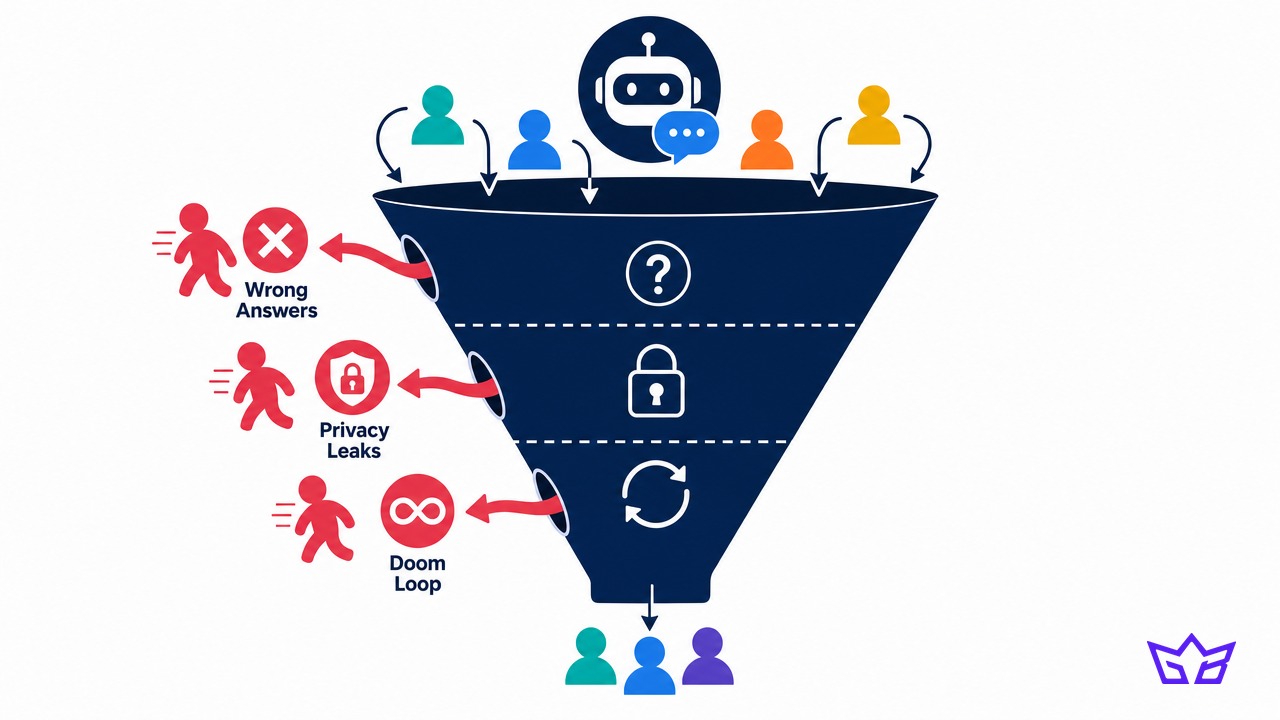
- Confident hallucinations. In 22% of failure cases, the bot gave customers confidently wrong information about their order, account, or policy. A human rep says "let me check." A badly configured bot just makes something up and says it with total conviction.
- Privacy leaks. In a genuinely alarming 31% of failure cases, the chatbot disclosed a customer's personal information during the interaction. That is not a bad-experience problem. That is a legal-exposure problem.
- The doom loop. Three in five consumers will repeat themselves exactly once to an automated system before abandoning it. One misunderstanding and most people are already reaching for the exit.
And they do leave. 75% of consumers say they have been left frustrated by AI customer support, and here is the quiet killer: 56% of unhappy customers simply stop doing business with you without ever complaining. You do not get an angry email. You do not get a chance to fix it. You just watch the repeat-purchase rate sag a quarter later and wonder why.
Even Klarna, the poster child for going AI-first on support, walked it back. After an aggressive automation push tied to a 40% headcount reduction, the company ended up rehiring humans for customer service once the AI underperformed on the complex, emotional, high-stakes tickets. If the company everyone cited as the success story had to reverse course, the lesson is not "AI does not work." The lesson is "AI-first, human-never" is the wrong design.
The difference between the 26% and everyone else
The businesses winning with support automation are not smarter or richer. They just refused to make five specific mistakes. If you are considering a bot, or you already have one limping along, this is the checklist that matters.
1. Scope it to the boring 70%, not the hard 30%. The fastest path to the 74% graveyard is pointing your bot at your most complex, emotional tickets first. Do the opposite. Feed it the repetitive, high-volume, low-stakes questions: "Where is my order?", "What are your hours?", "How do I reset my password?", "What is your return policy?" Those are the tickets that are expensive precisely because they are boring, and they are the ones a bot handles flawlessly. This mirrors what we cover in our breakdown of which marketing tasks to automate and which to never touch: the wins come from offloading volume, not judgment.
2. Build the human escape hatch before you launch, not after. Every bot needs a fast, obvious, one-click path to a human. Not buried. Not gated behind three more bot questions. The single most enraging support experience in 2026 is a customer who knows they need a person and cannot find the door. Design the handoff first. If the bot detects frustration, an unrecognized question, or the words "talk to a human," it should escalate instantly and pass the full conversation history along so the customer never has to repeat themselves.
3. Ground it in your real data, and forbid guessing. Hallucinations happen when a bot is allowed to answer from general knowledge instead of your actual policies, inventory, and order data. The fix is technical but non-negotiable: connect the bot to your real systems (your helpdesk, your order database, your knowledge base) and configure it to say "let me get a teammate for that" when it does not have a grounded answer. A bot that admits it does not know beats a bot that confidently lies, every single time.
4. Lock down what it can see and say. Given that 31% of failures involve leaked personal data, you cannot treat privacy as an afterthought. The bot should never expose one customer's information to another, never display full payment details, and should verify identity before discussing anything account-specific. Ask your vendor exactly how they handle this before you sign, not after your first incident.
5. Watch it like a new hire for the first 90 days. You would not let a brand-new support rep run unsupervised for three months. Do not do it with a bot either. Review transcripts weekly, especially the escalations and the low-confidence answers. Every one of those is a training opportunity that makes next month's automation rate higher and next month's failures rarer. The bots that get pulled offline were almost always fire-and-forget. The bots returning 340% got coached.
What it actually costs (real 2026 numbers)
The pricing has matured, and it is more accessible than most owners assume. A few reference points at real small-business volume:
- My AskAI runs inside the helpdesk you already use and charges a flat ~$0.10 per ticket, which makes your bill predictable and setup takes about 10 minutes with no developer. For most small businesses testing the waters, this is the lowest-risk entry point.
- Gorgias is the natural pick if you run a Shopify store, charging roughly $0.60 to $1.27 per automated resolution on top of a base helpdesk plan.
- Intercom Fin charges $0.99 per resolution, landing around $1,150 a month at roughly 1,500 tickets, with Gorgias closer to $975 at the same volume.
The pattern to notice: most serious tools now charge per resolution, meaning you pay when the bot actually solves something, not when it merely responds. That pricing model is your friend. It aligns the vendor's incentive with your outcome and caps your downside if the bot underperforms.
Run the back-of-envelope math for your own shop. If you handle 1,000 support tickets a month at a blended human cost of $8 each, that is $8,000. Automate even 60% of them at $1.50 a resolution and you are looking at roughly $900 in bot costs plus $3,200 in remaining human tickets: about $4,100 all-in, against $8,000. That is not a rounding error. That is real margin, every month, that you can redirect into acquisition or reinvest in the team you keep.
Start here this week
Do not buy the most powerful platform. Do not try to automate everything at once. That is exactly how businesses end up in the 74%.
Instead, run this sequence:
- Pull your last 200 support tickets and tag them by type. You will almost certainly find that a small number of question types make up the bulk of your volume. That repetitive cluster is your automation target.
- Pick one tool that plugs into your existing helpdesk rather than replacing it. Integration friction kills more of these projects than the AI ever does.
- Launch the bot on only your top 3 question types, with a one-click human handoff wired in from day one.
- Read the transcripts every week for the first month and expand the bot's scope only as it earns your trust on the questions it already handles.
Get those four steps right and you land in the 26% that see the 340% return. Skip them and you join the majority that spent money to actively annoy their own customers.
The technology is not the hard part anymore. The design is. A bot pointed at the right tickets, with a fast door to a human and a rule against guessing, is one of the highest-ROI systems a small business can install in 2026. A bot pointed at everything, with no escape hatch and no supervision, is a churn machine you are paying a monthly subscription to run.
If you would rather have a team scope, build, and supervise the automation so it lands in the winning column, that is exactly the kind of AI automation system we build for growing businesses. Or if you want to sanity-check your own plan first, book a 30-minute call and bring your ticket data. We will tell you which questions to automate, which to protect, and roughly what it will save you before you spend a dollar on a tool.
Reviewed by Gabriel Narsaik under our editorial policy.