Google AI Mode Is Eating Your Website Traffic. Here's the Survival Plan
93% of AI Mode searches end without a click. See which pages still win traffic and how to build an audience Google can't take away.
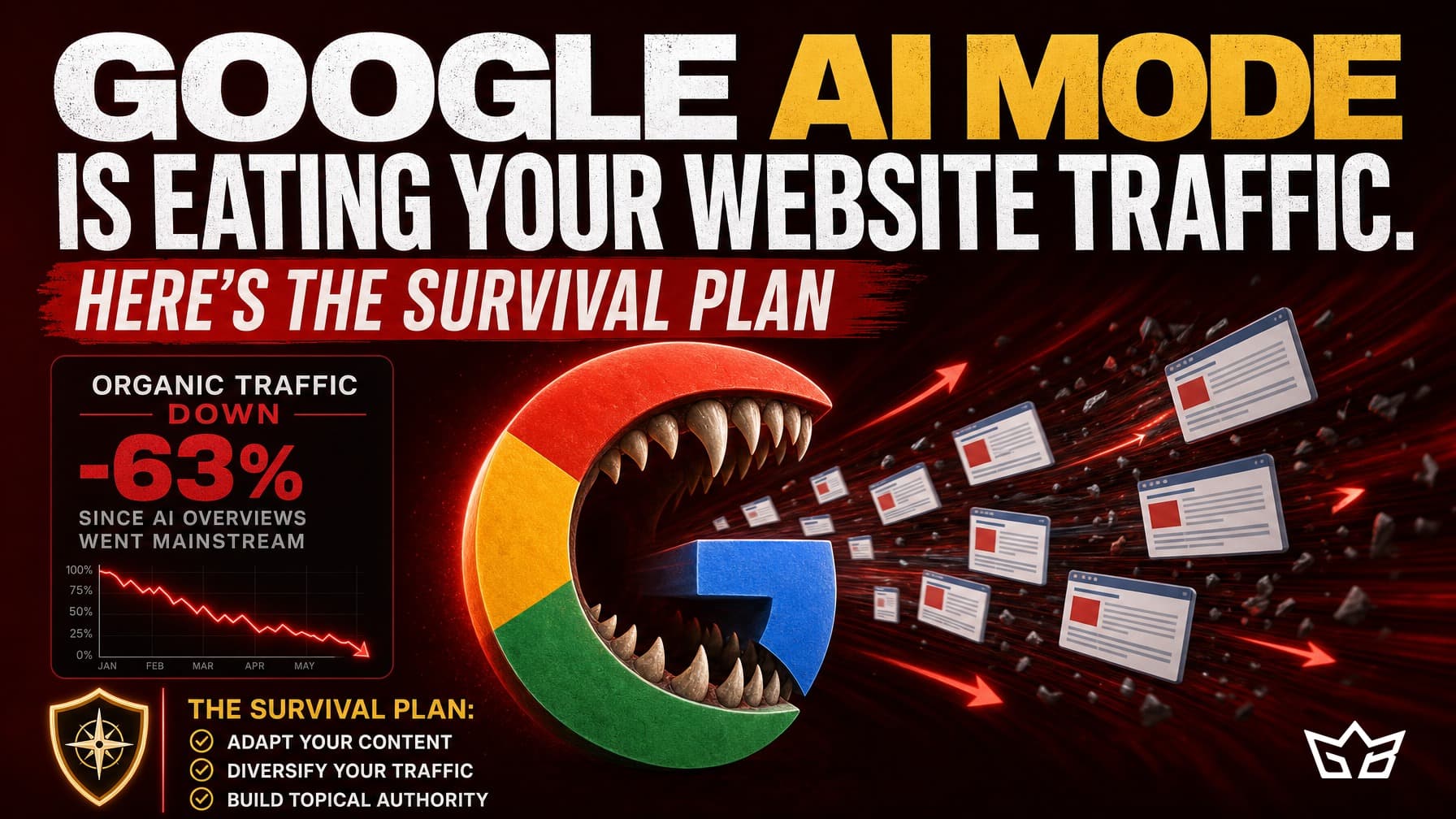
Your website traffic is not down because your content got worse. It's down because Google stopped sending the clicks. Semrush analyzed 69 million search sessions and found that 93% of searches in Google's AI Mode end without a single click to any website. Not your website. Any website.
If you run a business that counted on organic traffic, this is the most important shift since mobile. HubSpot, the company that literally wrote the playbook on blogging for traffic, lost an estimated 70 to 80% of its organic traffic. Business Insider dropped 55%. Publishers worldwide saw Google traffic fall by roughly a third in a single year. And the businesses we talk to every week in Toronto are seeing the same pattern in their analytics: rankings holding steady, impressions up, clicks falling off a cliff.
The good news: this is survivable. Some businesses are barely affected. The difference comes down to what kind of traffic you were relying on, and what you do in the next 90 days.
What Actually Changed in Search
Google now answers questions instead of listing links. There are two features doing the damage, and they behave differently.
AI Overviews are the AI-generated summaries that appear above organic results. They now trigger on roughly half of all searches, and when they appear, organic click-through rates drop hard. One large-scale analysis measured organic CTR at 0.61% when an AI Overview is present versus 1.62% without one. That's a 62% haircut on the clicks you used to get, even if your ranking never moved.
AI Mode is the bigger threat long-term. It's a full conversational interface that replaces the results page entirely. Users type longer, more natural questions (7.2 words on average, versus 4 in classic search), get a complete answer, ask a follow-up, and leave. That's where the 93% zero-click number comes from.
Here's the context most coverage skips: search was already becoming clickless. Bain measured that 60% of traditional searches ended without a click back in early 2025. AI didn't invent zero-click search. It industrialized it.
The Content That Got Hit (and the Content That Didn't)
This is the part that should change how you plan content, because the damage is not evenly distributed.
Semrush found that nearly 95% of the keywords that trigger AI Overviews are informational queries with little or no commercial value. Definitions, how-tos, "what is" questions, general guides. Google is happy to answer those itself because there was never much ad revenue in them anyway.
Transactional and high-intent queries are a different story. AI Overview rates on ecommerce transactional searches run around 3 to 4%. And when researchers watched real users search AI Mode for high-involvement local services (lawyers, dentists, contractors), 69% still clicked through to a website. People will let AI summarize a concept. They will not hire a roofer or buy a $200 product without looking at the actual business.
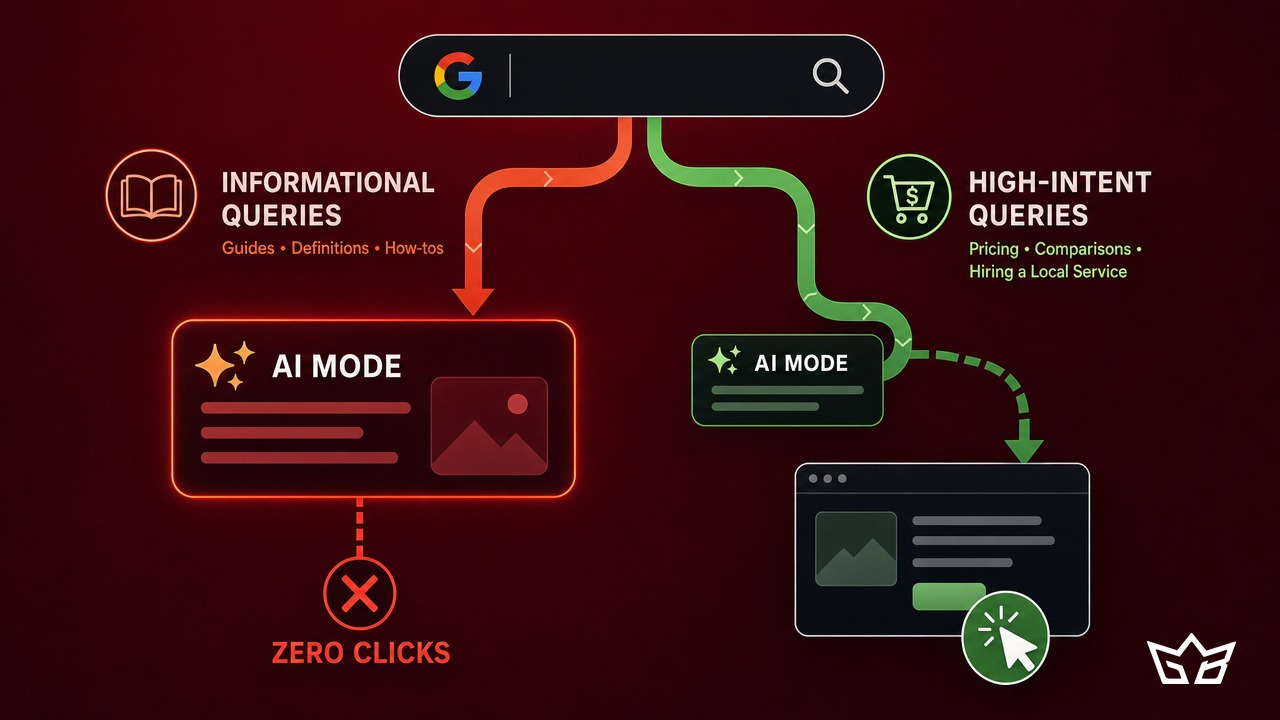
So the real question isn't "is SEO dead?" It's: how much of your traffic was informational, and what was it actually doing for your business?
For a lot of companies, the honest answer is that those blog visits were vanity volume. They inflated the traffic chart, converted at a fraction of a percent, and made monthly reports look healthy. HubSpot's collapse is the cautionary tale here: a decade of broad, top-of-funnel content with a weak connection to the product, and when Google stopped needing it, the traffic evaporated.
Step 1: Triage Your Content Like a Portfolio
Before you write anything new, figure out what you're actually losing. Open Google Search Console, compare the last 3 months year-over-year, and sort your pages into three buckets:
- Keep and defend. Pages with commercial intent that still earn clicks: service pages, product pages, pricing, comparisons, location pages, case studies. These are your revenue pages. Update them, strengthen them, build internal links to them.
- Convert. Informational pages that lost traffic but cover topics your buyers genuinely care about. Don't delete these. Restructure them to be citation-worthy (more on that below) and wire them to a conversion path: a tool, a checklist download, an email signup. If AI is going to summarize your article, make sure the people who do click through land somewhere useful.
- Stop feeding. Broad, generic informational content with no connection to what you sell. "What is digital marketing" style posts. This category is dead weight now. Every hour spent here is an hour not spent on pages that make money.
We've run this exercise with clients and the pattern repeats: 60 to 70% of lost traffic comes from pages that were generating almost no pipeline in the first place. The panic drops fast once you see revenue pages holding steady.
Step 2: Shift Weight to Pages AI Can't Answer
AI Mode can explain what conversion rate optimization is. It cannot show your pricing, your portfolio, your reviews, or what it's like to work with you. That's the moat. Double down on:
- Comparison and alternative pages. "X vs Y" and "best X for Y" queries still drive clicks because buyers want to see the options themselves.
- Pricing transparency. Pages that answer "how much does X cost" with real numbers earn both clicks and AI citations, because most competitors hide the ball.
- Proof pages. Case studies with specific numbers, before-and-afters, named clients. AI can't fabricate your track record, and buyers checking you out will look for it.
- Tools and calculators. An ROI calculator or audit tool gives people a reason to visit that no summary can replace.
- Local and service-area pages. High-involvement local searches still click through at nearly 70%. If you serve a geography, this is where the resilient traffic lives. Our local SEO playbook for service businesses covers exactly how to build these.
Step 3: Own Your Audience Before Google Finishes the Job
The deeper lesson of 2026 is about dependency. If your growth depends on a platform's willingness to send you strangers, you are renting your business. Google just raised the rent.
The businesses least affected by AI search are the ones with substantial direct and owned traffic: email lists, SMS lists, communities, repeat customers who type the brand name straight into the browser. Every informational visitor you do still get should be converted into someone you can reach without Google's permission.
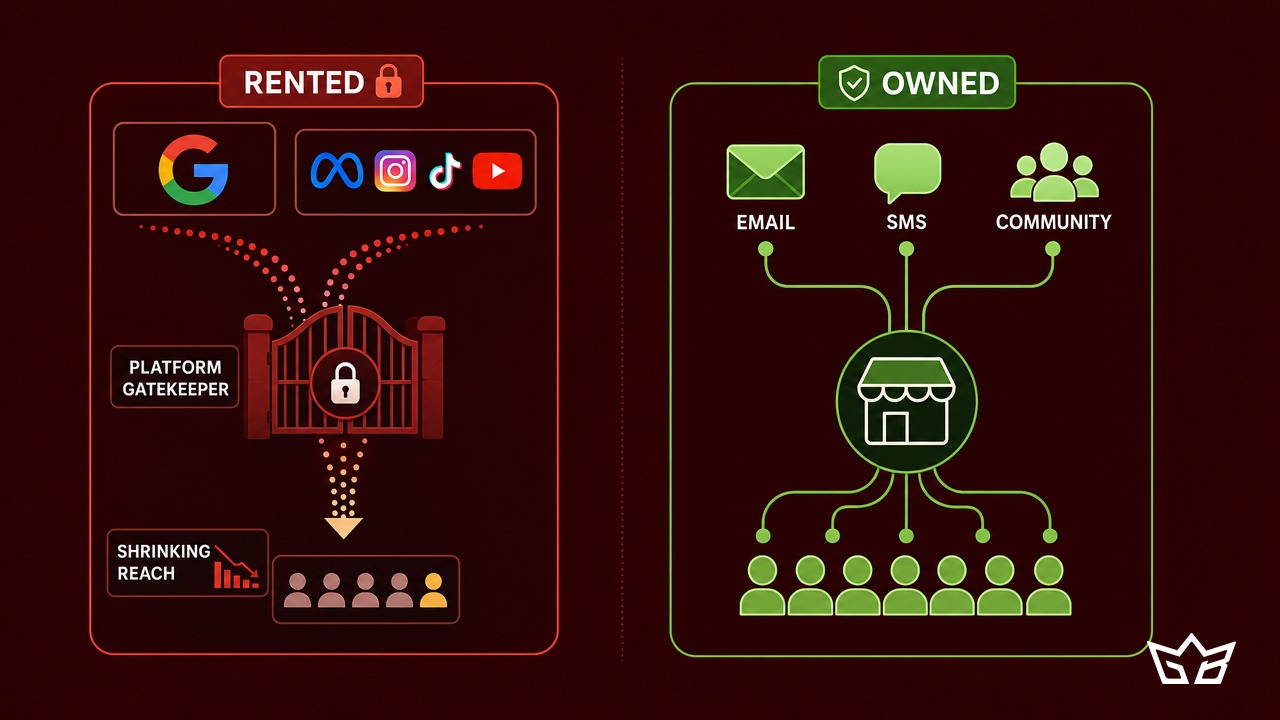
Email is the workhorse here, and the economics are absurd if you do it well: well-built DTC newsletter programs are running 30 to 40x ROI. A visitor who joins your list is worth many times one who reads and bounces, especially now that the bounce is happening inside Google before they ever reach you. We broke down the full system in our guide to email marketing in 2026.
The practical move: put a genuinely valuable opt-in (not "subscribe to our newsletter," an actual asset: a template, a calculator, a pricing guide) on every page in your "keep" and "convert" buckets. Your content's job is no longer traffic. It's capture.
Step 4: Get Cited in the Answers Themselves
Zero-click doesn't mean zero-influence. When AI Overviews or ChatGPT answer a question and cite your brand, you're being recommended at the exact moment someone asked. The click may not happen, but the impression does, and branded search follows.
Getting cited is its own discipline (structured content, direct answers, schema, digital PR, and consistency across the sources AI models trust). We wrote a full guide on answer engine optimization, so I won't repeat it here. The short version: format your best pages so a machine can lift a clean, quotable answer, and make sure your brand shows up in the third-party sources (reviews, directories, Reddit, industry roundups) that AI leans on.
One number worth knowing: AI-referred traffic to retail sites grew 693% year-over-year over the 2025 holidays. It's still a small slice, but the visitors who arrive from an AI recommendation are pre-sold in a way search traffic never was. They convert noticeably better. Small stream, high value, growing fast.
Step 5: Change What You Measure
If you keep grading marketing on sessions, this whole era will look like failure even while revenue grows. The scoreboard has to change:
- Branded search volume. People who saw you in an AI answer come back and search your name. Track it monthly; it's the new proxy for awareness.
- Direct traffic and returning visitors. The output of owned-audience work.
- Email and SMS list growth. Capture rate per 1,000 visitors matters more than the visitor count itself.
- Leads, demos, and revenue per page. Attach money to your "keep" pages so wins are visible even as raw traffic falls.
- AI visibility. Ask ChatGPT, Gemini, and Perplexity the questions your buyers ask. Are you in the answer? Screenshot it quarterly and watch the trend.
Traffic was always a proxy metric. AI search is just forcing everyone to admit it.
Do This Before Friday
Here's your next step, and it takes one hour. Open Search Console, filter to the last 28 days, compare year-over-year, and export your top 50 pages by clicks lost. Label each one: keep, convert, or stop feeding. That single spreadsheet will tell you whether you have a real revenue problem or just a vanity-metric problem, and it becomes the brief for everything above.
If the audit shows your revenue pages are the ones bleeding, that's a different conversation, and it's one worth having with people who fix this daily. We audit exactly this at GrowthBoss: where your traffic went, which pages still earn clicks in an AI-first Google, and what your capture-and-own system should look like. Bring the spreadsheet.
Reviewed by Gabriel Narsaik under our editorial policy.