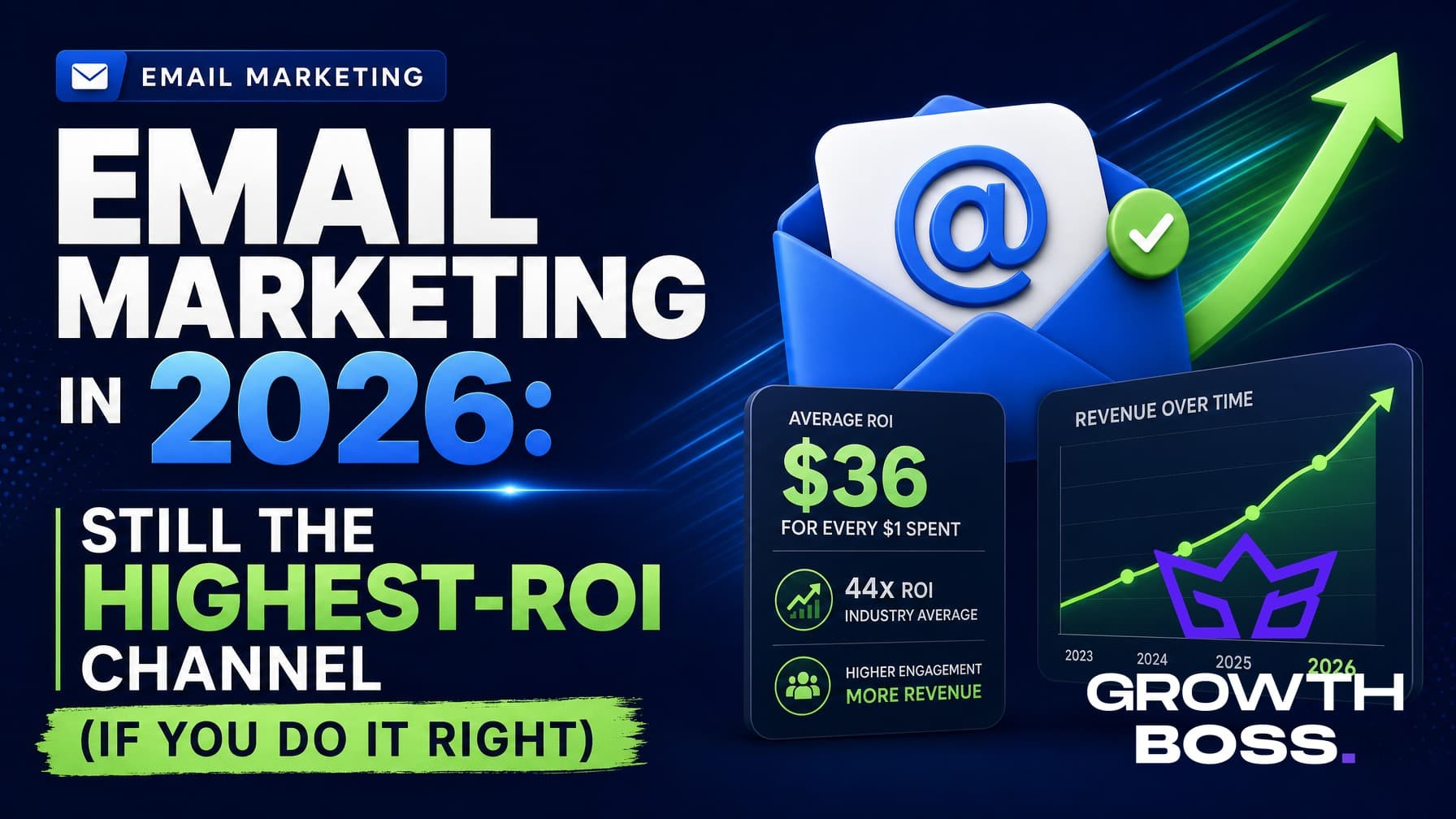
Email Marketing in 2026: Still the Highest-ROI Channel (If You Do It Right)
Email still returns more per dollar than any channel in 2026. See the flows, deliverability rules, and stats. Start your highest-ROI channel today.
Every few months someone declares email dead, and every few months the people sending it quietly outearn everyone who believed them. If you run a small business and you have written off the inbox because it feels old, you are leaving the single most profitable channel on the table. Email marketing for small business is not a nostalgia play in 2026. It is the highest-return channel most owners have, and the gap between email and everything else is getting wider, not smaller.
Here is the thing nobody tells you: email is not winning because it is flashy. It is winning because you own the list. Your ad accounts can get suspended. Your social reach can get throttled overnight by an algorithm change you had no vote in. But the names and addresses sitting in your email platform are yours, and you can reach them whenever you want without paying a tax to a platform every single time. That ownership is the whole story.
The ROI Numbers Are Almost Embarrassing
Let's talk money, because that is what this comes down to. The most commonly cited figure puts email at roughly $36 to $42 returned for every $1 spent. Compare that to what the paid channels typically deliver per dollar, and the contrast is hard to argue with.
Those paid numbers are directional, not gospel, and yours will vary by industry. But even if your email program lands at half the average, you are still beating the alternatives by a wide margin. For most small businesses, no other channel comes close on pure efficiency.
A few more figures worth knowing, all from recent industry benchmarks:
- Ecommerce email programs often report higher returns than the cross-industry average, with retail and consumer goods frequently cited near $45 per dollar and optimized programs running well above that.
- Small businesses lean on email for the majority of both customer acquisition and retention, not just one or the other.
- The return tends to climb as you tighten segmentation and add automation, which is the part most owners skip.
If you want to sanity-check what email could be worth for your own numbers, run them through our ROI calculator before you spend another dollar boosting a post.
Why "Doing It Right" Is the Whole Sentence
The headline of this post has a condition baked in: if you do it right. That is not a hedge. It is the entire game. Most of the businesses that tell us email "doesn't work for us" are doing one specific thing wrong: they blast the same message to everyone on the list and call it a newsletter.
That approach leaves the real money untouched. The data on segmentation and automation is blunt:
- Segmented campaigns consistently pull more opens and meaningfully more clicks than batch-and-blast sends, with some studies citing roughly 30% more opens and 50% more clicks.
- Automated emails punch far above their weight. Benchmarks repeatedly show automated flows driving a large share of all email revenue (often cited around a third) while making up only a tiny slice of total sends, in the low single-digit percentages.
- Marketers who invest in advanced segmentation report some of the steepest revenue jumps of any tactic.
Read that second bullet again. A handful of automated emails, set up once, can out-earn the dozens of manual campaigns you sweat over every month. That is the highest-return move in email, and it is sitting right there for any business willing to build it.
The Three Flows That Pay for Everything
If you do nothing else this quarter, build these three. They are the email equivalent of compound interest: set them up once and they keep working while you sleep.
- The welcome series. When someone joins your list, they are more interested in you than they will ever be again. Do not waste that with a single "thanks for subscribing" email. A short welcome sequence of three to five messages introduces your story, sets expectations, and makes a first offer. Welcome flows commonly convert in the low single digits and deliver returns in the neighborhood of 15:1.
- The abandoned cart (or abandoned inquiry) flow. Cart abandonment hovers around 75% across ecommerce, meaning three of every four people who add to cart walk away. A simple three-message recovery sequence, timed at roughly one hour, 24 hours, and 72 hours after abandonment, routinely recovers 10% to 15% of those lost sales. Abandoned cart flows are frequently cited as the single highest revenue-per-recipient flow in email, with returns reported around 30:1. Not an ecommerce shop? The same logic works for a service business: someone fills out half a form or books a call and ghosts, and a gentle nudge brings a real share of them back.
- The post-purchase / re-engagement flow. Getting a second order from an existing customer costs a fraction of acquiring a new one. A post-purchase sequence that thanks, educates, and cross-sells turns one-time buyers into repeat ones, and a win-back flow wakes up subscribers who have gone quiet before you lose them entirely.
We have seen this play out with dozens of clients. The businesses that build flows first and worry about the weekly newsletter second almost always come out ahead, because the flows are personalized by design: they fire based on what a specific person actually did.
Deliverability: The Part That Quietly Sinks Programs
You can write the best email of your life and earn exactly nothing if it lands in spam. Deliverability got real teeth in late 2025, and a lot of small senders did not get the memo.
Gmail, Yahoo, and Microsoft now enforce sender authentication seriously. If you send any meaningful volume, here is the short, non-negotiable checklist:
- Authenticate your domain. Set up SPF, DKIM, and DMARC. This is the digital equivalent of proving you are who you say you are. Bulk senders (generally those sending over roughly 5,000 messages a day) are required to have all three, and Gmail began rejecting and deferring non-compliant mail outright in late 2025.
- Use one-click unsubscribe. Gmail and Yahoo require a working one-click unsubscribe in marketing emails, honored within 48 hours. Make it easy to leave. Counterintuitively, it protects your inbox placement.
- Watch your spam complaint rate. Both Gmail and Yahoo enforce a hard ceiling: keep complaints under 0.3%. Cross it and your delivery falls off a cliff.
- Send from your own domain, not a free address. Sending campaigns from a gmail.com or yahoo.com address now actively hurts you.
The takeaway: authentication is no longer an IT nicety, it is the price of entry. If you have not confirmed SPF, DKIM, and DMARC are set up on your sending domain, stop reading and check that today. A good email platform walks you through it in under an hour.
AI Made Email Better, Not Obsolete
There is a fear that AI-written everything will drown the inbox and kill the channel. So far the opposite is happening for the people using AI well. AI is making the boring parts of email faster and the personalized parts sharper: drafting subject line variants to test, writing first drafts of flow copy, predicting which segment should get which offer, and picking better send times per person.
The catch is that AI raises the floor for everyone, which means generic gets ignored faster than ever. Your edge is not the AI. It is the proprietary thing AI cannot fake: your customer data, your voice, and your actual relationship with the people on your list. Use AI to move faster, then pour the time you save into segmentation and a message that sounds like a human who knows the reader.
A Quick Reality Check on Open Rates
One word of caution on measurement. Apple's privacy features inflate open rates by pre-loading images, so open rate is a noisier signal than it used to be. Judge your program on clicks, conversions, and revenue per email instead. Those are the numbers that show up in your bank account. If you want a clean read on whether your post-click experience is pulling its weight, our conversion rate calculator is a fast gut check.
What to Actually Do This Week
Email is not complicated, but it does reward people who start. Here is the order of operations that gets results fastest:
- Confirm deliverability. SPF, DKIM, DMARC, one-click unsubscribe, and a real sending domain. This is your foundation.
- Build the welcome series. Three to five emails, written once. This is the single most valuable hour you will spend this month.
- Add the abandoned cart or abandoned inquiry flow. Three messages, timed at one hour, a day, and three days out.
- Segment your list into a few obvious buckets. New subscribers, repeat buyers, and lapsed customers is plenty to start. Speak to each differently.
- Stop blasting one message to everyone. That single habit is the one quietly capping your returns.
Email rewards the businesses that treat the inbox like a relationship instead of a megaphone. Build the three flows, lock down deliverability, segment with intent, and let the automation compound. Do that, and email stays exactly what the numbers say it is: the highest-ROI channel you have.
Your concrete next step: pick one flow, the welcome series, and write it this week. If you would rather have it built right the first time and wired into the rest of your growth, that is the kind of work our marketing and growth team does every day. When you are ready to turn your list into a revenue engine, tell us where you are stuck and we will map the fastest path from here.
Reviewed by Keston Leader under our editorial policy.