Meta Just Overtook Google in Ad Revenue. Here's Where Your H2 2026 Budget Should Go
Meta just passed Google in ad revenue for the first time. Here's how to split your Meta vs Google ad budget for H2 2026, by business type and spend.
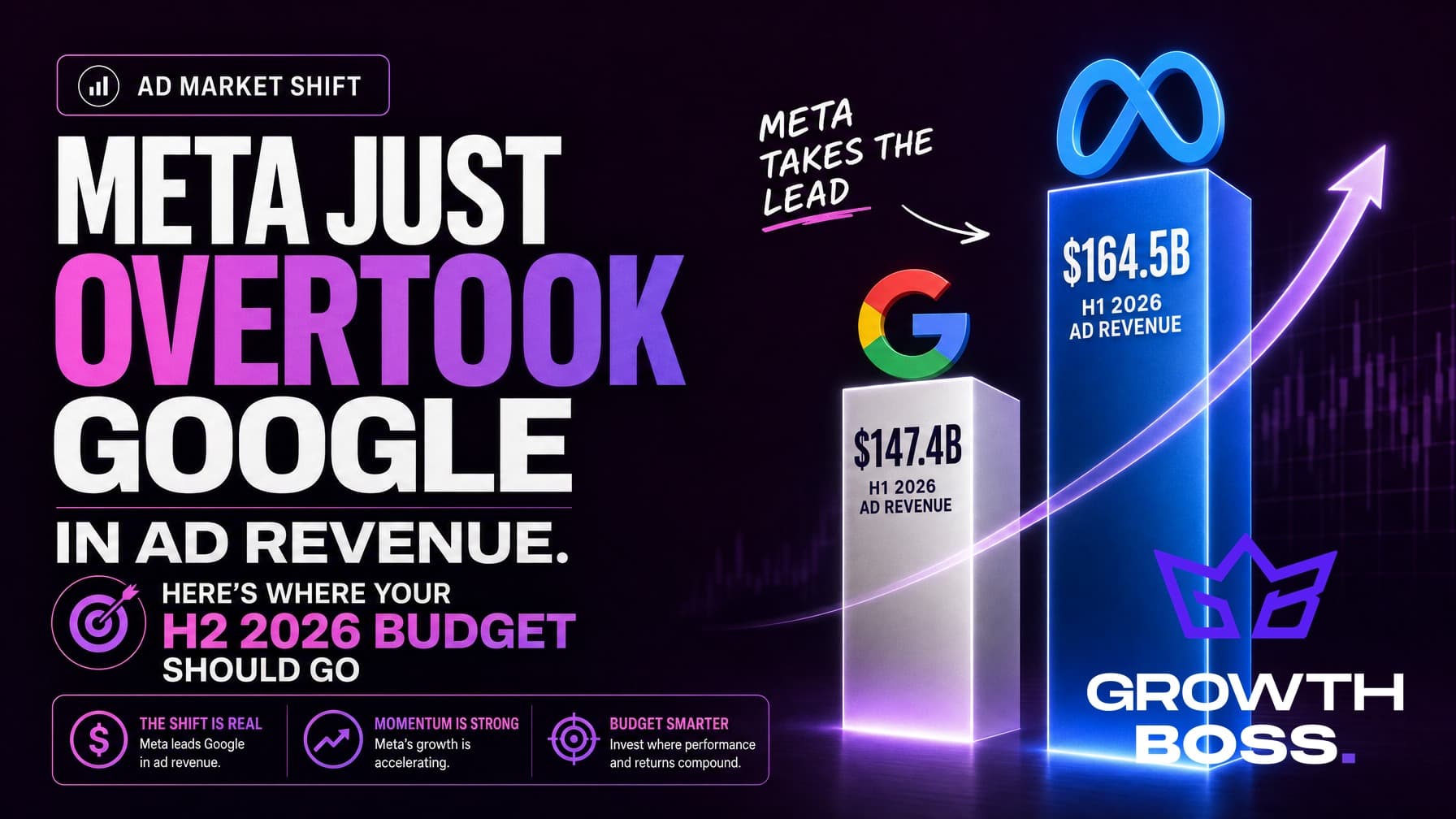
For the first time in the history of digital advertising, Google is not the biggest ad platform on Earth. eMarketer's latest forecast has Meta pulling in $243.46 billion in global ad revenue this year, edging past Google's $239.54 billion.
That is not a rounding error. It is the end of a two-decade reign, and it happened while most business owners were busy arguing about whether AI would change marketing. If you split an ad budget between Meta and Google (or you have been all-in on one), the second half of 2026 is the right moment to rethink the mix.
Here's the thing nobody's telling you, though: "Meta beat Google" does not mean "move your money to Meta." The real story is more useful than the headline.
What Actually Happened
The numbers behind the milestone tell you where the momentum is:
Meta is growing at more than double Google's rate. And the concentration at the top keeps tightening: Meta, Google, and Amazon together will take 62.3% of all global digital ad spend this year, up from 59.9% in 2025.
Three things are driving Meta's surge:
- Advantage+ actually works. Meta's AI-automated campaigns now account for 62% of ecommerce ad spend on the platform, and the data backs the adoption: Advantage+ Shopping campaigns average a 4.52x ROAS versus 3.70x for manually built campaigns. That is a 22% lift, with roughly 32% lower cost per acquisition across ecommerce verticals.
- Brand-new ad real estate. WhatsApp Status ads put 1.5 billion users in play, and Threads is pulling $5-$10 CPMs in high-revenue regions. Barclays estimates these two surfaces alone could add up to $6 billion in incremental revenue this year and $19 billion next year. Unlike the Reels transition a few years ago, this inventory is fully additive. Nothing is being cannibalized.
- Google is fighting itself. Roughly 68% of US Google searches now end without a click (we covered the zero-click shift here), and AI Overviews have been linked to a 58% drop in click-through rates for top-ranking pages. Google's own AI products are eating the search results that its ad business depends on.
Meta vs Google: What This Does NOT Mean
Before you drag your entire budget to Ads Manager, look at the other side of the ledger. Google still owns something Meta cannot manufacture: intent.
The data is clear on this one. Google's average cost per click hit $4.22 this year (up 18% from 2025), while Meta sits around $0.97. Meta looks 70% cheaper until you check conversion rates: Google converts around 3.75% of clicks while Meta converts about 0.9%. Someone typing "emergency plumber near me" at 11pm is a fundamentally different buyer than someone who paused on your Reel for three seconds.
We've seen this play out with dozens of clients. The businesses that panic-shift their whole budget toward whatever platform is in the headlines usually spend a quarter relearning the same lesson: the platforms do different jobs.
- Meta creates demand. It puts your product in front of people who were not looking for it and makes them want it.
- Google captures demand. It catches people at the exact moment they are ready to act.
- Meta feeds Google. A customer sees your product on Instagram, searches your brand name three days later, and buys. Google's dashboard claims that conversion, but Meta started it. If you judge each platform only by its own attribution, you will systematically underrate Meta and overrate Google.
That last point matters more than any headline. Google's higher reported ROAS partly measures demand that Meta created. Kill the Meta spend and watch your "high-performing" branded search campaigns quietly dry up six weeks later.
Where Your H2 2026 Budget Should Actually Go
There is no universal split, but after running this across ecommerce brands, service businesses, and B2B clients, the patterns are consistent. Use these as starting points and let your own marginal ROAS data move them:
If you sell products (DTC / ecommerce):
- Start around 60-65% Meta, 35-40% Google.
- Put the Meta side into Advantage+ Shopping plus a steady creative testing budget. The AI handles targeting; your job is feeding it.
- Put the Google side into Shopping, branded search, and Performance Max. Protect branded search first. It is your cheapest revenue.
If you sell services (local or professional):
- Flip it: 60-70% Google, 30-40% Meta.
- High-intent search terms ("divorce lawyer Toronto", "furnace repair near me") still convert better than anything Meta can offer.
- Use Meta for retargeting and for staying visible between buying cycles, not for cold lead gen.
If you are B2B:
- Google search CPCs above $15 in categories like CRM software make pure demand capture brutally expensive.
- Meta's job-title and company-size targeting delivers B2B leads at $2-4 per click. Use it to build an audience, then let Google branded search close.
- A 50/50 split with heavy Meta retargeting is a reasonable H2 test if your Google CPCs have crept past $10. And if Performance Max is part of your Google mix, set it up to optimize for pipeline, not form fills.
If your budget is small:
- Under $3K/month: pick ONE platform and get good at it. Splitting a small budget two ways means neither platform's algorithm gets enough data to learn.
- $3K-$8K/month: run Meta for demand plus Google branded search only. That combination covers creation and capture at minimum cost (our small-budget Google Ads playbook shows how to make the Google side count).
- Above $10K/month: now the splits above apply, and you have enough volume to measure marginal ROAS per platform instead of trusting dashboard averages.
How to Tell If Your New Split Is Actually Working
Whatever split you land on, the dashboards will lie to you about it. Both platforms grade their own homework, and both will happily claim the same conversion. Before you judge the H2 reallocation, set up measurement that answers the only question that matters: did total revenue per total ad dollar go up?
Three checks that take an afternoon to set up and will save you thousands:
- Track blended CAC weekly, not platform ROAS. Total ad spend across both platforms divided by total new customers. When you shift budget toward Meta and blended CAC drops over the following 4-6 weeks, the shift worked. If platform dashboards look worse but blended CAC improves, trust the blend.
- Watch branded search volume as a Meta health metric. Pull up Google Search Console and watch searches for your brand name. Rising Meta spend should push branded impressions up within two to three weeks. Flat branded search while Meta spend climbs means your creative is reaching people but not sticking.
- Run a geo holdout if you spend $15K+/month. Pause Meta in two or three comparable regions for four weeks and compare total revenue against matched markets where it kept running. This is the closest a small business gets to real incrementality testing, and it regularly reshapes budgets more than any dashboard ever has.
One of our ecommerce clients ran that third test last year, convinced Meta was their weak channel because in-platform ROAS looked mediocre. Revenue in the holdout regions fell 19% inside a month. The "weak" channel was quietly driving a fifth of the business through conversions Google was claiming.
The Catch: Creative Is the New Targeting
Here is the part most businesses miss when they shift money toward Meta. Advantage+ took targeting away from you. You cannot out-segment your competitors anymore, because everyone's campaigns are being optimized by the same AI. The only input you still control is the creative.
The numbers on this are blunt: brands testing 20+ new ad creatives per month see 65% higher ROAS than brands testing fewer than 10. Meta's AI is a distribution engine, and it rewards whoever feeds it the most raw material to work with.
So if your H2 plan is "increase Meta budget," the honest version of that plan is "increase Meta budget AND build a creative pipeline." That means:
- A repeatable system for producing ad variations weekly, not quarterly
- UGC-style content in the mix, since polished brand ads keep losing to authentic formats
- A kill-fast mentality: let the algorithm bury losers within days instead of nursing them
Budget without creative volume is how you end up in the group that spends more on Meta in H2 and gets less back.
The Mid-Year Move That Actually Matters
The Meta-Google crossover is a genuinely big deal, but not because you should pick a winner. It is a signal that the old defaults (Google first, Meta as an afterthought) no longer describe how demand works. AI-automated buying, new inventory on WhatsApp and Threads, and a weakening organic search channel have redrawn the map in about 18 months.
Your move this week: pull your ad spend and revenue data from January through June, calculate cost per acquisition per platform (not per campaign), and check what percentage of your Google conversions come from branded search. If branded search is doing the heavy lifting, Meta is probably creating more of your demand than your dashboards admit, and it deserves a bigger share of your H2 budget than it got in H1.
If you want a second set of eyes on that math, this is exactly the kind of mid-year budget audit we run at GrowthBoss. Book a strategy call and bring your numbers. We will tell you where the money should go, even if the answer is "leave it alone."
Reviewed by Bahaa Zuraik under our editorial policy.