Q4 Is Won in July: Your BFCM 2026 Prep Timeline
Black Friday 2026 is 19 weeks out. Smart stores win BFCM in July, not November. Get the month-by-month prep timeline for inventory, speed and email.
Black Friday 2026 lands on November 27. That is roughly 19 weeks away, and the stores that will actually win it are already working on it right now, in the middle of July, while their competitors are still telling themselves there's plenty of time.
There isn't. The uncomfortable truth about the holiday quarter is that the biggest sales weekend of the year is decided months before a single discount goes live. The brands that posted record numbers last November didn't out-discount anyone in the final week. They spent the summer fixing the things that cannot be fixed under load: inventory depth, site performance, feed accuracy, and the automated flows that quietly do most of the selling. By the time Black Friday arrives, the work is already done. All that's left is to turn it on.
Why the stakes are higher than you think
Let's get the scale straight, because it reframes everything. Over the BFCM 2025 weekend, Shopify merchants alone did $14.6 billion in sales, up 27% year over year, from more than 81 million shoppers. At the peak, at 12:01 p.m. EST on Black Friday, those stores were selling $5.1 million worth of product every single minute. Across the wider U.S. market, 197 million people shopped between Thanksgiving and Cyber Monday.
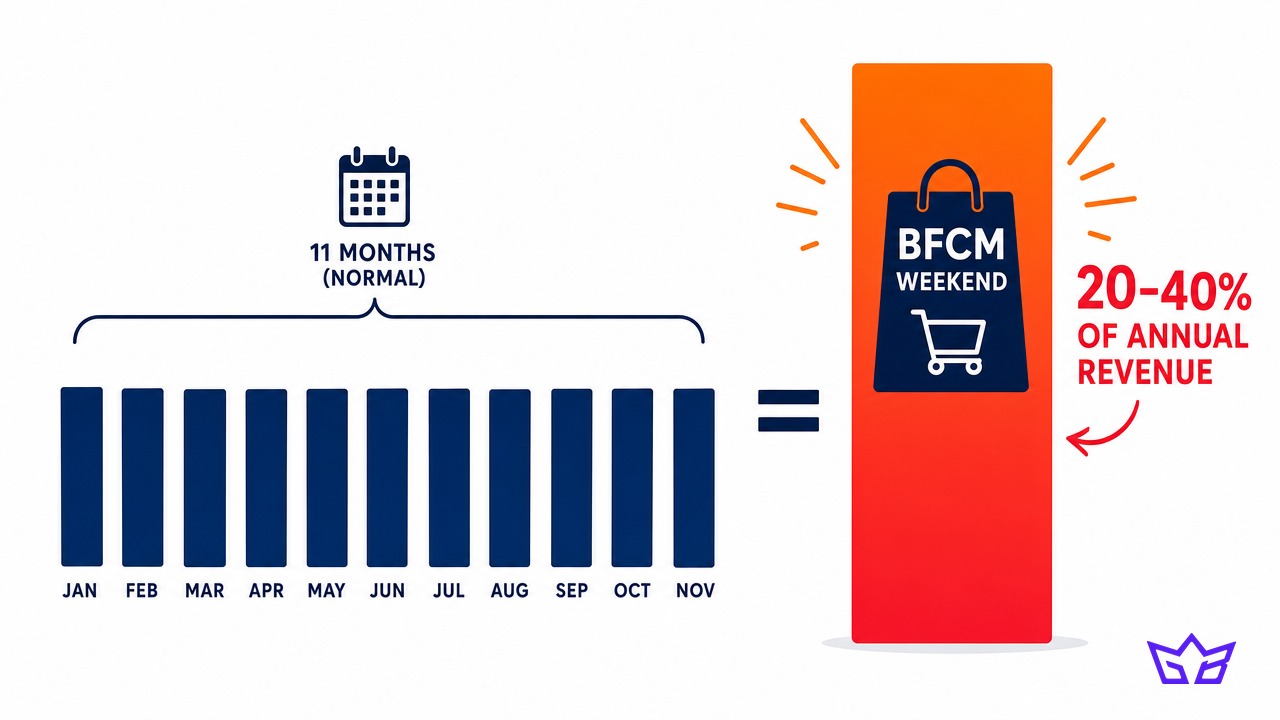
Here's the number that should stop you cold: 73% of merchants say more than 20% of their entire annual revenue comes from the October-to-December window. For a lot of stores it's closer to 40%. That means one long weekend in November can outweigh three or four ordinary months. Get it right and you fund your whole next year. Get caught flat-footed and you spend Q1 explaining to yourself why the traffic showed up and the sales didn't.
The problem is that most owners treat BFCM like an event they attend rather than a system they build. They start thinking about it in October, panic-write some emails in the first week of November, slap a 20% code on the store, and hope. That approach worked when the field was less crowded. It does not work now, and it definitely won't work against a competitor who started in July.
What you genuinely cannot fix in November
Some things are easy to change at the last minute. Your banner copy, your discount percentage, your ad budget. Those are levers you can pull the week of. But the things that actually determine whether BFCM pays off are all slow-moving, and if you haven't started them by late summer, you've already lost that lever for the year.
- Inventory that isn't on the water yet. If your best-seller sells out at 2 p.m. on Black Friday, no amount of ad spend brings that revenue back.
- A site that buckles under 5x normal traffic. Speed and stability are baked in over weeks, not bolted on the night before.
- An email domain with a cold reputation. You can't safely blast 100,000 people if your sending history says you normally mail 5,000.
- A product feed the AI shopping engines can't read. The machines that now recommend products need clean data long before the shopping starts.
Every one of those has a lead time measured in weeks or months. That's the whole reason July matters. Not because you need to be writing Black Friday emails today, but because the foundation those emails sit on has to be poured now.
The inventory clock is already ticking
This is the single most time-sensitive piece, so start here. If you sell physical product and any part of your supply chain runs overseas, your ordering window for the holidays is closing faster than the calendar suggests.
The math is unforgiving. Overseas manufacturing commonly carries a 6 to 8 week production lead time, and that's before ocean freight and customs, which add several more weeks. Work backward from a mid-October arrival (you want stock landed and checked in well before the late-November rush) and you land on a hard deadline: best-sellers need to be ordered by mid-August at the very latest. For anything with a longer lead time or a supplier you don't fully trust, that deadline is really late July.
Waiting until September isn't a small risk, it's a cascade of expensive problems: rush air-freight fees that eat your margin, partial shipments that leave you selling a fraction of what you planned, and the slow-motion stress of watching stock tick down while your supplier keeps pushing the ship date. Lead times aren't dramatically worse than a couple of years ago, but they're more variable in Q4. A shipment that clears in five days in August can take fifteen in November when everyone's warehouse is jammed.
Do this now: pull your top 20% of SKUs by revenue, forecast holiday demand at 1.5x to 2x your normal monthly volume for those items, and get the purchase orders in before your window closes.
Your site has to survive the spike
Traffic on Black Friday doesn't rise gently. It spikes, and a store that feels perfectly fine in July at normal volume can fall over at 5x load exactly when every visitor is a buyer with a card in hand.
This is where summer prep quietly separates the winners. Site speed and stability are the entry ticket now, not a nice-to-have. Around 55% of ecommerce stores already fail Google's Core Web Vitals on an ordinary day, and that same slowness costs 8 to 35% of conversions under pressure. We wrote a full breakdown of why most stores fail Core Web Vitals and how to fix it, and the short version for BFCM is this: the fixes take a focused day or two of work, so do them in August when nothing's on fire, not in a panic on November 26.
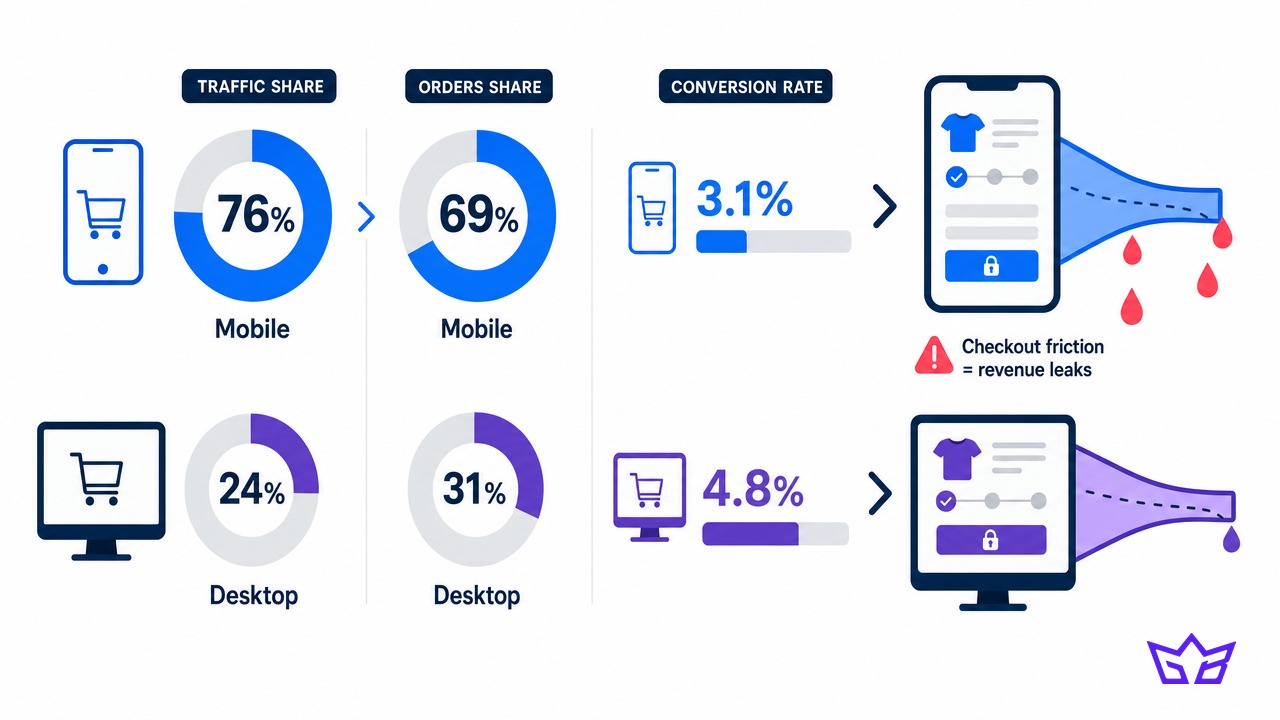
Remember where the traffic actually comes from, too. Mobile now drives about 76% of holiday traffic and 69% of orders, and Cyber Monday 2025 saw a record 63% of purchases completed on phones. Yet desktop still converts higher (roughly 4.8% versus 3.1% on mobile), which tells you exactly where the friction is. If your mobile checkout has any drag in it, you're leaking your largest audience. Test the full path on a real phone, on real cellular data, before the traffic arrives.
A short pre-BFCM technical checklist worth running in August:
- Run PageSpeed Insights on your homepage, top product page, and cart. Fix anything in the orange or red.
- Uninstall every app you haven't opened in 90 days. Each one adds scripts that slow every page.
- Load-test your checkout. Simulate a spike and watch what breaks.
- Confirm your payment processor and any buy-now-pay-later options are live and tested. BNPL alone drove over $1 billion in online spend on Cyber Monday 2025.
The email and SMS engine needs a summer warm-up
Here's the part almost everyone gets wrong. They build a beautiful Black Friday email, schedule it to their entire list, hit send at 6 a.m. on the big day, and half of it lands in spam. Why? Because they normally mail 5,000 engaged people and suddenly tried to reach 90,000, most of whom hadn't heard from them in months. Inbox providers read that spike as exactly what it looks like: a blast. And they throttle it.
Sender reputation is earned slowly and spent instantly. If you want your November campaigns to actually land, the work starts in late summer:
- Warm the list now. Start reintroducing your unengaged subscribers to your active sends over the coming weeks, so by November you're mailing a list that's proven it opens.
- Run win-back campaigns in August and September. Wake up the cold contacts early. Don't try to resurrect them on Black Friday, that's the fastest way to tank your deliverability at the worst possible moment.
- Segment by engagement. Sending to your active buyers first keeps your open and click rates high, which is what protects placement for the bigger sends.
- Audit and test every flow by September. Welcome, abandoned cart, browse abandonment, post-purchase. These automations do the quiet, compounding selling while your team sleeps.
Email is still the highest-ROI channel you own, and we've made that case in detail before. But in 2026 the smart move is to pair it with SMS for the time-sensitive drops. A text hits a 98% open rate and cuts through a Black Friday inbox that's stuffed with 300 other offers. Get consent collected and your SMS flows built now, well ahead of the rush, so the channel is warm and compliant when it matters.
The new front door: the AI shelf
This is the part that wasn't on anyone's BFCM checklist two years ago, and it's the fastest-moving story of the season. A growing share of your holiday shoppers won't start on Google or on your homepage. They'll start by asking ChatGPT, Gemini, Copilot, or Perplexity what to buy.
The numbers are not subtle. AI-referred traffic to U.S. retail sites grew 805% year over year on Black Friday 2025, and those AI-referred visitors converted at a 38% higher completion rate than shoppers from traditional search, because they arrive pre-qualified and closer to the buy. AI platforms are on track to drive $20.9 billion in retail spending in 2026, nearly quadruple the prior year. Walmart, Etsy, and thousands of Shopify brands are already feeding these engines.
The catch is that an AI agent can't see your gorgeous homepage. It reads your structured product data, and if that data is thin or stale, the agent recommends the competitor whose feed was complete. We broke down how to get your products recommended by AI shopping agents, and the BFCM implication is simple: auditing and cleaning your product feed is now a summer prep task, right alongside inventory and site speed. Clean feeds take weeks to propagate. Start in July and you're on the shelf by November. Start in November and you've missed the fastest-growing traffic source of the season.
The month-by-month runway
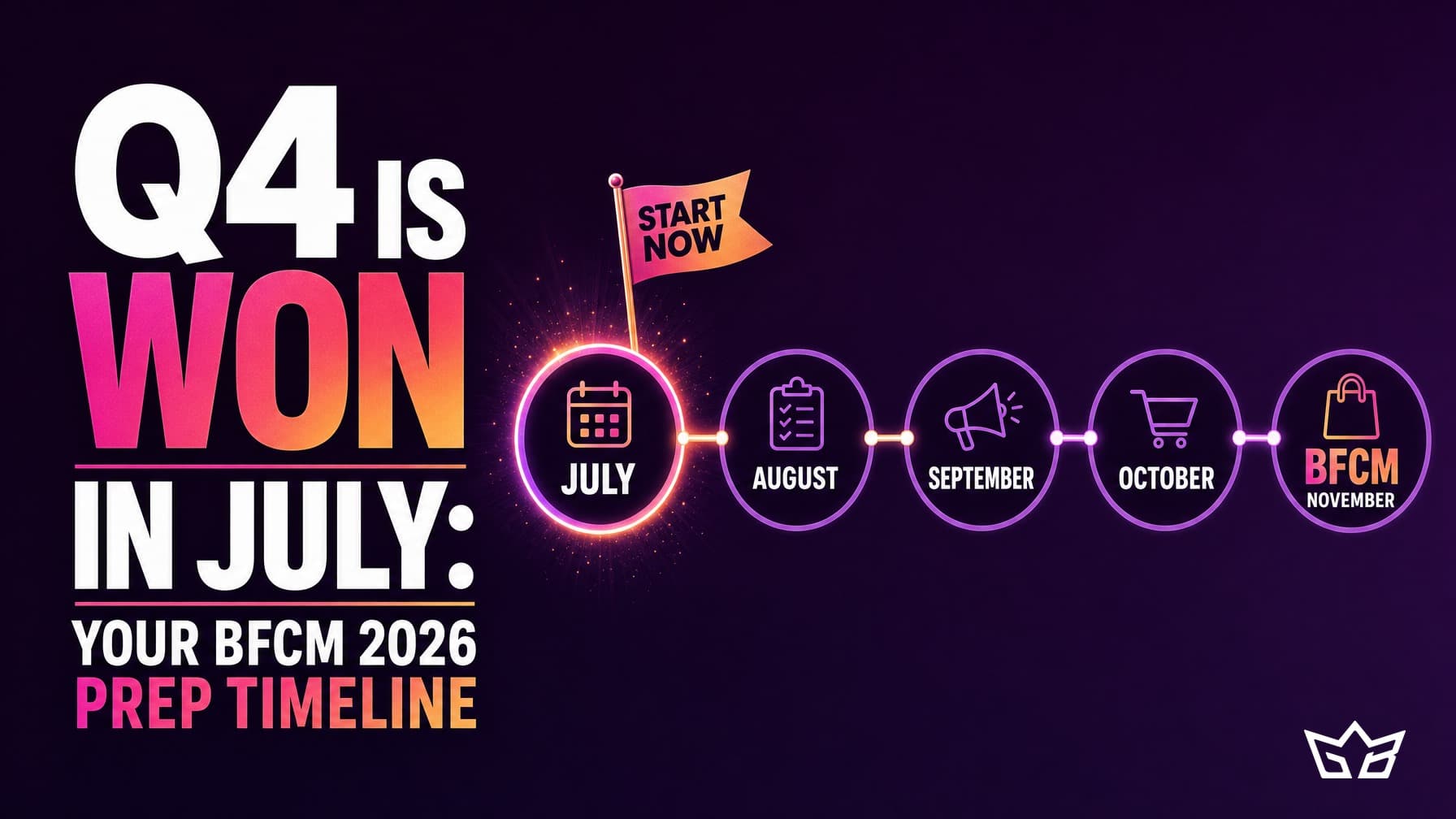
Here's the whole thing on one timeline. Nothing here is heavy on any single week; that's the point of starting early.
- Mid-to-late July: forecast demand, finalize best-seller inventory orders, and start feed cleanup plus your email list warm-up.
- August: place all remaining purchase orders, run the full site-speed and checkout technical audit, and launch win-back campaigns.
- September: build and test every automated flow, lock your offer strategy, set up and warm SMS, and run a deliverability audit.
- October: stock lands and gets checked in, finalize creative and ad campaigns, and soft-launch early access to your VIP segment.
- November: execute. The system is already built, so this stretch is about monitoring, not scrambling.
Notice what November looks like when you do this right. It's calm. You're watching dashboards and topping up ad spend on winners, not rebuilding your checkout at midnight or emailing a supplier who's stopped replying.
What to do this week
You don't need to boil the ocean in July. You need to start the slow-moving pieces so the clock works for you instead of against you. This week:
- Pull your top 20% of SKUs by revenue and forecast holiday demand. If anything needs an overseas reorder, get that PO drafted now.
- Run PageSpeed Insights on your three most important pages and write down what's failing. You'll fix it in August, but you want the list today.
- Check your email engagement segments. Start the warm-up. Schedule a win-back campaign for the next two weeks.
- Open your product feed and look at it with cold eyes. Missing GTINs, vague titles, stale availability. That's your AI-visibility to-do list.
The stores that treat the holiday quarter as a system they build over four months, rather than an event they cram for in one, are the ones quietly compounding while everyone else panics. The gap between those two groups is decided right now, in July, when it still feels like there's time.
If you'd rather have a team run the full pre-BFCM audit for you, covering your inventory forecast, site performance, feed hygiene, and the email and SMS flows that carry the weekend, that's exactly the kind of growth system we build. Send us your store URL and your top-selling products, and we'll tell you which of the four foundations is your biggest risk before the season starts.
Reviewed by Bahaa Zuraik under our editorial policy.