Getting Your Brand Ranked Inside LLMs: The Complete AEO, GEO and LLMO Guide for 2026
Gartner predicted search would fall 25% by 2026. It did not. But ChatGPT now handles around 2.5 billion prompts a day, AI Overviews appear on close to half of all Google searches, and brands cited in them earn about 35% more organic clicks. This is the complete guide to being one of them: what AEO, GEO and LLMO mean, how assistants actually pick their sources, and the 90-day plan to get cited.
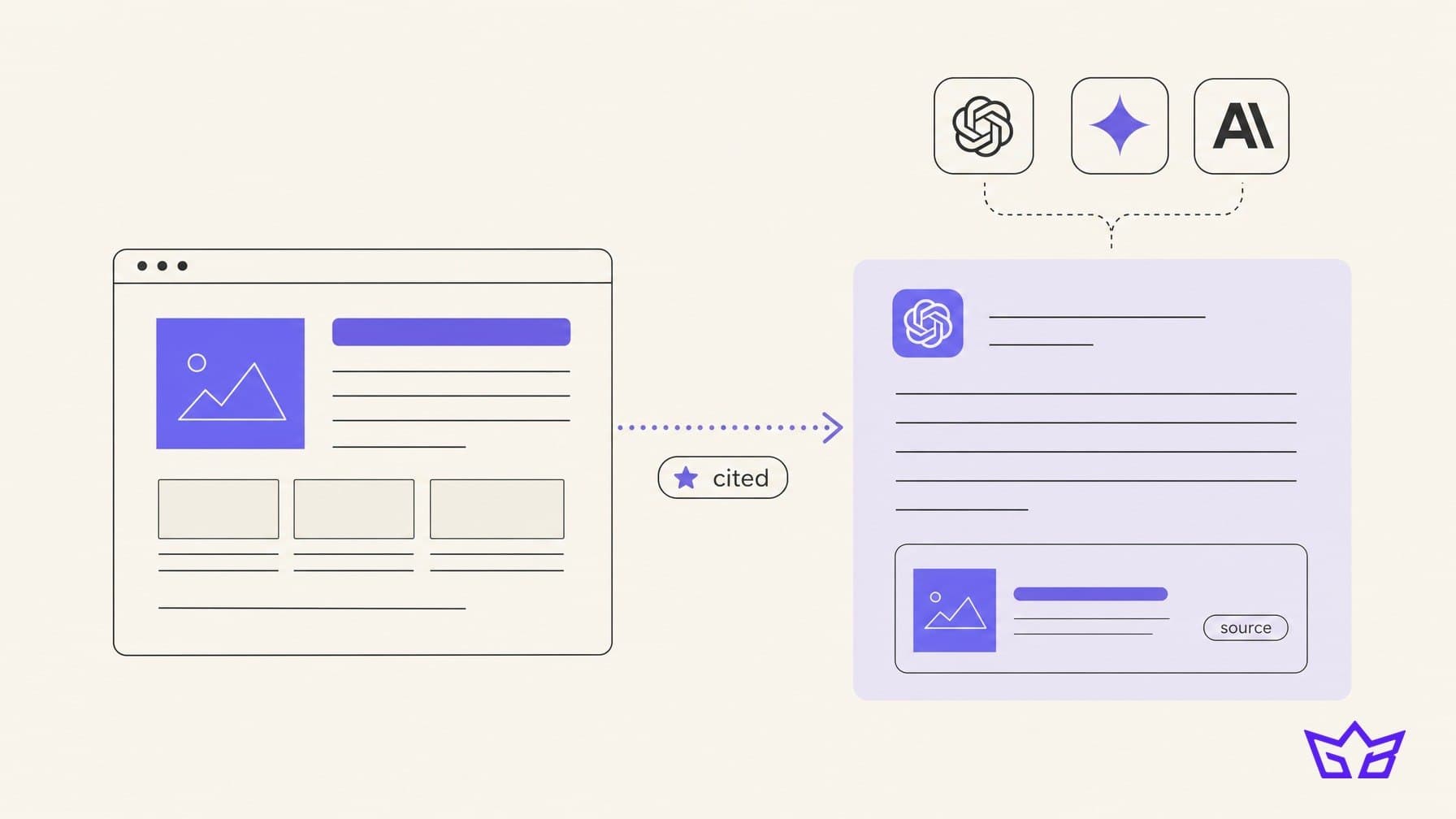
In February 2024, Gartner predicted that traditional search engine volume would drop 25% by 2026, as AI chatbots took over.
It is September 2026. It did not happen. Google still handles the overwhelming majority of the world's searches, and search volume did not collapse.
Hold onto that, because nearly every article written about AI search opens by quoting that prediction and never goes back to check it. If a guide is still using a two-year-old forecast as evidence that search is dying, it is not a guide worth following.
Here is what actually happened instead, which is more interesting. ChatGPT went from 400 million weekly users in early 2025 to around a billion monthly users by early 2026, handling roughly 2.5 billion prompts a day. And Google did not sit still: its AI Overviews now appear on close to half of all searches.
So search did not shrink. A second discovery surface grew alongside it, and then Google built one into itself. Your buyers now ask an assistant "what is the best CRM for a startup" and get three names and a recommendation, and if you are not one of the three, you were never in the running.
This guide covers how to be one of the three. It uses three terms you will see used interchangeably, and it is worth knowing why they exist.
What AEO, GEO and LLMO actually mean
AEO, GEO and LLMO are three names for the same job: making sure your brand is named when an AI system answers a question in your market. They emerged from different communities and emphasise different things, but the tactics overlap almost entirely. Learn one properly and you have learned all three.
- AEO, Answer Engine Optimization. The broadest of the three. It covers any system that returns a direct answer instead of a list of links: Google's AI Overviews, Bing Copilot, Perplexity, and voice assistants. The goal is to be the answer, not to be a blue link beneath it. The term grew out of featured snippets and "People Also Ask" boxes, then expanded as chat interfaces took over.
- GEO, Generative Engine Optimization. This one comes from academia: the paper GEO: Generative Engine Optimization by Aggarwal and colleagues, presented at KDD 2024. It stresses the generative part. Unlike a search engine that retrieves and ranks existing pages, a generative engine synthesises a new answer from several sources. Your content is raw material the model rewrites.
- LLMO, Large Language Model Optimization. The most technical framing, concerned with how specific models find and cite information. It acknowledges something the other two gloss over: optimising for ChatGPT is not identical to optimising for Claude or Gemini, because they retrieve and cite differently.
In practice, marketers say AEO, SEO professionals say GEO, and technical teams say LLMO. Pick whichever your audience uses and get on with the work.
How an AI assistant actually chooses its sources
Most assistants do not answer current questions from memory. They run a live web search, retrieve a set of pages, score them, and synthesise an answer from the passages they trust most. This process is called retrieval-augmented generation, or RAG, and understanding it explains almost every tactic in this guide.
The sequence looks like this:
- The model interprets what you actually asked, which is often broader than the words you used.
- For anything current, it issues one or more web searches.
- It retrieves candidate documents from those results.
- It scores them for relevance, authority and trust.
- It synthesises an answer from the passages that survive.
- It cites the sources it leaned on.
The critical detail is in step five. The model does not cite your page. It cites a passage from your page. Everything below follows from that.
What makes a passage citable comes down to five things: clarity, whether a self-contained answer can be lifted out without the surrounding paragraphs; authority, whether the source looks trustworthy; structure, whether the page is organised enough to parse; specificity, whether it contains concrete facts rather than adjectives; and freshness, whether it is current enough to rely on.
Where each assistant gets its information
Assistants have markedly different source diets, which means a single strategy will not serve all of them. Profound's analysis of 30 million citations between August 2024 and June 2025 found ChatGPT drew 47.9% of its top citations from Wikipedia, while Perplexity drew 46.7% of its from Reddit.
- ChatGPT leans encyclopedic. Wikipedia dominates, followed by a long tail of established publications and review sites. It rewards being a clearly defined, well-documented entity.
- Google's AI Overviews lean community and multimedia. Reddit, YouTube, Quora and LinkedIn feature heavily. Content that exists only as a blog post is at a structural disadvantage here.
- Perplexity leans overwhelmingly on Reddit and on review platforms and community discussion.
The strategic read is straightforward. For ChatGPT, invest in being documented: consistent facts about your business in places that get cited as reference. For Google's AI surfaces, a genuine Reddit presence and video coverage matter more than another article. For Perplexity, you are largely working on Reddit and review sites.
The mix itself is moving too. ChatGPT still sends the large majority of measurable AI referral traffic, but its share of overall generative-AI usage has fallen from roughly three quarters to about half in a year, as Gemini climbed past a quarter and Claude grew fastest of the three. Building for one assistant is a shrinking bet.
One caveat worth keeping: these shares move. The study above covers a window ending in mid-2025, and platforms change their retrieval behaviour without announcing it. Treat the pattern as directional, and re-test your own queries rather than trusting a table forever.
Why traditional SEO is the foundation, not the casualty
This is where the "SEO is dead" framing falls apart. Because assistants answer current questions by searching the live web, a page that does not rank is a page the assistant never retrieves, never reads, and cannot cite. Ranking is not the goal any more. It is the entry ticket.
The data supports this bluntly. Grow and Convert analysed over a hundred prompts across five industries and found 86% of citations came from industry-specific domains, frequently the vendors' own blogs, with only 14% from generic sites like Reddit, Wikipedia and Forbes. Their clients' content was cited in 88% of the topics analysed. The sites winning in AI answers are, overwhelmingly, the sites that already did the SEO work.
The relationship runs in both directions, and this is the number to take to whoever controls your budget. Roughly 43% of pages ranking first on Google are cited by ChatGPT, and Seer Interactive found that brands cited inside an AI Overview earn about 35% more organic clicks than brands that are not. Being cited does not cannibalise your traffic. It compounds it.
The Grow and Convert finding also sits in productive tension with the citation-share data above, and the tension is the insight: generic community sites dominate broad questions, while industry sites dominate specific, commercial ones. The questions your buyers ask before they spend money are the specific kind.
So the SEO fundamentals keep earning their place, now for two audiences at once:
- Schema markup tells both a crawler and a model what your content is, rather than leaving them to infer it.
- Clear heading hierarchy is what makes a page chunkable into extractable passages.
- FAQ sections map directly onto how people phrase questions to an assistant.
- Internal linking builds the topical authority that makes you look like a subject specialist rather than a generalist.
- Fast, crawlable, HTTPS pages remain the price of admission for both.
The technical layer: schema and structure
Schema markup is structured data that states plainly what a page contains, so a model does not have to guess whether "Apple" means the company or the fruit. It is the cheapest, highest-certainty work on this list, and most sites either skip it or implement one type and stop.
The types worth implementing first, roughly in that order:
- Organization on the homepage, carrying your brand entity, logo, contact details and sameAs links.
- FAQPage wherever you answer real questions, because the format matches how answers get retrieved.
- Article with a named author and dates, on everything editorial.
- Person for author credentials, which is how expertise becomes machine-readable.
- Product for anything with a price or availability.
- HowTo for genuine step-by-step instructions.
Structure matters just as much. Models process documents in chunks of roughly 75 to 225 words, so a page built as one long argument gives them nothing clean to lift. A page built as a sequence of questions, each answered immediately underneath, gives them a dozen candidates.
The 40 to 60 word answer formula
Lead every section with a self-contained answer of about 40 to 60 words, then add the context and evidence below it. That opening block is what gets extracted. If it depends on the paragraph above to make sense, it cannot be lifted, and it will not be cited.
The difference is easiest to see side by side. Here is a sentence that cannot be cited:
"Our revolutionary platform transforms how businesses engage with their customers."
And here is one that can:
"HubSpot CRM tracks customer interactions across email, phone and chat. The free tier includes contact management for up to one million contacts. Paid plans start at $45 per month."
The second contains extractable facts. The first contains adjectives. Assistants have no use for adjectives, and neither, frankly, do buyers.
Specificity is measurable, not just a matter of taste. The GEO paper found that optimisation methods of this kind, particularly adding statistics, quotations and improving fluency, can boost visibility in generative responses by up to 40%, with statistics addition and quotation addition among the strongest performers. Concrete numbers, attributed quotes and named sources do measurably better than confident prose.
Building entity authority
An entity is a uniquely identifiable thing, a company, person or product, that a knowledge graph recognises and can describe. When a model knows Stripe is a payments company founded by the Collison brothers and connected to ecommerce and fintech, it can recommend it confidently. When it cannot pin down who you are, it will not risk naming you.
Four things build that identity, in ascending order of difficulty:
- Consistent NAP. Identical name, address and phone across your website, Google Business Profile, LinkedIn and every directory. Contradictions are the single most common reason a model hedges about a business.
- sameAs connections. Link your Organization schema to your authoritative profiles, so the model can join the records up rather than guessing they are the same company.
- Author entities. Real author pages with Person schema, credentials and links to real profiles. Given how heavily ChatGPT leans on encyclopedic sources, documented people are worth more than anonymous bylines.
- Wikipedia and Wikidata presence, which is the highest-leverage and hardest item here. It cannot be bought, cannot be written by you, and requires genuine third-party coverage to survive. Most small businesses will not qualify, and pursuing it prematurely wastes months.
Then cluster your content around the entity rather than around keywords. A pillar page on your core topic, with supporting pages on definitions, features, pricing, comparisons and implementation, all interlinked, is what tells a model you are the specialist rather than a site with one good article.
Earned media is the other half of the job
Everything above is on-site work you control. The other half happens on other people's websites, and it is the half that decides whether an assistant treats you as a credible name or an unknown.
Muck Rack's study of more than a million links cited by AI models found over 95% came from non-paid sources, with 84% classified as earned media in their May 2026 update. That is the clearest finding in this entire field: you cannot buy your way into an AI answer the way you can buy a search ad.
What works instead:
- Original research. Benchmark data, survey results and market analysis are citation magnets, because a model answering a factual question needs a number and someone has to have produced it. This is the single most reliable play available to a small brand.
- Trade and industry publications that already get cited in your category, which matter more than one placement in a famous title outside it.
- Review platforms such as G2 and Capterra, kept accurate and actively collecting reviews.
- Authentic community participation, particularly on Reddit, given its dominance in Perplexity and Google's AI surfaces. Participate as a practitioner, not as a brand running a campaign, or it will backfire.
A note on paid contributor programmes, since people ask: memberships that let you publish on a major masthead typically run a few thousand dollars a year and can genuinely accelerate coverage. But with 95% of citations coming from non-paid sources, treat them as an accelerant on top of earned media, never as a substitute for it.
E-E-A-T is the trust layer underneath all of it
Experience, Expertise, Authoritativeness and Trustworthiness is Google's framework for evaluating content quality, and it maps almost perfectly onto what makes a source citable by a model. Both are trying to answer the same question: can this source be relied on?
- Experience. Publish specific case studies with real numbers, including the parts that did not work.
- Expertise. Real credentials on real author pages, marked up with Person schema.
- Authoritativeness. Earned links and mentions from sources already trusted in your category.
- Trustworthiness. HTTPS, reachable contact details, cited sources, visible dates and corrections when you get something wrong.
Invented author personas deserve a specific warning. Models cross-reference names against the wider web, and a byline that exists nowhere else is a signal of low trust rather than a neutral one.
How to measure whether any of it is working
Track five things: how often you appear in answers to your priority questions, how often your brand is mentioned at all, your share of voice against named competitors, the sentiment of those mentions, and, most overlooked, whether what the model says about you is factually correct.
That last metric is the one most teams skip and the one most likely to be costing you business. An assistant confidently quoting a price you retired two years ago does more damage than not being mentioned.
Dedicated tracking tools now exist across a wide price range, from roughly $30 a month at the entry level to enterprise platforms in the hundreds. Pricing and coverage change constantly, so compare current plans rather than trusting any list, including this one.
You can also do this manually, for free, and every business should before paying for anything. Write down the 20 to 30 questions a buyer would genuinely ask before choosing you. Run them across ChatGPT, Google, Perplexity and Gemini once a month. Record who gets cited, whether you appear, and whether what is said about you is accurate. A spreadsheet and an hour a month establishes a baseline that most of your competitors do not have.
Eight mistakes that cost people visibility
- Treating this as a replacement for SEO. Assistants search the live web. Abandoning rankings removes you from the retrieval pool entirely.
- Trying to buy your way in. Over 95% of citations come from non-paid sources.
- Writing marketing copy instead of facts. Adjectives do not survive extraction.
- Running one strategy across every platform, when their source preferences differ enormously.
- Publishing and walking away. Answers change month to month, so monitoring is the work, not a report at the end of it.
- Inventing authors. Cross-referencing is trivial for a model and the trust cost is permanent.
- Keyword stuffing. Models work semantically. Repetition reads as manipulation.
- Letting facts go stale. Outdated prices and claims get quoted back to your prospects with total confidence.
Your first 90 days
Start with measurement, not tactics, so you can tell later whether any of this worked. The order below front-loads the cheap, certain work and leaves the slow compounding work running in the background.
Weeks 1 and 2: find out where you stand
Run your 20 to 30 buyer questions across the major assistants and record the results. Audit your schema coverage, page speed and heading structure. Check your business details for consistency across every profile you own. This is your baseline, and without it every later claim of improvement is guesswork.
Weeks 3 and 4: fix what you control
Add Organization schema to the homepage and FAQPage schema wherever you answer questions. Restructure your five most commercially important pages so each section opens with a 40 to 60 word answer. Replace vague claims with specific, sourced numbers. This is the fastest-moving work, because assistants re-read live pages on every query.
Month 2: start the slow work
Correct your directory listings, build out author pages, plan genuine community participation, and begin the original research piece you will still be earning citations from a year from now. None of this pays off this month, which is exactly why it gets skipped and why it is worth doing.
Month 3: close the loop
Re-run the same questions from week one against the same baseline. Look at what changed, what did not, and which competitors gained. Set a monthly cadence and keep it, because this is a programme rather than a project.
What this actually comes down to
The shift from ranking on Google to being cited by an assistant is real, but it is an addition to how discovery works, not a replacement. Gartner's prediction did not come true, Google did not collapse, and the brands winning inside AI answers are overwhelmingly the ones who did the unglamorous SEO work first and then made their content extractable.
Four things carry most of the weight. Traditional SEO is the foundation, because a page that does not rank is never retrieved. Authority is earned rather than bought, at a rate of better than nineteen to one. Content has to be structured for extraction, because models cite passages and not pages. And your identity has to be unambiguous, or a model will decline to name you rather than risk being wrong.
Your buyers are already asking assistants who they should hire. The only open question is whether the answer includes you.
If you would rather have someone run the audit and the 90-day programme for you, that is what our SEO team does, or you can just get in touch and we will tell you honestly whether it is worth it for your business yet.
Frequently asked questions
How do I get my business recommended by ChatGPT?
Rank for the questions buyers actually ask, structure each page so a single passage answers one question in 40 to 60 words, mark it up with Organization and FAQPage schema, and earn mentions on sites the assistants already cite. ChatGPT searches the live web for current questions, so ranking on Google remains the entry ticket.
What is the difference between AEO, GEO and LLMO?
AEO (Answer Engine Optimization) is the broadest term, covering any system that returns a direct answer. GEO (Generative Engine Optimization) comes from a 2024 academic paper and stresses that engines synthesise answers rather than rank links. LLMO (Large Language Model Optimization) is the most technical, focused on how individual models select and cite sources.
Is SEO dead in 2026?
No. Gartner predicted traditional search volume would fall 25% by 2026 and it did not happen; Google still handles more than 90% of search. Roughly 43% of pages ranking first on Google are cited by ChatGPT, so ranking is now how you get retrieved. AI visibility is an addition to SEO, not a replacement for it.
Why is my competitor showing up in AI answers and I am not?
Usually one of three reasons: they rank for the question and you do not, their pages answer it in an extractable passage while yours buries the answer in marketing copy, or they are mentioned on third-party sites the assistant trusts. Check all three before assuming the model is biased against you.
How long does it take to show up in AI search results?
Technical and structural fixes can change citations within weeks, because assistants re-read live pages on every query. Entity and earned-media work runs on a much slower clock, typically one to two quarters, since it depends on third parties publishing about you. Treat it as a compounding programme, not a campaign.
Can I pay to appear in ChatGPT or Perplexity answers?
Not meaningfully, as of September 2026. A study of more than a million cited links found over 95% came from non-paid sources and 84% from earned media. Paid placements such as contributor programmes can accelerate coverage, but they do not substitute for earned mentions and organic ranking.
Reviewed by Keston Leader under our editorial policy.