The Local Business AI-Visibility Gap: Why ChatGPT Barely Recommends Local Companies
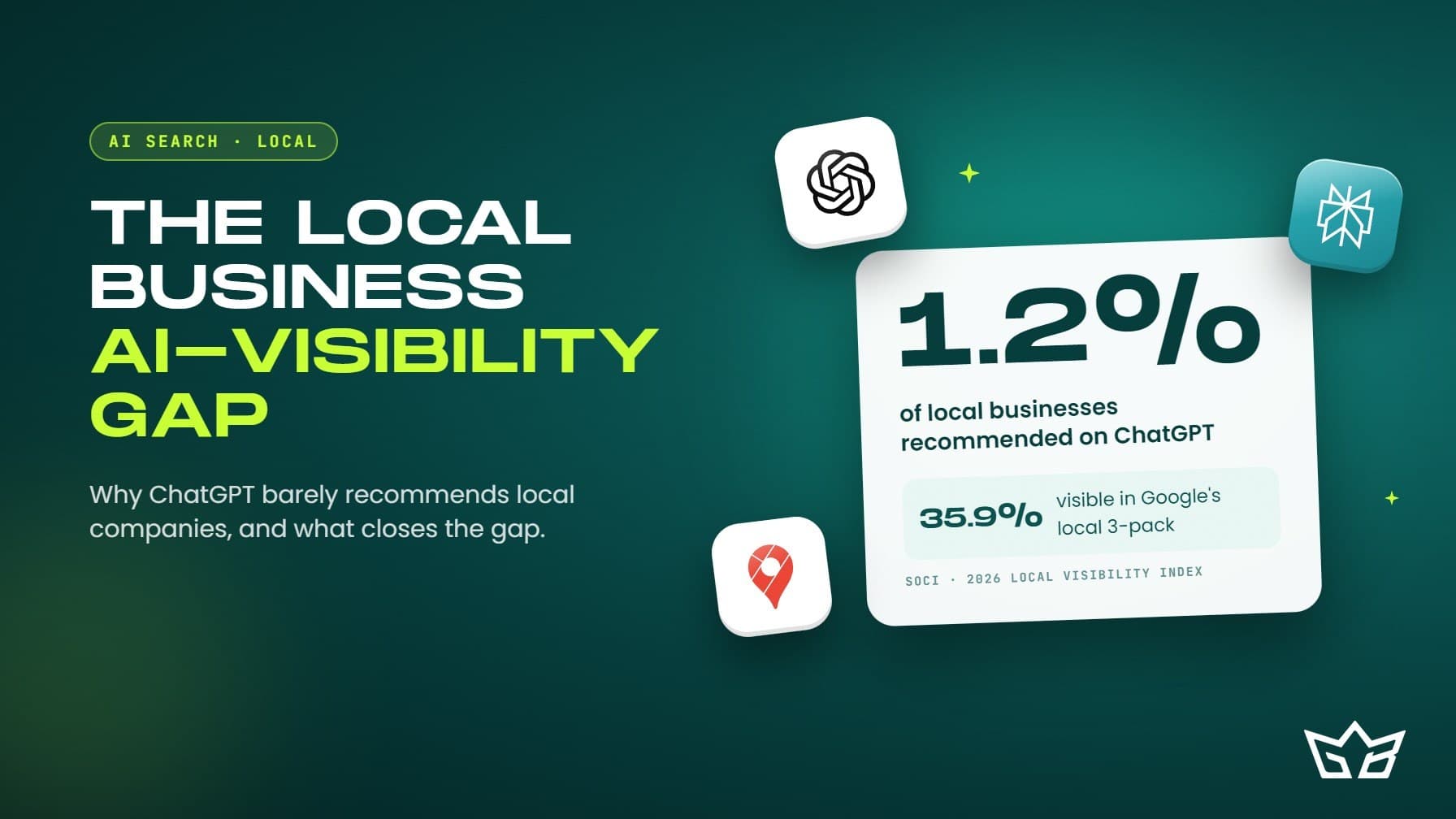
ChatGPT recommends just 1.2% of local businesses. Google's local 3-pack shows 35.9% of them. Here's what the 2026 data says is driving that gap, and what actually narrows it.
If your business shows up in Google's local 3-pack, you'd expect ChatGPT to recommend it too. It almost certainly doesn't.
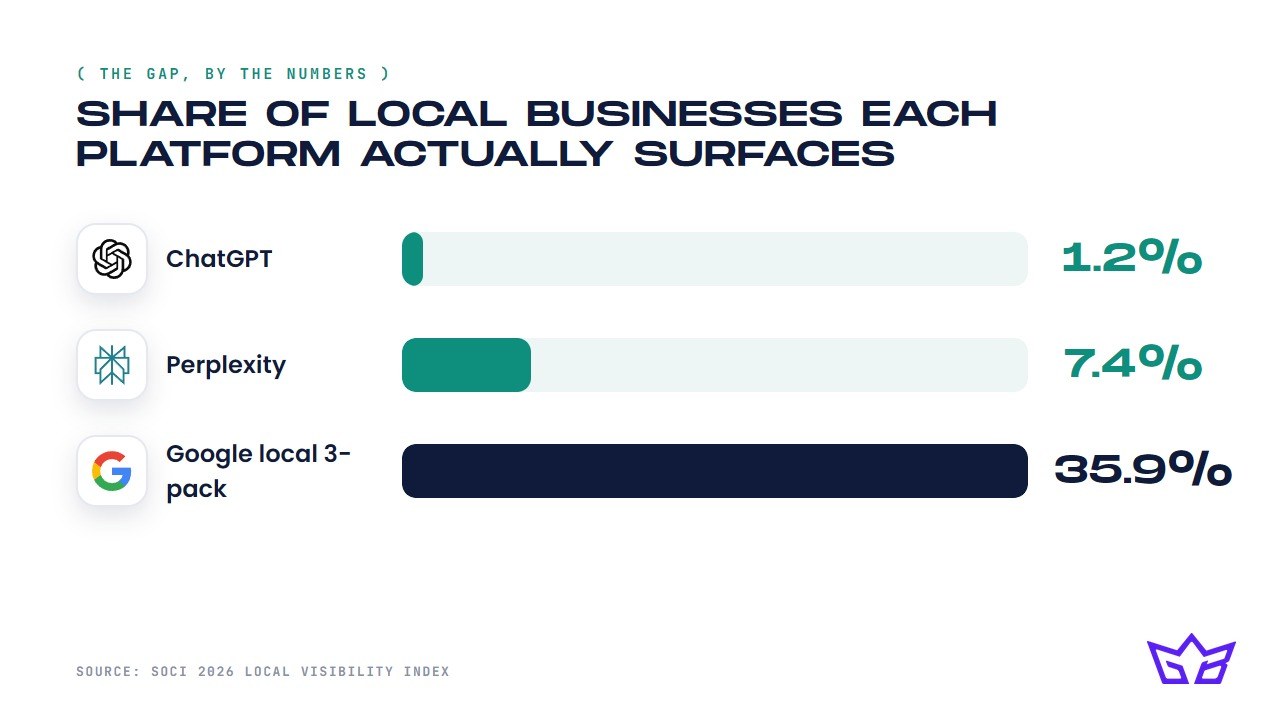
According to SOCi's 2026 Local Visibility Index, AI platforms recommend just 1.2% of local business listings on ChatGPT and 7.4% on Perplexity, compared with 35.9% visibility in Google's local 3-pack for the same categories of business. The study looked at more than 350,000 locations across 2,751 multi-location brands. That's not a small gap. It's two systems making two very different decisions about who deserves to be in front of a customer.
This post is about that specific gap: why it exists, what the data says is driving it, and what a local business can actually do about it. For the fuller picture of AEO, GEO, and LLMO as disciplines, we've covered that separately in our AEO/GEO/LLMO guide, and how we run it for clients is on our AI SEO agency page. This is the narrower, more practical question underneath all of it: why isn't AI recommending businesses that already rank?
The Gap, by the Numbers
The 1.2%, 7.4%, and 35.9% figures above aren't just a recommendation-rate gap, they trace back to a data-accuracy gap. that same SOCi research found business profile information (hours, address, phone number, category) was only about 68% accurate on both ChatGPT and Perplexity, compared with 100% on Gemini. A business can have a flawless Google Business Profile and still get described incorrectly, or skipped entirely, by the AI tool a customer happens to be using.
Ranking well in Google doesn't fully insulate you from this, either. In a study of 15,000 prompts across ChatGPT, Gemini, and Copilot, Ahrefs found that only about 12% of the URLs those assistants cited also appeared in Google's top 10 results for the same query. That's a general search finding, not a local-only one, but it reinforces the same point from a different angle: a strong Google ranking is no longer a reliable predictor of showing up in an AI answer.
Some of the gap also comes down to format, not just data. Google's local 3-pack is a fixed shelf of three listings next to a map, so a business just has to be one of three. A ChatGPT or Perplexity answer to a question like "best plumber near me" is usually a short, conversational list of two or three names, generated fresh for that specific question rather than pulled from a static ranking. Fewer slots, assembled less predictably each time, is part of why the recommendation rate is so much lower even before data quality enters the picture.
Why AI Assistants Barely Recommend Local Businesses
AI assistants recommend so few local businesses because they're pulling from a messier, less centralized set of data than Google's local algorithm, and weighting what they find differently once they have it. Google's 3-pack runs on Google Business Profile and Google Maps data that Google collects, verifies, and controls directly. ChatGPT and Perplexity don't have anything close to that. They're assembling an answer from whatever mix of review sites, directories, news mentions, and crawled web pages happens to be indexed for a given business, and that mix is rarely as clean or as current as Google's own first-party data.
That's also the simplest explanation for why Gemini does noticeably better than the other two. Gemini draws directly on Google Maps data, the same source the 3-pack itself runs on (the same SOCi index put Gemini's own recommendation rate at 11%, well behind Google's own 35.9% but close to ten times ChatGPT's 1.2%). Gemini isn't winning some separate AI-optimization game. It just has access to the one dataset everyone agrees is accurate. ChatGPT and Perplexity are stitching together a lower-fidelity picture from third-party sources, which is where that 68% accuracy figure comes from.
On top of the data-quality problem, AI assistants seem to lean harder on reputational signals, specifically reviews and brand mentions, than Google's local algorithm does. Ahrefs' analysis of 75,000 brands found that how often a brand is mentioned across the web correlated far more strongly with AI Overview visibility (a 0.664 correlation) than backlinks did (0.218). For a local business, the equivalent is how often you're named, reviewed, and talked about across review sites, local press, and directories, not just how many links point at your website.
There's also a more mechanical reason worth knowing about. BrightLocal's research into ChatGPT's search sources notes that ChatGPT's web search leans heavily on Bing's index for a large share of queries, not Google's. A business that has never checked whether Bing can actually crawl and index its site can be invisible to ChatGPT for reasons that have nothing to do with how well it ranks on Google.
For a GTA business, this plays out in a specific way. You might already be the top result in Google for "plumber Etobicoke" or "accountant Mississauga," built on years of local SEO work, and still be a business ChatGPT never mentions when someone in that same neighbourhood asks the same question in a chat window instead of a search bar. The ranking work isn't wasted. It's just answering a different system than the one a growing share of customers are now using first.
The Demand Is Already There. The Supply Isn't.
Consumers have already moved toward asking AI for local recommendations faster than local businesses have adapted to being found there. BrightLocal's 2026 Local Consumer Review Survey found that 45% of consumers said they'd used ChatGPT or another generative AI tool to find a local business in the past year, up from just 6% the year before. That's not a slow trend building over several years. That's a behavior shift inside a single year, and it means a meaningful share of new customers are now forming their first impression of a business, or never finding it at all, inside an AI answer the business has little control over yet.
What hasn't moved at the same speed is which businesses actually get surfaced once someone asks. Reputation is a big part of what still hasn't caught up. AI-recommended businesses skew toward noticeably higher star ratings than the category average, and that kind of rating only holds up at scale when there's a real, substantial, and current review base behind it, not a handful of five-star reviews from years ago. A thin or stale review profile is one of the clearest, most fixable reasons a business that ranks fine on Google still gets passed over by an AI assistant deciding who to name.
Put the two studies together and the picture is straightforward. The audience already trusts AI assistants enough to ask them where to go. Most local businesses simply haven't built the kind of consistent, well-reviewed, visible footprint that gets them chosen once someone does.
What Actually Narrows the Gap
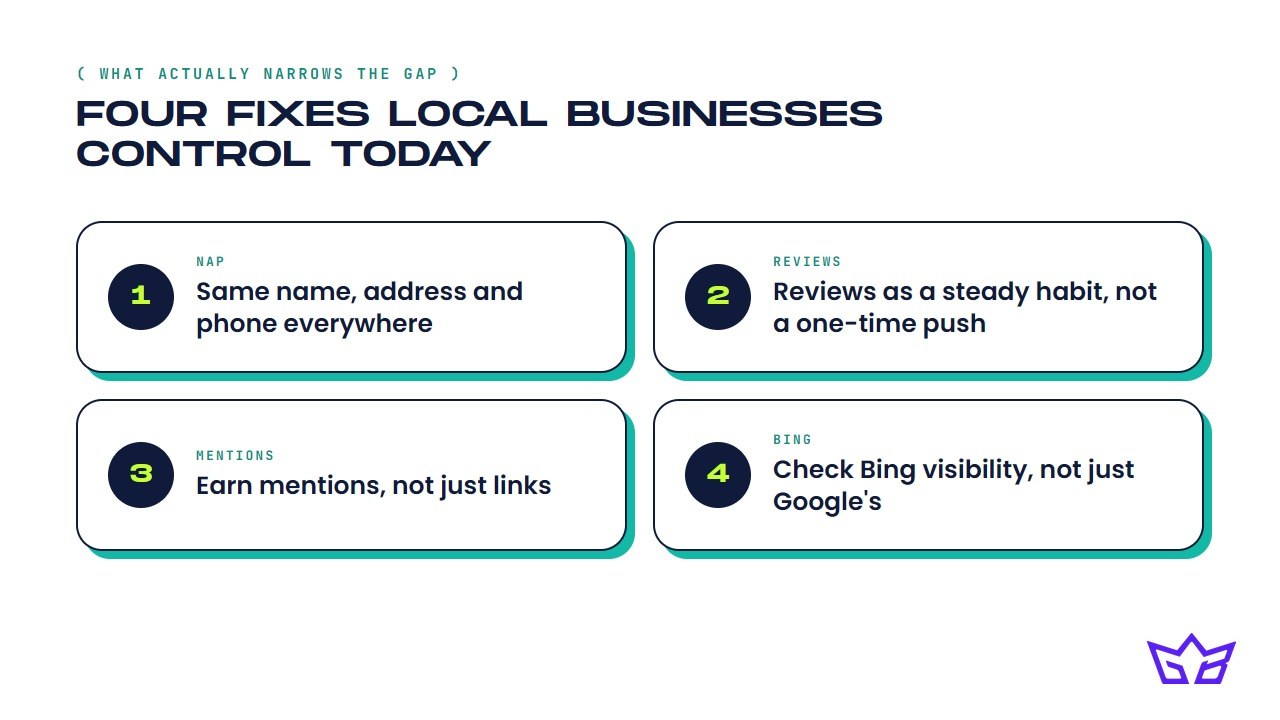
Closing the gap comes down to four things: consistent business data everywhere it appears, a steady flow of new reviews, visible mentions beyond your own website, and making sure the index ChatGPT actually uses can find you in the first place.
Keep your name, address, and phone number identical everywhere
Match your business name, address, phone number, hours, and category exactly across your Google Business Profile, Bing Places, Apple Maps, Yelp, Facebook, and any directory you're listed in. Small mismatches, a suite number here, an abbreviated street name there, are exactly the kind of inconsistency that drags down the data quality AI assistants are working from. It's also the cheapest fix on this list: nobody has to build anything new, you're just making what already exists agree with itself.
Industry-specific and local directories count too, not just the big platforms. If a GTA chamber of commerce listing, a local review site, or an old directory entry still has your previous address or a disconnected phone number, that's one more inconsistent data point an AI assistant might be weighing against you.
Treat reviews as an ongoing habit, not a one-time push
Given how much weight AI assistants seem to put on a business's review profile, a slow and steady stream of new reviews matters more than a single campaign to collect a batch and stop. Ask at the moment a customer is happiest, right after the job's finished or the service delivered, not three weeks later in a generic follow-up email. Make it a routine part of how you close out work, not an occasional push you remember to do every few months.
Earn mentions, not just links
Since brand mentions correlated more strongly with AI visibility than backlinks did, getting your business named in local press, community roundups, and partner sites, even without a link back, carries real weight. Local sponsorships, partnerships with other GTA businesses, guest appearances on local podcasts, and showing up in "best of" roundups all generate exactly this kind of mention, and most of them are relationship-building, not technical SEO work.
Check your Bing visibility, not just Google's
Since a meaningful share of ChatGPT's web search runs through Bing's index, confirm your site is actually indexed in Bing Webmaster Tools, not just Google Search Console. Verification is free and usually takes a few minutes: add your site, verify ownership, and submit your sitemap much the same way you would in Google Search Console. It's a step most local businesses have simply never taken, because nobody thinks to look anywhere other than Google.
You can track whether any of this is working without buying new software. Every month or two, ask ChatGPT and Perplexity the exact question a customer would, such as "best [your service] in [your city]," and note whether you're named, misnamed, or missing. It isn't a precise measurement (AI answers vary from one session to the next) but checked regularly it will show you the trend that matters: whether you're starting to show up more often, less often, or not at all.
None of this is a fix you make once and move on from. The businesses with consistent data, steady reviews, and real mentions are the ones showing up when someone asks an AI assistant where to go, and that position needs to be maintained, not just reached.
If you want a second opinion on where your business actually stands, that's exactly what our free AI visibility audit covers, part of our AI SEO services alongside our local SEO work, including for businesses competing specifically in the Toronto and GTA market. If your broader SEO foundation needs attention too, that's a longer conversation, but the fixes above are where local AI visibility specifically starts. Or just get in touch, we'll tell you honestly if it's worth the investment for your situation.
Frequently asked questions
Why does ChatGPT recommend so few local businesses compared to Google?
Mainly because of data quality. ChatGPT and Perplexity assemble local answers from inconsistent third-party sources instead of one authoritative dataset, and SOCi's 2026 Local Visibility Index found business profile accuracy of only about 68% on both platforms, well below Google's own data.
Does ranking in Google's local 3-pack mean a business will also show up in ChatGPT or Perplexity?
No. The two systems reward different signals. Ahrefs found that across a broad set of search queries, only about 12% of the URLs cited by AI assistants also ranked in Google's top 10 for the same prompt, so a strong Google ranking doesn't carry over automatically.
Why does Gemini recommend local businesses more often than ChatGPT or Perplexity?
Gemini draws directly on Google Maps data, the same first-party source that powers Google's own local 3-pack, so its business information is far more consistently accurate. ChatGPT and Perplexity have to piece together a picture from third-party sources instead.
What's the biggest factor separating businesses AI recommends from businesses it ignores?
Reputation signals, reviews and brand mentions in particular, appear to matter more than classic ranking factors. Businesses AI assistants recommend skew toward meaningfully higher star ratings than the category average, and that kind of rating only holds up with a real, current base of reviews behind it, not a handful collected once and left alone.
Will adding an llms.txt file or AI-specific schema markup get a business recommended by ChatGPT?
Not based on what's been reported so far. Google has stated llms.txt doesn't factor into Search rankings or AI Overviews, and no special schema markup guarantees AI citation. Data consistency, review volume, and brand mentions are what actually correlate with AI visibility.
What can a local business do to close the AI visibility gap?
Keep your business name, address, phone number, and hours identical across every platform and directory, build a steady flow of new reviews rather than a one-time push, earn mentions from local press and community sites, and confirm your site is indexed in Bing Webmaster Tools, since a large share of ChatGPT's web search runs through Bing.
Reviewed by Gabriel Narsaik under our editorial policy.