Why Isn’t Your Business Showing Up in ChatGPT? A 10-Minute Diagnostic
If you've asked ChatGPT about your own business and gotten nothing, or a competitor's name instead, you're not imagining it. Here's the 10-minute diagnostic: five checkable, fixable reasons it happens, in the order they're most likely to be the actual cause.
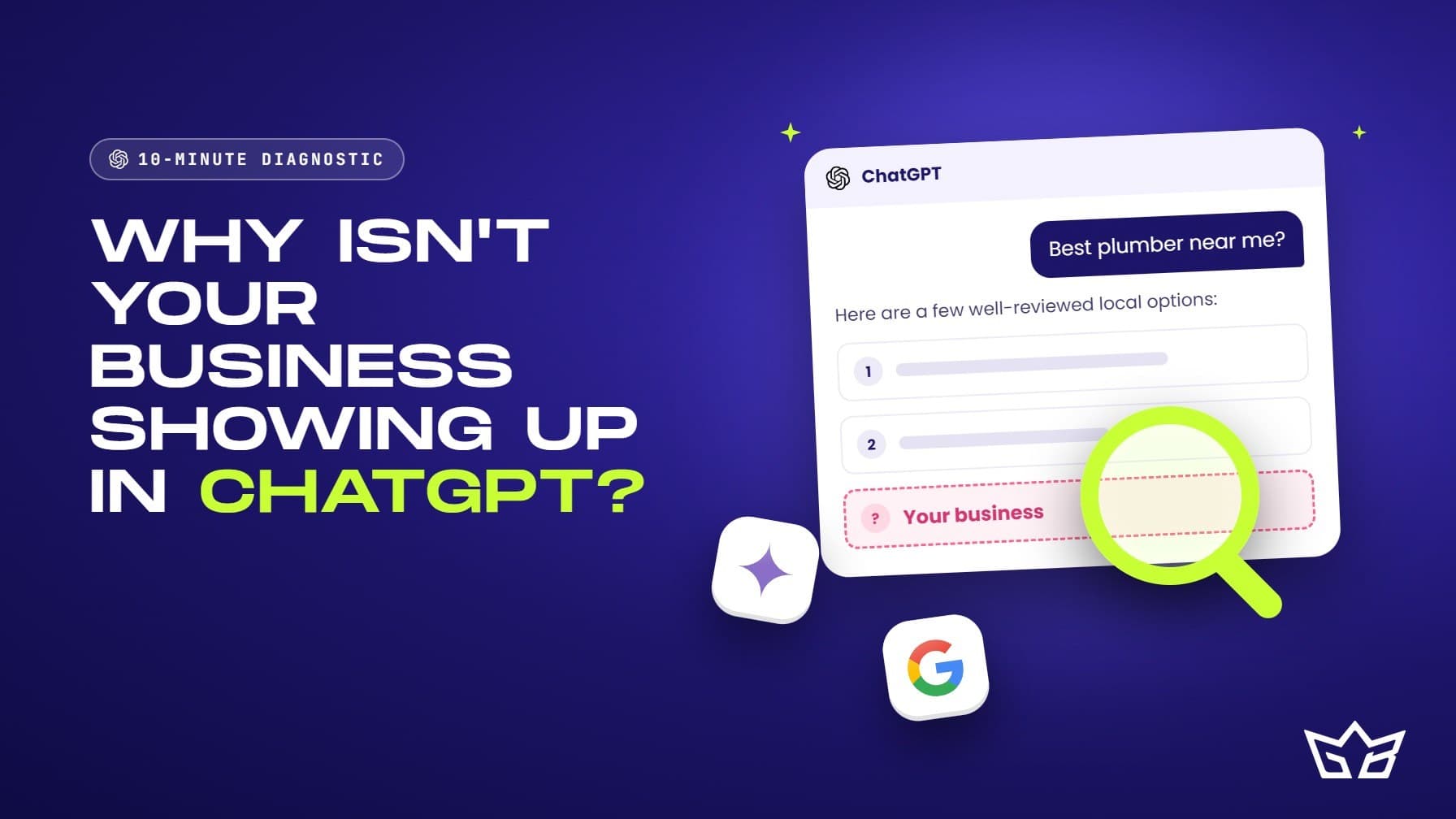
If you rank well on Google and still get nothing when you ask ChatGPT about your own business, that is not a contradiction, it is how the system actually works. Ahrefs analyzed 15,000 prompts across AI assistants, including ChatGPT and Perplexity, and found that the sources they cite overlap with Google's top 10 results for that same query by an average of just 12%. Ranking well in Google buys you almost nothing in ChatGPT specifically: they are different systems, built on different indexes, with different rules for who gets mentioned.
That is actually useful news, because it means the problem almost certainly isn't "your business isn't good enough." It is one of a small number of checkable, fixable issues. Here is the ten-minute version: five things to check, in the order they are most likely to be the actual cause, starting with the mistake most business owners make before they even run a real test.
This post is deliberately narrow. It is a diagnostic for one specific symptom, not a full strategy. If you want the complete picture of how AI answer engines pick sources and the longer plan behind it, we cover that in our AEO, GEO and LLMO guide, and our AI SEO agency page shows how we run it for clients. Everything below is just the fastest way to find out why your business, specifically, isn't showing up.
Start by testing it properly, most people don't
The single most common reason a business owner thinks ChatGPT "doesn't know them" is that they tested it wrong, not that they are invisible. Typing your business name into the free ChatGPT box without web search turned on just queries the model's training data, a static snapshot that may be a year or more old and was never meant to work as a live business directory. That is not the test that matters.
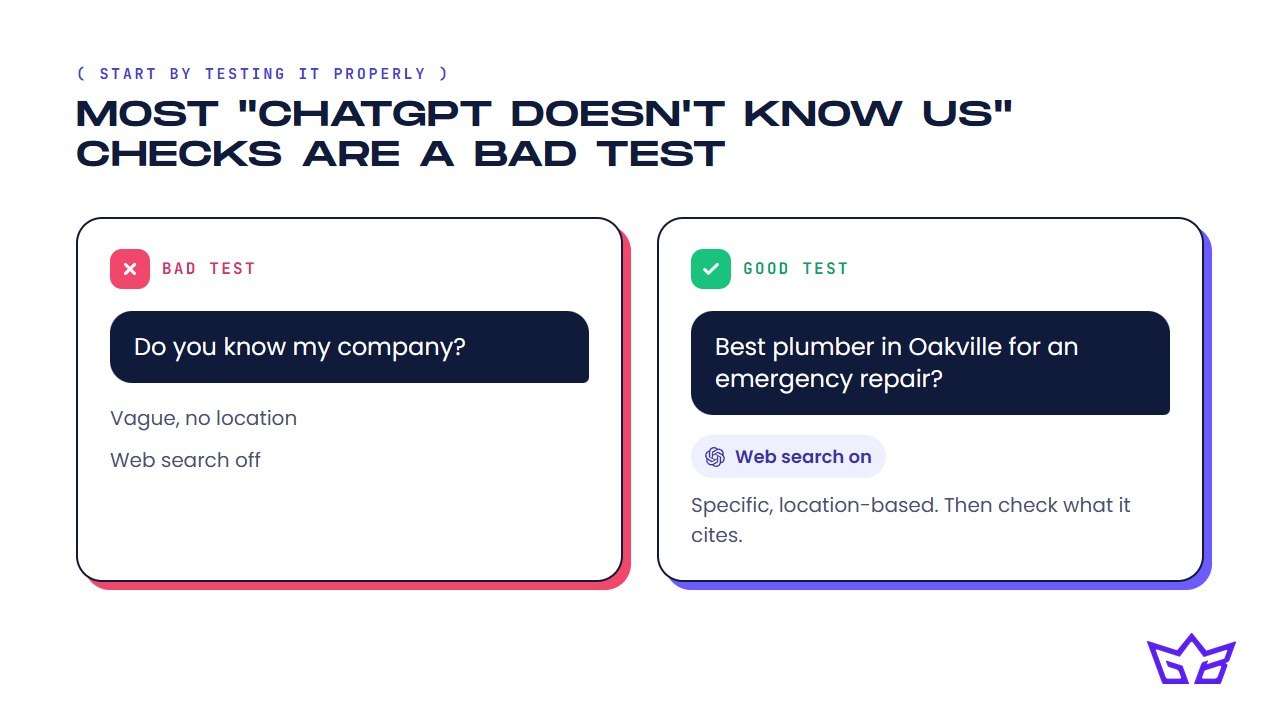
Run two tests instead. First, turn on web search (the globe or "Search" option in ChatGPT, or simply ask it to search the web) and ask the way a real customer would, not "tell me about [Your Business]" but something like "best [your service] in [your neighbourhood or city]" or "[your service] open near [a landmark]." That is the query that actually competes for a citation. Second, look at whether the answer cites anything at all: ChatGPT shows small source links next to claims it pulls from the live web. If it answers confidently with zero citations, it is reciting generic training knowledge rather than reading current local results, and the fix for that is different from "not winning the citation."
If, after a properly phrased, web-search-enabled, location-specific question, the answer still names other businesses and never yours, work through the checks below in order. They are sorted by how common the cause tends to be and how quickly you can check it yourself.
Check your robots.txt for a blocked search crawler
The fastest check on this list takes about ten seconds: open yourdomain.com/robots.txt in a browser and look for a line disallowing OAI-SearchBot. If it is there, you likely have your answer. OpenAI's own crawler documentation is explicit that a site opted out of OAI-SearchBot will not be shown in ChatGPT's search answers, regardless of how well that site ranks anywhere else.
This happens more often than you would expect, and rarely on purpose. A broad rule meant to block scrapers, a security plugin, or a web application firewall can catch OAI-SearchBot by accident along with whatever it was actually meant to stop. While you are checking, note that OAI-SearchBot is a different crawler from GPTBot: GPTBot controls whether OpenAI can use your content to train future models, while OAI-SearchBot controls whether ChatGPT can cite you in a live search answer right now. Blocking GPTBot does not hurt your visibility in ChatGPT's search feature. Blocking OAI-SearchBot does, so check which one, if either, your site is actually disallowing before you change anything.
Check that Bing has actually indexed you, not just Google
If robots.txt is clean, the next most common gap is Bing, not Google. ChatGPT's search feature has long relied heavily on Microsoft Bing's index under the hood, so a site that ranks well on Google but has never been properly indexed by Bing can be functionally invisible to ChatGPT even with a perfect robots.txt file.
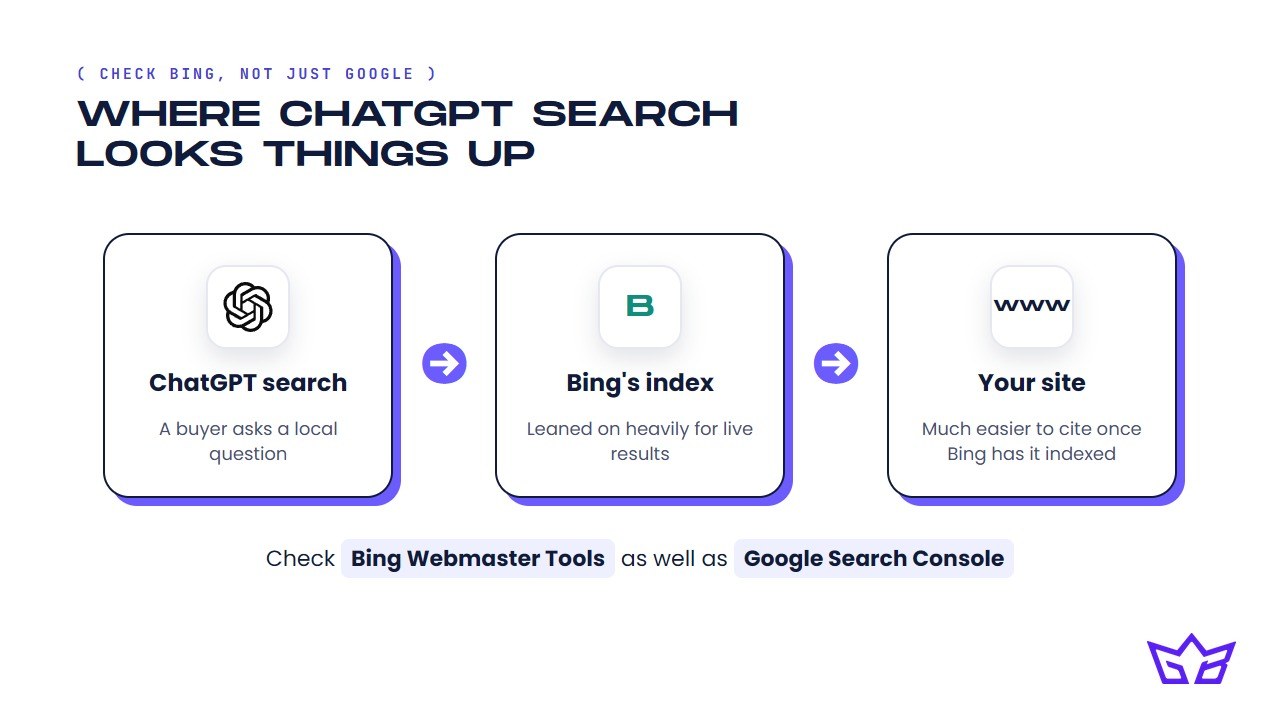
Check this two ways. Quick version: search site:yourdomain.com directly on Bing.com and see whether your key pages show up at all. Proper version: sign up for Bing Webmaster Tools, which is free, verify your domain, and check the indexing report. It will show exactly how many of your pages Bing has actually crawled and lets you submit your sitemap directly if that number looks low. Most businesses set this up for Google Search Console years ago and never touched the Bing equivalent, because historically Bing did not matter much for organic traffic. It matters now.
Check your review volume, and whether it has stalled
If the technical checks come back clean, reviews are the next place to look, and the number that matters most is volume and recency, not just your star rating. AI assistants use a business's review profile as a trust signal when deciding whether to mention it: a thin or stalled count reads as risk, a healthy, actively-growing one reads as a real, currently-operating business worth recommending. It is a gap in activity more than in quality: on this logic, a solid business with a handful of old reviews is a less confident recommendation than an average one with a large, recent base.
While you are checking the count, check the dates too. If your most recent review is a year or more old, fix that before anything else on this list: message your last few happy customers today and ask directly for a Google review. It costs nothing, takes one message, and a thin or stalled review profile is one of the easiest problems on this entire page to fix.
Check whether anyone else actually talks about you online
The last and often most revealing check is whether your business is mentioned anywhere other than your own website. Ahrefs' study of 75,000 brands found that brand mentions across the web, whether or not they link back to you, correlate with showing up in Google's AI Overviews far more strongly than backlinks do: 0.664 for mentions versus 0.218 for backlinks. A link tells an algorithm you exist. A mention, in a local news story, an industry roundup, a partner's page, a community listing, tells it that other people think you are worth talking about, and that appears to carry real weight with systems trying to decide who to recommend.
Search your business name in quotes, add -site:yourdomain.com to exclude your own pages, and see what actually comes back. If the honest answer is "nothing, just my own website and my Google Business Profile," that is a real and fixable gap, but it is a slower project than the checks above: it means actually getting talked about elsewhere (local press, sponsorships, supplier or partner pages, industry directories, guest contributions), the kind of broader SEO and digital visibility work most businesses eventually need alongside anything purely local.
Why this feels so hard right now: it actually is
If you have worked through all five checks and fixed what you found, and you are still barely showing up, that is not a sign you did something wrong. It is a sign of where the entire local-business category sits right now. BrightLocal's 2026 Local Consumer Review Survey found that the share of consumers using ChatGPT and other generative AI tools for local recommendations jumped from 6% to 45% in a single year, becoming the third most popular source of local recommendations.
The supply side has not caught up with that shift. SOCi's 2026 Local Visibility Index, which studied more than 350,000 business locations, found that brands appear in Google's local 3-pack 35.9% of the time on average, while only 1.2% of locations are recommended by ChatGPT and 7.4% by Perplexity. AI platforms are not running a smaller version of the same local-search game Google plays. They are running a far more selective one, and most businesses, including plenty that rank well, have not been built for it yet.
None of that is a reason to panic. It is a reason to treat this as what it actually is: an early, structural gap in a category that is moving fast, which means the businesses that close it now get a real, compounding head start over the ones that wait. It is the same pattern we see constantly in our work with Toronto-area businesses: the ones who fix the basics early keep showing up months before their competitors even run the test in this article.
If you have worked through everything above, you likely already know whether this is a ten-minute fix or a longer project for your business. Either is fine. Our AI SEO services and local SEO service are built around exactly these signals, profiles, reviews, citations, indexing, if you would rather have someone else run the full audit and fix what it finds. Or just get in touch and we will tell you honestly whether it is worth paying for in your specific case.
Frequently asked questions
Why doesn't ChatGPT know about my business if I rank well on Google?
Because ranking in Google and being cited by ChatGPT are different systems with different indexes and different selection rules. Ahrefs found that across AI assistants like ChatGPT and Perplexity, only 12% of the links they cite also rank in Google's top 10 for the same query, so a strong Google ranking is not a reliable predictor of AI visibility. Technical factors, like a blocked search crawler or missing Bing indexing, and reputation factors, like review volume and brand mentions, matter more.
What is OAI-SearchBot, and how do I check if I'm blocking it?
OAI-SearchBot is the crawler that determines whether ChatGPT can cite your site in a live search answer. Check by opening yourdomain.com/robots.txt in a browser and looking for a line that disallows OAI-SearchBot. If it's there, that's very likely why you're not showing up, independent of how your site ranks elsewhere.
Does blocking GPTBot stop my business from appearing in ChatGPT?
No. GPTBot only controls whether OpenAI can use your content to train future models, it has no effect on whether ChatGPT cites you in a search answer today. That's controlled separately by OAI-SearchBot, so check which crawler your robots.txt actually disallows before assuming either one is the problem.
How many Google reviews do I need to show up in ChatGPT or Perplexity?
There's no official minimum. What matters more than hitting a specific number is having a substantial, active review profile: a thin count or a long gap since your last review is one of the more common patterns among businesses AI assistants skip over. Recency counts too, reviews from the last few months read very differently to a model than a page of reviews that are all a few years old.
Does adding an llms.txt file help my business get cited in ChatGPT?
Not based on Google's own guidance. As Search Engine Journal reported, Google's Search documentation states plainly that llms.txt isn't needed for AI Overviews, AI Mode, or other generative AI search features, and no major AI provider has confirmed that its assistant uses the file to decide what to cite. A clean robots.txt, solid Bing indexing, and real reviews and mentions do far more for visibility.
Is it just my business, or is this happening to everyone?
It's structural, not personal. SOCi's 2026 Local Visibility Index found that, averaged across industries, Google's local 3-pack surfaces 35.9% of businesses, while ChatGPT recommends just 1.2% and Perplexity 7.4%. AI platforms are far more selective than traditional local search right now, which is exactly why fixing the checkable basics early is such a meaningful head start.
Reviewed by Gabriel Narsaik under our editorial policy.