Paid Media Agency: How to Pick the Right Google and Meta Ads Partner
Hiring a paid media agency in Canada? When to start with Google or Meta, the questions to ask, what the report should show, and real fees.
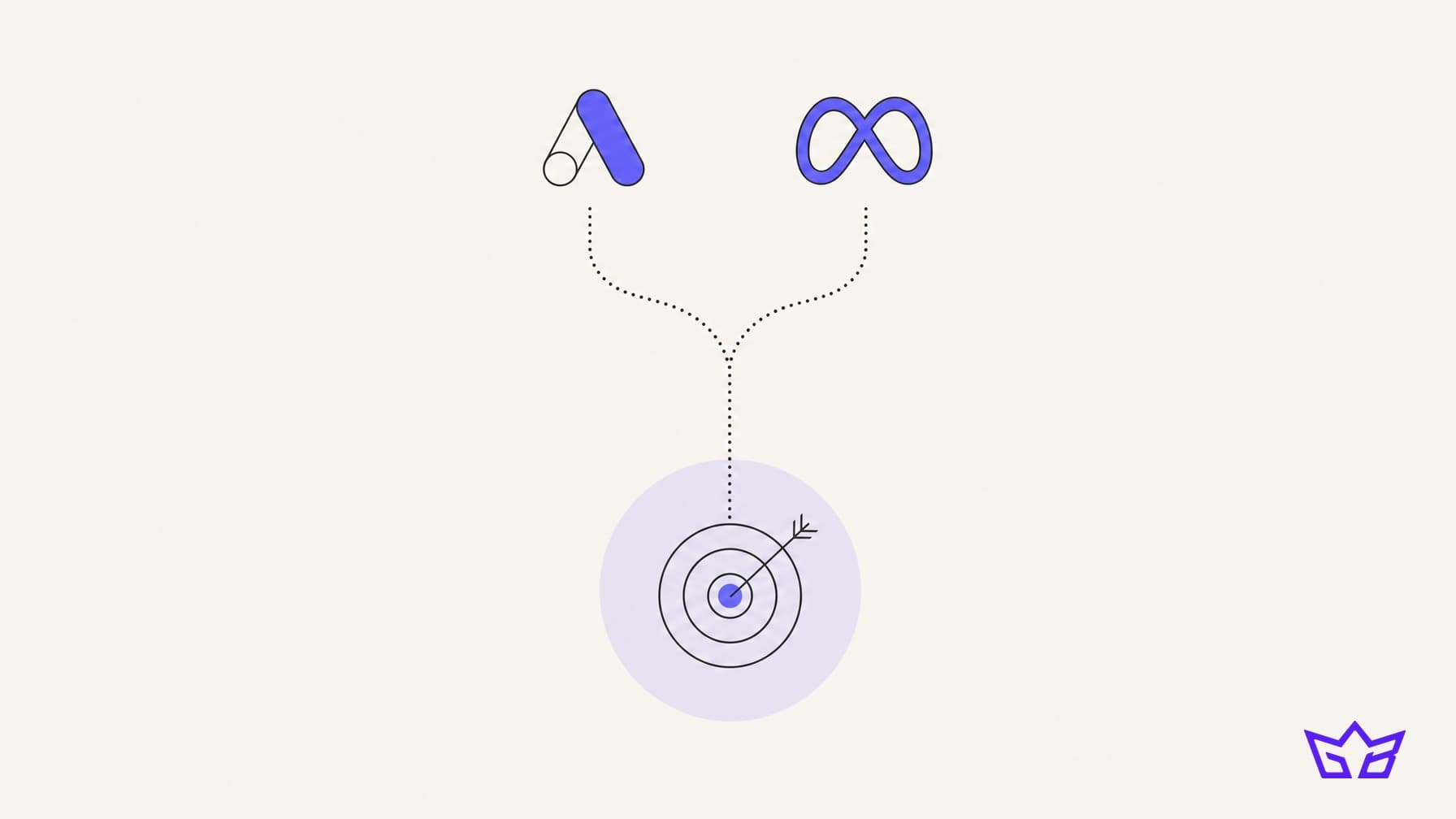
Most businesses hire a paid media agency backwards. They pick the agency first, then let the agency pick the platform, and it usually picks the one it knows best. A shop built on Google search finds a reason you need more search. A shop built on Instagram creative tells you your customers live on Meta. Neither is a neutral answer.
So flip the order: decide which job you need done first, vet the agency against that job, then check the report, the access and the fee. That holds whether you are comparing a PPC agency in Toronto, a paid social agency or a full-service shop.
What a paid media agency does
A paid media agency plans, buys and manages the ads you pay for: Google Search, Shopping, YouTube and Performance Max on one side, Facebook and Instagram on the other, sometimes LinkedIn or TikTok. You pay the agency a management fee. The ad spend goes straight to the platforms.
You will meet three kinds of shop:
- The search specialist. Usually sold as a PPC agency. Strong on keywords, conversion tracking and Shopping feeds. Often weak on creative, because a search ad is mostly text.
- The paid social shop. Sold as a Meta ads agency or paid social agency. Strong on video, offers and creative testing. Often thin on search and on tracking past the platform.
- The full-funnel paid media agency. Runs Google and Meta under one strategy and one report, so one person decides where the next dollar goes.
The label on the website matters less than who will be inside your account every week. Ask for that person's name, how many accounts they run, and whether they work both platforms or hand you between two teams.
Google first or Meta first?
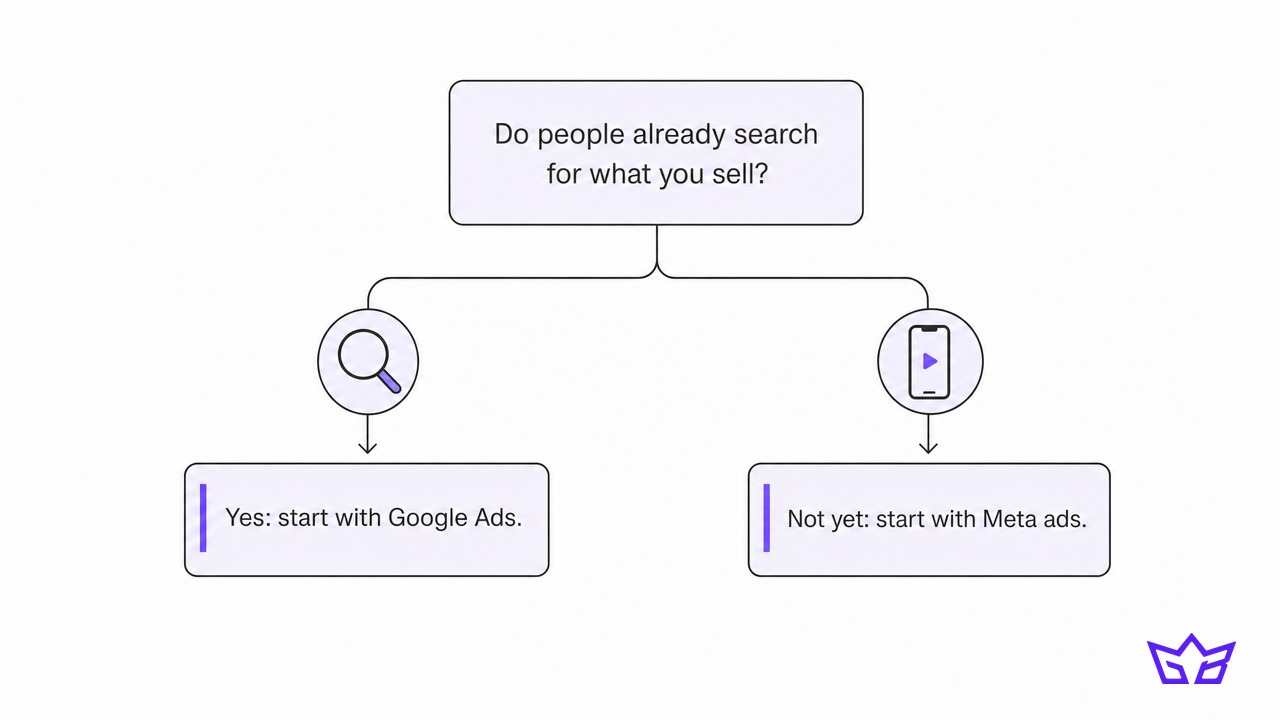
Google Ads catches people who are already looking. Meta puts you in front of people who were not looking yet and gives them a reason to care. We covered splitting a budget across both in where your Meta vs Google ad budget should go, so here is the narrower question: which agency do you hire for first?
Run this 20 minute check before you take a single sales call.
- Open Google Keyword Planner. It is free inside any Google Ads account. Type five phrases a customer would use to find you and set the location to your city or Ontario. If "furnace repair Oakville" shows steady monthly searches, demand already exists and you want a Google Ads agency in Toronto and the GTA that can capture it.
- Ask whether your product sells on sight. A new skincare line or a product category nobody has heard of gets close to zero searches, yet a 10 second video can still make someone want it. That is a job for a Meta ads agency.
- Check your budget against two platform minimums. At Growth Boss we ask for at least $500 a month of spend on Google and $750 a month on Meta. If you cannot fund both, pick one and do it properly before adding the second.
In practice, service businesses with search demand (plumbers, dentists, accountants, B2B distributors) start on Google and add Meta retargeting once search is profitable. Ecommerce brands and new categories start on Meta, with Google Shopping and branded search underneath to catch the people Meta sends.
Vetting a Google Ads agency
The Google job changed this year. Google started auto-upgrading campaigns that use automatically created assets or campaign-level broad match to AI Max for Search in September 2026, and says Dynamic Search Ads will begin their automatic upgrade in February 2027. AI Max matches your ads to searches you never chose as keywords, and can rewrite headlines and pick landing pages on its own.
Three questions are worth more than any case study slide:
- "What will you do with AI Max in my account?" A serious answer names the controls. Google's AI Max documentation lists brand inclusions and exclusions, URL inclusions and exclusions, and locations of interest. An agency that cannot name two of those has not opened the settings.
- "What counts as a conversion for us?" You want to hear qualified leads, calls over a set length or purchases with real values, plus a plan to send closed sales from your CRM back to Google.
- "What happens in month one?" Get it in writing. We laid out what Google Ads management services should include each month.
If an agency's AI Max answer is "we turn it off", ask why. If it is "we turn it on", ask what they exclude. You want a reason, not a habit.
Vetting a Meta ads agency
On Meta, automation took targeting off the table. Meta says its Advantage+ campaigns apply AI across "audience, placement and budget", with versions for sales, leads and app installs. Meta reports a 20% improved CPA for Advantage+ sales campaigns and a 10% lower cost per qualified lead for Advantage+ leads campaigns. Those are Meta's own figures, so treat them as the pitch, not a promise.
If the algorithm picks the audience, the ads themselves become the targeting. Meta's engineering team wrote in December 2024 that more than a million advertisers used its generative AI tools to create more than 15 million ads in a single month, and introduced a new ad retrieval system, Andromeda, built for that growing pile of ads. Your competitors are feeding it fresh creative every week.
Three questions for any Facebook advertising agency
- Who makes the ads, and how many new ones go live each month? If the answer is "send us your photos", you are the creative department. Our Meta Ads management includes up to 4 paid ads a month. Hold any agency to a number, not "as needed".
- Will you set up the Conversions API? It sends events from your server or CRM to Meta, including offline sales. That is how Meta learns which leads became customers instead of rewarding the cheapest form fills.
- How will you keep lead quality up? Cheap instant form leads who never pick up the phone are the classic Meta trap. Expect talk of qualifying questions, follow-up speed and cost per qualified lead.
The report you should demand
Running two platforms has a catch: each one grades its own homework. A customer sees your Reel on Tuesday, searches your name on Friday and buys. Meta counts the sale. Google counts the sale. Your bank account counts it once.
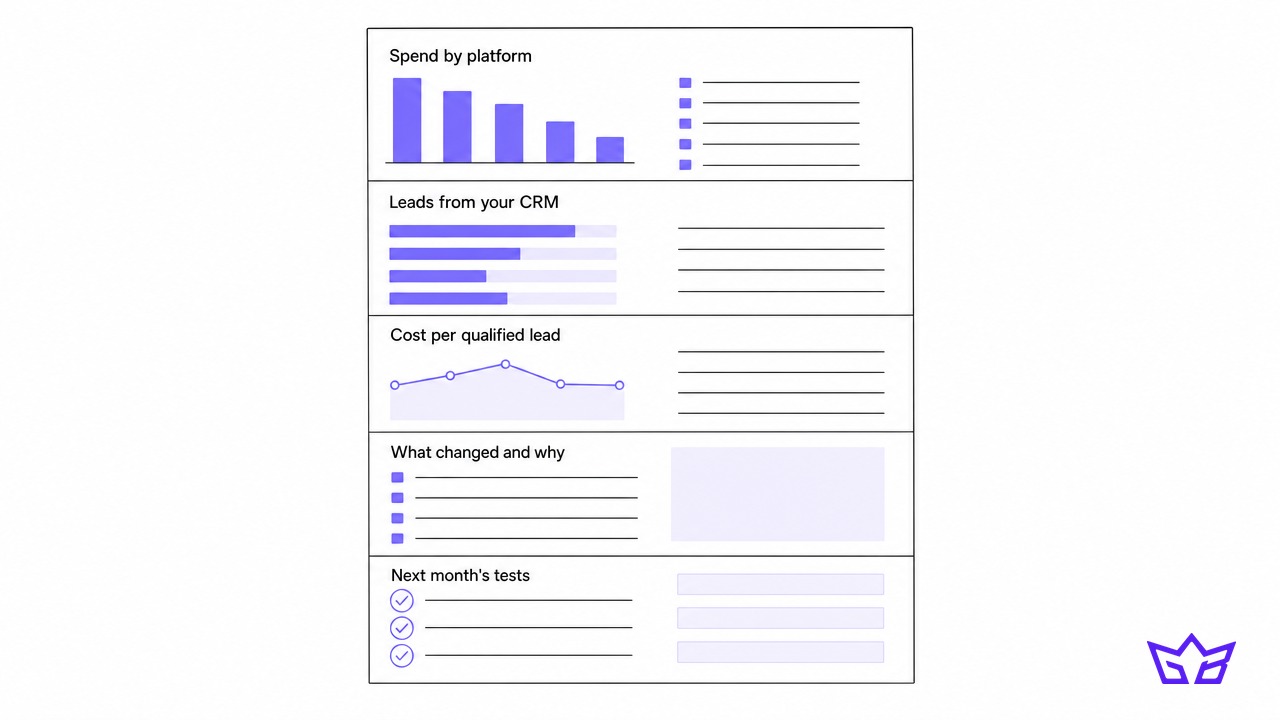
So a good paid media agency reports from your numbers, not theirs. Every month you should get one page with:
- Spend by platform, and the total.
- Leads or orders from your CRM or store, such as HubSpot, GoHighLevel or Shopify, not platform-reported conversions.
- Cost per qualified lead or per customer, blended and split by platform.
- What changed and why, one dated line per change.
- Next month's tests: new ads, keywords or landing pages.
If Google and Meta together claim more conversions than you received, the report should say so. For example, if Google reports 40 conversions and Meta reports 35, but your CRM shows 52 new leads, at least 23 conversions were counted twice. A report built only on dashboards describes activity.
Red flags to walk away from
Most bad agency relationships show their problems before the contract is signed.
- They run your ads from their own accounts. On Google, the ad account sits under your login and the agency links in through its manager account. On Meta, your ad account, Page and pixel belong in your own business portfolio, and the agency gets partner access. If they leave, you keep the history.
- No logins, only PDFs. You should be able to open Google Ads or Ads Manager and see your own campaigns any day you like.
- A percentage of spend fee across both platforms, with no cap. Every recommendation to spend more is also a raise. Ask what happens to their fee if they tell you to cut.
- No creative in the Meta scope. Managing Meta without making ads is half the job.
- A long lock-in before you have seen a report. A three-month minimum is reasonable (ours is three months, then 30 days' notice). A 12 month contract signed before any results is a bet placed with your money.
What it costs in Canada
You pay two bills: the agency's management fee, and the ad spend you pay Google and Meta directly. Fees come as a flat monthly amount, a percentage of spend or a hybrid, so compare the total at your real budget, not the headline rate. To size the media side, see what Google Ads cost in Canada.
Here is ours, from the live Growth Boss packages and pricing page, in CAD with taxes extra:
- Google Ads management: $750 a month. Campaign setup, monitoring and analysis. Ad spend paid to Google directly, minimum $500 a month.
- Meta Ads management: $750 a month. Up to 4 paid ads a month, managed end to end. Ad spend paid to Meta directly, minimum $750 a month.
- Both, inside the Conversion plan: $2,500 a month paid quarterly in advance, or $2,875 billed monthly. It includes Meta Ads and Google Ads management, up to 4 paid ads a month, a paid media strategy and a monthly paid media report, alongside up to 6 social posts a week.
Run both platforms as add-ons and your floor is $1,500 a month in fees plus $1,250 a month in media. If the fee is bigger than the media, you are paying more for oversight than for ads, so start with one platform and grow into the second.
Your next step
Before you talk to any agency, including us, do two things this week: run the Keyword Planner check above, and write down what one new customer is worth to you. Those two numbers tell you which platform to start with and what you can afford per lead. Any agency worth hiring will ask for both.
Then compare how our Facebook advertising agency and Google Ads agency services work, and get in touch with your numbers. We will tell you honestly whether to start with Google, Meta, or neither yet.
Frequently asked questions
What is a paid media agency?
A paid media agency plans, buys and manages your paid advertising on platforms like Google Ads, Facebook and Instagram. You pay the agency a management fee and pay the ad spend to the platforms directly. A good one owns the strategy across platforms and reports from your own sales data.
How do I choose a paid social media advertising agency?
Start with who makes the creative and how many new ads go live each month, because on Meta the ads now do most of the targeting. Then confirm your ad account, Page and pixel stay in your own business portfolio, and ask whether they will set up the Conversions API. If their sample report leads with reach and likes instead of qualified leads or sales, keep looking.
What is a paid media agency for ecommerce?
It is a partner that runs ads tied to your product catalogue: Google Shopping and Performance Max fed from Google Merchant Center, plus Meta catalogue ads for prospecting and retargeting. The extra work is the product feed, since its titles, images and prices decide which products show. Ask who fixes feed errors and how often.
What is an AI paid media agency?
Usually an agency that leans on the platforms' own automation, such as Google's AI Max and Meta's Advantage+, plus AI tools for creative and reporting. Every serious agency uses these now, so the label tells you little. Ask what they do that automation cannot: define a conversion, send CRM data back, make new ads and decide what not to advertise.
How much does a paid media agency charge in Canada?
Fees are a flat monthly amount, a percentage of ad spend or a hybrid, with ad spend paid separately to the platforms. Growth Boss charges $750 a month for Google Ads management and $750 a month for Meta Ads management, in CAD with taxes extra. Both are also included in our Conversion and Super Growth plans.
Should I start with Google Ads or Meta ads?
Start with Google Ads if people already search for what you sell, because you are catching buyers who are ready to act. Start with Meta if your product sells on sight but few people search for it yet. If you cannot cover both platform minimums, pick one and do it properly first.
Reviewed by Bahaa Zuraik under our editorial policy.