Google Ads Management Services: What You Should Get Every Month
What Google Ads management services should deliver month by month, the three pricing models worked out at real spend, and what you must own.
Most Google Ads management services are sold on a promise and billed on a mystery. You sign, you pay a monthly fee, and 30 days later you get a PDF full of impressions and clicks that says nothing about whether the phone rang. The fix is not a cheaper agency. It is knowing what the work should look like each month, so you can check it.
Here is the work good Google Ads management services deliver, stage by stage: onboarding week, month one, months two and three, and every month after. Then the three ways PPC services are priced (with the math at real spend levels), what you must own no matter who runs the account, and the honest case for not hiring anyone yet.
Onboarding Week: The Unglamorous Work That Decides Everything
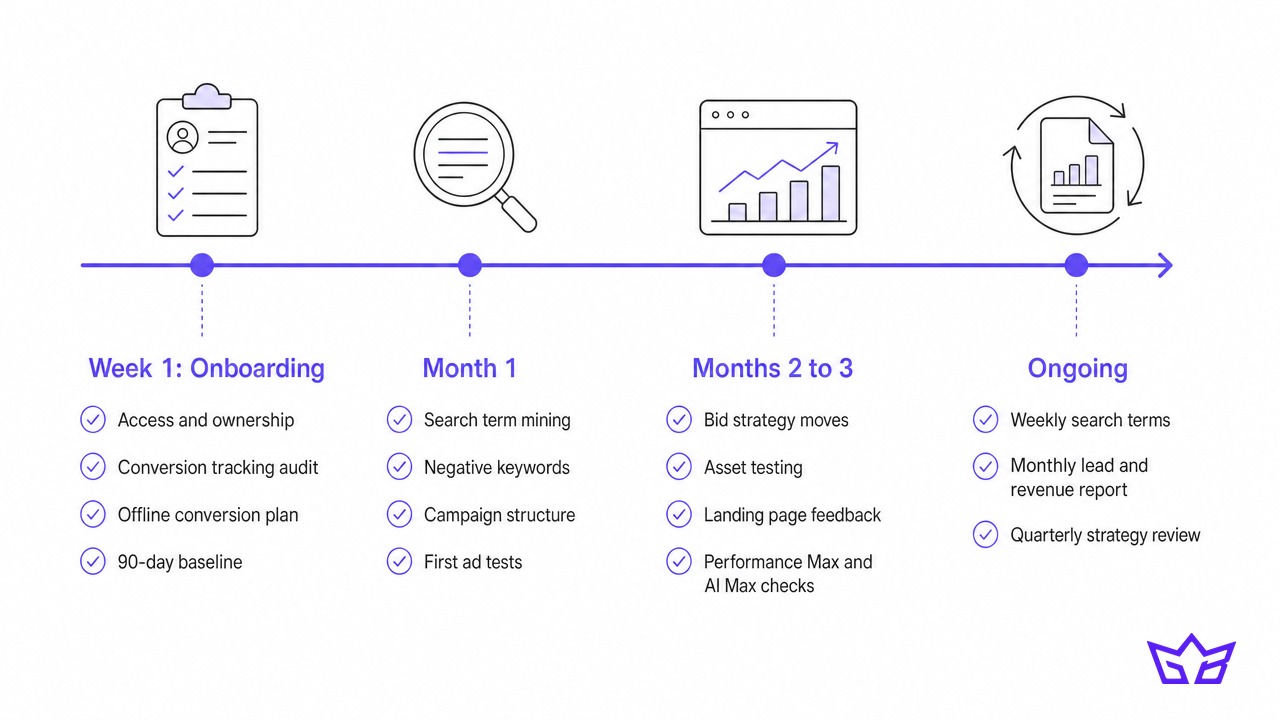
The first week of good Google Ads management should produce almost no visible change in your ads. That is a good sign. The work is plumbing, and if it gets skipped, every later month is built on bad data.
Here is what should happen in the first five to seven business days:
- Access set up properly. The agency links its manager account to yours, or you add them as a user. You stay the owner (more on that below).
- A conversion tracking audit. Which actions count as conversions today? We regularly find accounts counting page views, contact page visits or duplicate form fires as conversions, which teaches Google to hunt for the wrong people.
- Conversions rebuilt around money. Qualified form fills, calls over 60 seconds, scheduled jobs, purchases with real values. Each one gets a value that reflects what it is worth to you.
- An offline conversion plan. If your sales close on the phone or in a CRM, Google needs to hear which clicks became customers. Google's offline conversion imports exist for exactly this: the Google Click ID is saved with the lead, and when that lead signs, the conversion goes back to Google Ads. Google now recommends the upgraded version, enhanced conversions for leads, and reports a median 10% more measured conversions than standard imports.
- A written baseline. The last 90 days of cost per lead, by campaign. Without a starting number there is no way to judge month three.
If your onboarding call never includes the question "what is a customer worth to you?", the agency is about to optimize your account toward something other than revenue.
Month One: Clean the Signal and Stop the Leaks
Month one is about waste. Nearly every account we inherit is paying for searches it should never have appeared on, and the search terms report is where you find them.
- Search term mining, at least weekly. Your manager reads the actual queries people typed, not just the keywords you bid on. A roofer bidding on "roof repair" will find itself paying for "roof repair jobs", "DIY roof repair" and "roof repair shingles Home Depot". Each one becomes a negative keyword.
- A negative keyword foundation. Jobs, careers, free, DIY, training, competitor names you do not want, and places you do not serve. A few hundred negatives by the end of month one is normal for a service business.
- Structure that matches how you sell. One campaign per service line or margin tier, not one campaign for everything. If drain cleaning and full bathroom renovations share a budget, the cheaper, higher volume service will eat it.
- First ad copy tests. Two or three responsive search ads per ad group, written around your real offers and proof (reviews, guarantees, response times), not generic "quality service" lines.
 Bidding starts conservatively. With little clean conversion data, a manager will often run Maximize Conversions, or even manual bidding, while the signal builds. Jumping to aggressive targets before Google has data is how a month's budget disappears in a week.
If your budget is small, month one also means narrowing: one service, one city, one tight keyword set. We covered how to do that in running Google Ads on a small budget.
Months Two and Three: Where Real Management Shows Up
By week six to eight you have enough clean data to make decisions instead of guesses. This is where you find out whether you hired a manager or a monitor.
Bid strategy moves
Once conversions flow reliably, campaigns should move toward target cost per acquisition or target return on ad spend, set from your real numbers rather than Google's suggestion. Every change should come with a written reason and a date, because smart bidding needs a week or two to settle and you deserve to know when a dip is expected.
Ad copy and asset testing
Automation decides which headline shows to whom, so the variable you control is what goes into the mix. Expect new headlines, sitelinks, callouts and images every month, and the losers removed. The same three ads running from launch to month eight is a red flag.
Landing page feedback
Good Google Ads management services tell you when the problem is not the ad. If paid visitors land on a page that loads slowly on mobile or buries the phone number, you should hear it with numbers attached: conversion rate by landing page, by device, and the specific fix they would make first.
Performance Max and AI Max oversight
Performance Max spreads your budget across Search, YouTube, Display, Gmail, Maps and Discover. AI Max for Search adds broader query matching, headline customization and final URL expansion inside regular Search campaigns, and Google says advertisers who turn it on typically see 14% more conversions or conversion value at a similar cost per acquisition or ROAS. Both need a human checking which queries got matched, which placements got bought, and whether branded searches are being counted as new wins. Google folds Dynamic Search Ads into AI Max automatically in February 2027, and our AI Max guide covers what to do before that switch. For what the ads themselves cost, see what Google Ads cost in Canada.
Ongoing: The Monthly Rhythm You Should See in Writing
After month three the work settles into a cadence. Ask any agency to put this in the proposal:
- Weekly: search terms reviewed, negatives added, budget pacing checked, tracking breaks fixed the same week.
- Monthly: a report built around leads, cost per qualified lead and revenue, plus what changed, why, and what is being tested next.
- Quarterly: a strategy review. Which services and cities earn their budget, which should be cut, and whether spend should go up or down.
The report is the proof of the work. If it cannot tell you how many leads became customers and what each one cost, it is describing activity, not results.
Ask for one number every month: cost per qualified lead, by campaign. Everything else in the report should explain that number.
How Google Ads Management Cost Is Priced: Three Models, Worked Out
There are three common ways to pay for PPC management. Here is each one at two spend levels, $3,000 and $10,000 a month in ad spend.
- Flat monthly fee. A fixed price for a defined scope. Our Google Ads management is $750 a month for campaign setup, monitoring and analysis, with ad spend paid to Google directly (minimum $500 a month). At $3,000 of spend, $750 is 25% of media. At $10,000 with the same scope, it is 7.5%. The incentive is clean because the fee does not rise when you spend more.
- Percentage of spend. Commonly 10% to 20%. At 15%, you pay $450 on $3,000 of spend and $1,500 on $10,000. Cheap while you are small, expensive as you scale, and it quietly rewards the agency for recommending bigger budgets.
- Hybrid. A base fee plus a smaller percentage. Say $400 plus 10% of spend: $700 at $3,000, and $1,400 at $10,000. It covers the fixed work (tracking, reporting) while scaling a little with complexity.
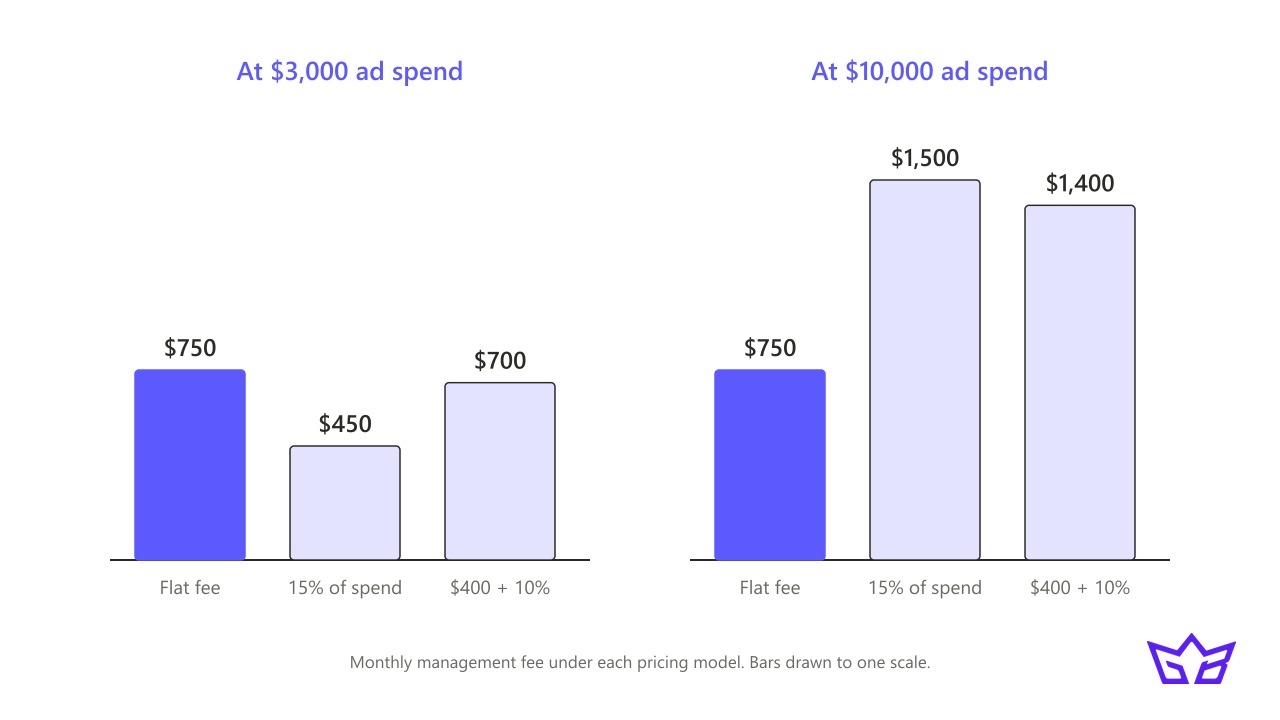 The takeaway: percentage pricing looks cheapest on a small account and costs the most on a growing one. Whatever the model, ask what happens to the fee if the agency recommends cutting your budget.
For context, Canadian retainers commonly run from about $800 to $3,000+ a month, which we unpacked in what PPC management should cost and deliver in Toronto. Our terms are a three-month minimum, then 30 days' notice, and Google Ads management is also included in our Conversion and Super Growth plans on the packages page.
What You Must Own, No Matter Who Runs the Account
This part is not negotiable. A good agency will insist on it before you do.
- The account. Created under your business, on your Google login, with your payment method on file. The agency works inside it.
- Admin access. Google Ads has five access levels: Email only, Billing, Read only, Standard and Admin. Someone at your company should always hold Admin, because Admin is the level that controls users and linked products.
- The data and the history. Conversion actions, audience lists, and your GA4 and Tag Manager containers should all live in accounts you own. The learning sits in the account, so if an agency built everything in theirs and you leave, you start from zero.
- A link you can remove. Agencies connect through a manager account link that you approve, and you can unlink it any time.
When we run Google Ads management services, we work inside your account with manager access for exactly this reason: if we part ways, you keep the account, the history and the learning.
When You Should Not Hire Google Ads Management Yet
Most agencies will not say this because it costs them a client. Sometimes paying for management is the wrong move.
- Your spend is too small for the fee to pay back. At our $500 minimum spend plus $750 of management, you are paying more for oversight than for ads. That can still work for one high value service, where a single extra job covers several months of fees. For most businesses, though, if media is under about $2,000 a month, a fee of $750 or more is a big slice of the budget. Run one tight campaign yourself first, or raise spend until management can pay for itself.
- You cannot say what a customer is worth. If a customer is worth $2,000 and you close 20% of leads, a lead is worth $400 to you. Without that number, nobody can judge the account, including the agency.
- Your website cannot convert the click. If the phone number is buried and the page takes six seconds to load on mobile, fix the page first. Paid traffic makes a weak page more expensive, not better.
Your Next Step
Open your Google Ads account today and pull one number: cost per conversion over the last 90 days, by campaign. Then ask how many of those conversions became paying customers. If you cannot answer, that gap is where management earns its fee.
If you want a second pair of eyes on it, get in touch through our Google Ads agency page. We will check your account against the onboarding list above and tell you honestly whether it needs a manager, a fix, or just a bigger budget.
Frequently asked questions
What do Google Ads management services include?
Campaign setup or restructuring, conversion tracking (including offline conversion imports if you sell by phone or through a CRM), weekly search term and negative keyword work, bid strategy changes, ad and asset testing, landing page feedback, and a monthly report tied to leads and revenue. If a proposal only lists "bid optimization" and "monthly reporting", ask what happens in onboarding week.
How much does PPC management cost?
In Canada, PPC management usually runs 10% to 20% of ad spend, or a flat fee from roughly $750 to $3,000+ a month. Growth Boss charges $750 a month for Google Ads management, with ad spend paid directly to Google (minimum $500 a month). Your media budget sits on top of the fee.
How do I add a manager to my Google Ads account?
There are two ways. The agency can send a link request from its manager account, and you accept it by signing in, clicking Admin, going to Access and security, opening the Managers tab and choosing Accept under "Link request" (Google's linking steps). Or you can invite a person directly: Admin, then Access and security, then the plus button, enter their email, pick an access level (Standard covers day-to-day management) and send the invitation. Keep Admin for yourself.
Can AI manage Google Ads?
Partly. Smart bidding, AI Max and Performance Max already automate bids, query matching and ad combinations, and they do it well when the data is clean. What they cannot do is decide what counts as a good lead, send CRM results back to Google, write your offers, or cut a service line that loses money. AI Google Ads management is a tool your manager uses, not a replacement for one.
Is a flat fee or a percentage of spend better?
A flat fee is usually better once you spend more than a few thousand dollars a month, because the fee does not grow with your budget and the agency has no reason to push spend. A percentage can be cheaper on a small account. Whichever you choose, get the monthly scope in writing so a flat fee never turns into a subscription to a PDF.
Reviewed by Keston Leader under our editorial policy.