Google AI Max Is Replacing Dynamic Search Ads: What to Do Before It Switches On
Google AI Max takes over Dynamic Search Ads in February 2027. What changes, the four risks, and the checklist Canadian advertisers should run now.
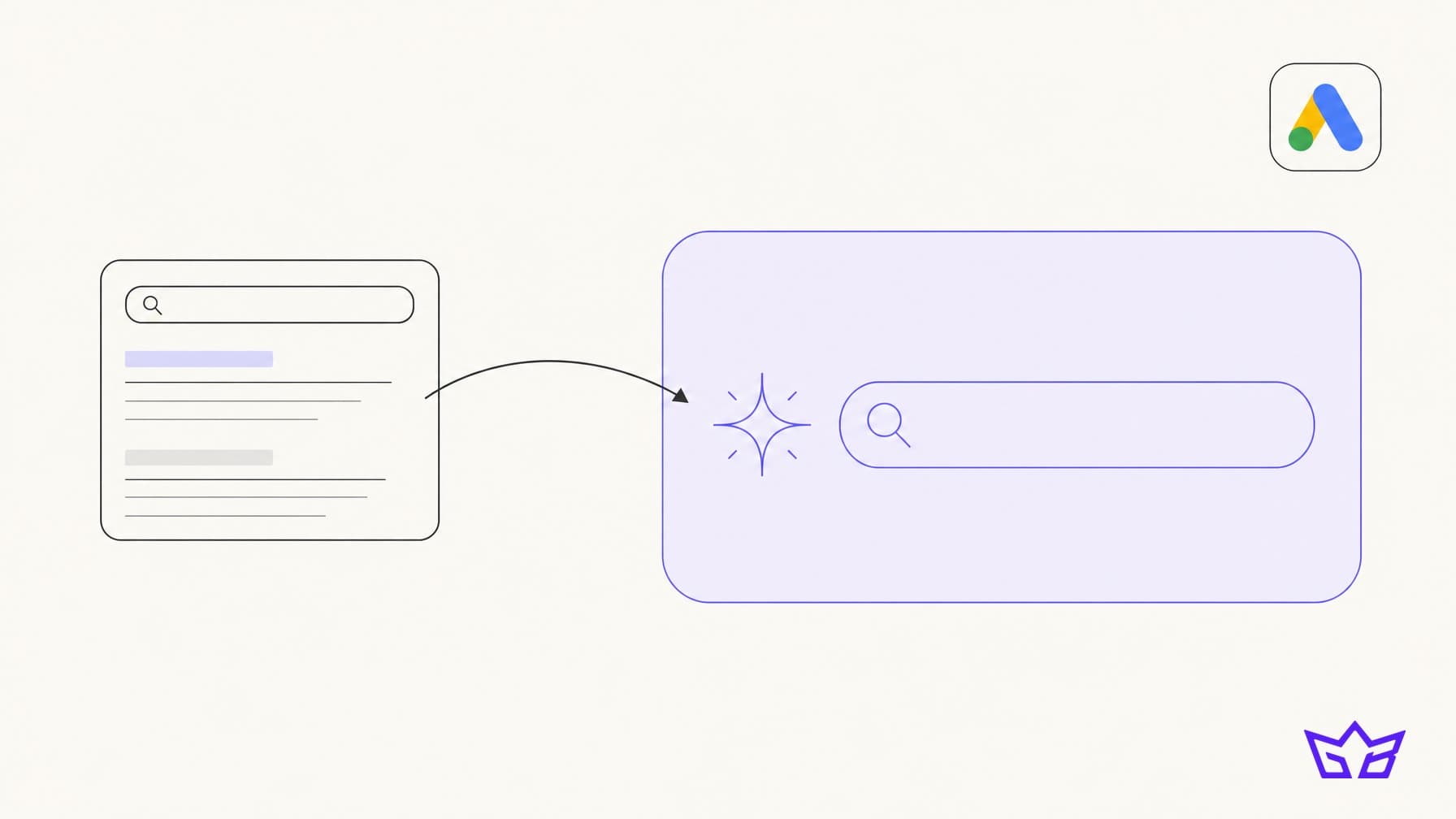
If your Google Ads account had automatically created assets or the campaign-level broad match setting switched on, Google already moved it into AI Max this month. Nobody asked, and the email announcing it probably sat unread next to a billing receipt. Dynamic Search Ads are next: Google AI Max for Search campaigns becomes their automatic replacement in February 2027, and the settings you put in place before then decide whether the switch makes you money or quietly spends it.
Here is what actually changes, where it goes wrong, and the checklist we are running on Canadian accounts right now.
What Google AI Max Actually Is
AI Max for Search campaigns is not a new campaign type. It is a bundle of settings you switch on inside an ordinary Search campaign, and it has three parts:
- Search term matching. Google reads your keywords, ads and landing pages, then finds queries beyond your keyword list using broad match and "keywordless" matching. If you have run Dynamic Search Ads, this is DSA logic applied to your whole campaign.
- Text customization. Google writes headlines and descriptions tailored to each search, built from your existing ads, your landing page and generative AI. You cannot edit these assets.
- Final URL expansion. Google chooses which page of your site the click lands on when it predicts a different page will beat the one you set. It only works while text customization is on.
The controls matter as much as the features. According to Google's own explanation of how AI Max works, you get brand exclusions at the campaign level, brand inclusions at campaign and ad group level, locations of interest at ad group level, URL exclusions at campaign level and URL inclusions at ad group level. Google's announcement also lists text guidelines, which let you steer the wording it generates.
Reporting improves too. The search terms report shows an "AI Max" match type with a source column (broad match or keywordless), and the landing pages report has a "Selected by" column showing which pages Google picked instead of you.
Google's pitch: advertisers who activate AI Max typically see 14% more conversions or conversion value at a similar CPA or ROAS (its internal 2025 data, non-retail advertisers). Hold that number loosely.
The Real AI Max Timeline (It Changed in June)
Google announced the upgrade on April 15, 2026 and originally planned to move everything in September. Then it split the plan in two. The official Google Ads announcement, updated in June, now works out like this:
- September 2026: automatically created assets and campaign-level broad match. Upgrades started September 1. Campaigns using auto-created assets came over with search term matching and text customization on. Campaigns using the campaign-level broad match setting came over with search term matching on and nothing else.
- February 2027: Dynamic Search Ads. Google pushed this piece back after advertisers asked for more time, and to avoid major account changes during Q4. It also restored the ability to create new DSA campaigns on June 15. That is a reprieve, not a reversal.
- Right now: every new Search campaign. AI Max is on by default when you build a new Search campaign, so anyone launching this fall is opted in unless they switch it off.
This is the change we flagged in our breakdown of what Google Ads cost in Canada, now with firmer dates.
If you run DSA, you have about four months to upgrade on your terms. After that, Google upgrades on its terms.
What Happens to a DSA Campaign When It Converts
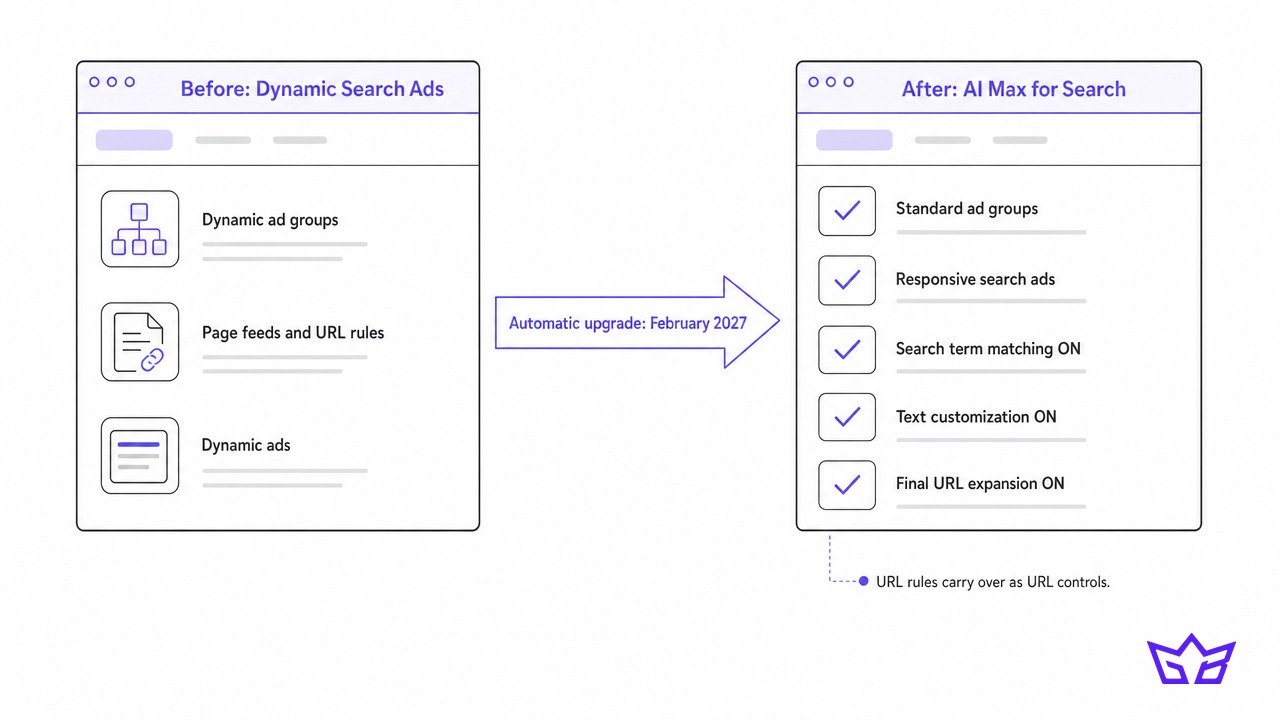
This is the part that catches people off guard. Per Google's setup documentation, a DSA campaign moving to AI Max goes through five changes:
- Dynamic ad groups become standard ad groups.
- Your dynamic search ads become responsive search ads, and Google generates the minimum required headlines and descriptions itself.
- All three AI Max features switch on: search term matching, text customization and final URL expansion.
- Your existing URL targeting rules and historical data carry over, with the URL rules becoming AI Max URL controls.
- The old DSA ads keep running briefly while the new responsive search ads are generated and reviewed.
Look at point 3. The September group did not get final URL expansion; DSA campaigns do. That is logical for a campaign that already let Google pick landing pages, but it also means the migrated campaign starts writing its own ad copy on day one.
Four Ways the Switch Can Cost You Money
AI Max is not bad. It is permissive, and permissive gets expensive when nobody is watching. These are the four failure modes we look for first.
Queries you would never have bought
Keywordless matching casts a wide net. A Mississauga plumbing company bidding on "emergency plumber" can end up paying for "plumber salary Ontario" or "how to become a plumber" if its negative list is thin. The good news: Google's AI Max FAQ confirms negative keywords are still respected with AI Max on. Your negative list is now the main fence.
Traffic landing on the wrong page
Final URL expansion can send a paid click to your careers page, an old blog post, an out-of-stock product, or a French-language page when the searcher typed in English. Every one of those is a full-price click with no path to a lead. Bilingual Canadian sites are especially exposed.
Paying for your own brand
Expanded matching can pull branded searches into non-brand campaigns, where they look like cheap, high-converting wins. Most of those people were going to find you anyway, so without brand exclusions your non-brand numbers get inflated by customers you already had.
Budget drifting toward volume over efficiency
Independent data says the lift is real but not free. Smarter Ecommerce analyzed 250 ecommerce Search campaigns running AI Max and found median conversion value up 13% and median CPA up 16%, with ROAS landing anywhere from 42% above baseline to 35% below it, as Search Engine Journal reported. More conversions at a higher price each is fine if your margins allow it. It is not fine for a service business that needs its cost per lead under $80.
One more trap: pinned headlines. Google's FAQ says pinning is not respected when both text customization and final URL expansion are on, or when URL inclusions are used. If you pin a line like "Licensed in Ontario" for compliance reasons, check your ads after the switch.
The Pre-Switch Checklist for AI Max for Search Campaigns
Work through these in order. In a small account, most take under an hour each.
- Find out what already moved. Open Settings for each Search campaign and look for the AI Max section. If it is on and you never turned it on, you were in the September group. Decide on purpose whether to keep it.
- Audit every DSA campaign. Write down which page feeds and URL rules each one uses, then export 90 days of search terms and landing pages. That export is your baseline for judging the switch later.
- Set URL exclusions. Block careers, blog, about, privacy, login and out-of-stock pages, plus any French pages you do not want English searchers landing on (or the reverse).
- Add brand exclusions to non-brand campaigns, and give your brand its own campaign on exact match so you can see what it really does.
- Rebuild your negative keyword lists. From that 90-day export, add job-seeker terms, DIY and "free" terms, and competitor names you will not pay for. Apply the list at account level so new campaigns inherit it.
- Fix conversion tracking before anything else. AI Max wants Maximize Conversions or Maximize Conversion Value, and search term matching does not work on manual CPC. Smart bidding optimizes toward whatever you count: if a newsletter sign-up counts the same as a quote request, AI Max will cheerfully find you more sign-ups. Keep only real leads as primary conversions, and import qualified leads from your CRM if you can (we walk through that setup in our Performance Max guide for B2B lead gen).
- Test on one campaign with an experiment. Google offers AI Max experiments that split traffic between your current setup and an AI Max version. Pick your highest-volume DSA or Search campaign, run it for four to six weeks, and judge it on cost per qualified lead, not raw conversion count.
- Review search terms every week for the first eight weeks after any campaign turns AI Max on. Filter by the "AI Max" match type, add negatives, and check the landing pages report for pages you did not choose.
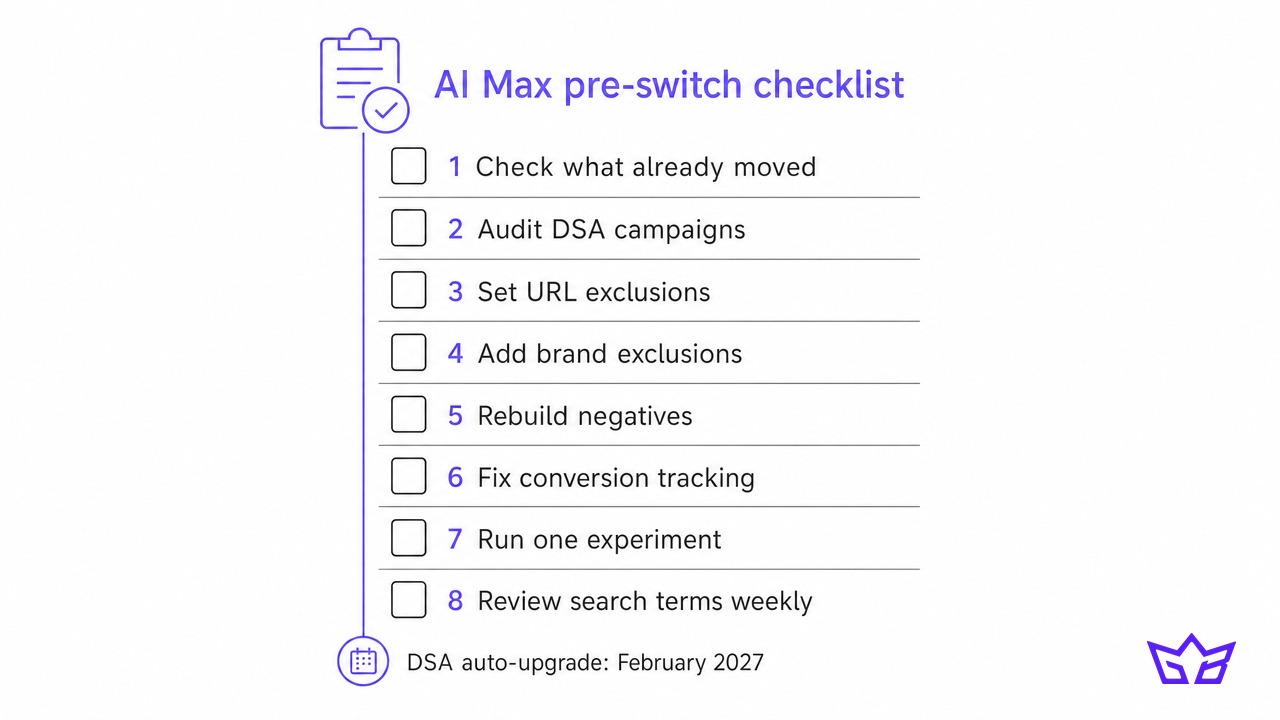 The takeaway: the checklist is the same whether you upgrade early or wait. The only difference is who picks the day it goes live.
Performance Max vs AI Max: Which One Gets the Click?
- Performance Max is its own campaign type, running across Search, Shopping, YouTube, Display, Gmail, Discover and Maps from one budget.
- AI Max lives inside a Search campaign. Keywords, ad groups and budget stay put; it only expands what that campaign can match and show.
When a search is eligible for both, Google's FAQ says the higher Ad Rank serves. Keep brand and URL exclusions consistent across both, or they will compete for the same customer and blur your reporting.
Should You Turn On AI Max Early?
Our verdict: yes for DSA, on your schedule. Maybe for keyword campaigns. Not while your tracking counts junk.
- If you run Dynamic Search Ads: upgrade manually before February. Google itself recommends the manual tools over waiting because they give you more oversight. Service businesses should run the experiment in October or November. Retailers facing Black Friday and Boxing Day should set exclusions now, experiment in early January, and upgrade before February. Swapping ad copy engines during your biggest sales weeks is how you lose a December.
- If you run tight exact and phrase match campaigns that hit target: no rush. Google has not announced a forced upgrade for standard keyword campaigns that never used the broad match setting or auto-created assets. Test AI Max on one campaign when you want more volume.
- If your conversion tracking counts page views or newsletter sign-ups: do not turn anything on. Fix tracking first, because AI Max scales whatever signal you feed it.
- If you spend under about $1,500 a month: a 50/50 experiment may take months to show a clear result. Keep one tight campaign, turn on search term matching only, and watch it weekly. Our guide to Google Ads on a small budget covers how to keep that narrow.
If your agency has not raised AI Max with you by now, that tells you something. Here is what PPC management should cost and deliver in Toronto.
Your Next Step
Open Google Ads today and check the AI Max section on every Search campaign. Five minutes tells you whether Google already changed your account. Then export 90 days of search terms, because every step above depends on that file.
If you would rather hand the audit to someone who does this weekly, our Google Ads management team will review your DSA campaigns, set exclusions and negatives, and run the experiment before February forces the issue. Management is $750 a month, with your ad spend paid to Google directly. Get in touch and we will tell you honestly whether AI Max belongs in your account yet.
Frequently asked questions
What is Google AI Max for Search campaigns?
AI Max is a set of features inside a Google Search campaign: search term matching (broad match plus keywordless), text customization and final URL expansion, with brand, location and URL controls. It replaces Dynamic Search Ads, automatically created assets and the campaign-level broad match setting.
When do Dynamic Search Ads switch to AI Max?
Google will automatically upgrade DSA campaigns to AI Max starting in February 2027. The date was originally September 2026, but Google extended it in June. Campaigns using automatically created assets or campaign-level broad match were upgraded starting September 1, 2026.
Can I opt out of the AI Max upgrade?
Not permanently. Google's FAQ says you can switch AI Max off in campaign settings, which disables all of its features. What you cannot do is keep Dynamic Search Ads past the February 2027 migration, because the format is being retired.
Does AI Max respect negative keywords?
Yes. Google confirms negative keywords are respected with AI Max on, which makes a clean account-level negative list your most important control.
Is AI Max the same as Performance Max?
No. Performance Max is a separate campaign type that runs across Google's channels. AI Max is a feature set inside a Search campaign, so your keywords and ad groups stay in place. When both are eligible for one search, the higher Ad Rank serves.
Do I need smart bidding to use AI Max?
For the main feature, yes. Google says search term matching does not work with manual CPC and recommends Maximize Conversions or Maximize Conversion Value, which only work as well as your conversion tracking.
Reviewed by Keston Leader under our editorial policy.