Content Marketing Services: What You're Actually Buying
What content marketing services include, what they cost in Canada, and the five questions that separate a real strategy from a content calendar.

Most content marketing services sell you volume. Four blog posts a month, eight social captions, one newsletter, invoice, repeat. Nine months later you have 36 posts, no rankings, and a spreadsheet nobody reads.
The problem is not the writing. The problem is that volume was never the product. Content marketing works when every piece is aimed at a search someone is already making or an objection that is already killing your deals. Everything else is expensive noise.
Here is what content marketing services should actually include in 2026, what they cost, and the five questions that separate an agency building you an asset from one filling a calendar.
What content marketing services actually include
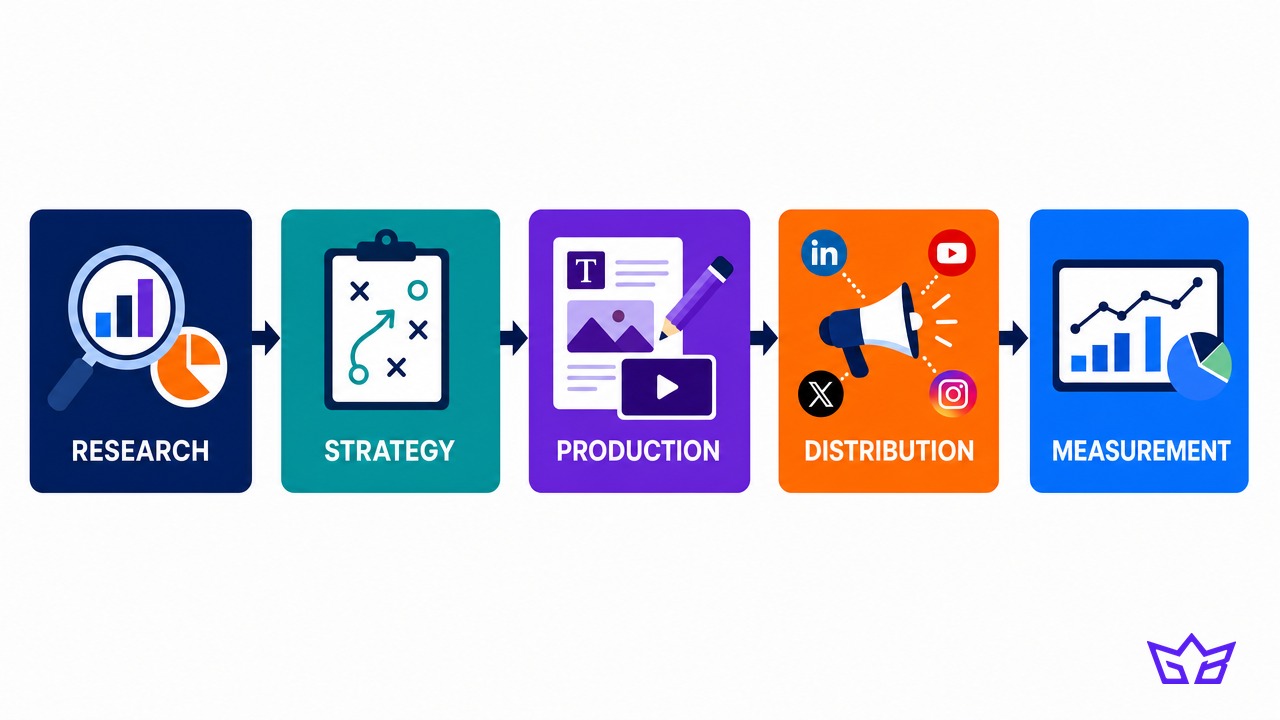
When you buy content marketing services, you are buying five things. Most agencies quietly deliver two of them.
- Research. Real keyword data with search volume and difficulty, plus the questions your buyers type before they are ready to talk to you. Without this, the calendar is guesswork.
- Strategy. A decision about which topics you can realistically win, and which ones a bigger competitor already owns. A young site chasing "digital marketing" is lighting money on fire. That same site can own "content marketing services" in its own city inside a quarter.
- Production. The writing, editing, design, and images. This is the part everyone sells.
- Distribution. Publishing is not distribution. Content needs internal links from pages that already rank, a spot in your email sequence, and a plan for the social cut-downs.
- Measurement. Not pageviews. Which pieces produced pipeline, and which keywords moved from position 30 to position 8.
If a proposal only describes production, you are buying a writer with an agency markup.
What content marketing services cost in 2026
Canadian pricing sorts into three brackets, and the gap between them is mostly about who is doing the thinking.
Freelance writer: $150 to $600 per piece. You get words. You bring the strategy, the keywords, the editing, and the internal linking. This works if you already know exactly what you want to rank for and have someone in-house to direct it.
Boutique agency retainer: $2,000 to $6,000 per month. Research, strategy, production, and light distribution. Usually four to eight pieces a month plus the surrounding work. This is where most companies doing $500K to $10M in revenue land, and it is the bracket where the strategy actually gets done.
Full-service content programs: $8,000 to $25,000 per month. Multi-format work: long-form, video, design-heavy assets, paid amplification, sometimes original research. Justified when content is your primary acquisition channel, not a side bet.
The expensive mistake is not overpaying. It is paying $3,000 a month for 18 months against keywords you were never going to rank for. That is $54,000 for a nice-looking archive.
A useful gut check: if the agency cannot tell you the search volume and difficulty of the term each piece targets, they are not doing research. They are picking topics.
The four deliverables that actually move revenue
Across the content programs we have run, four formats do the heavy lifting. Everything else supports them.
- The commercial page. Not a blog post. A page built to convert the exact search someone makes when they are ready to buy: "content marketing services", "web design in Pickering", "SEO company Mississauga". These carry the money terms and they need real depth, real proof, and a real offer.
- The objection post. Whatever your prospects ask on the third call. Pricing, timelines, contract length, what happens if it does not work. Our own post on what a small business website costs in Ontario has produced first-touch leads, because it answers the question people are too polite to ask early.
- The comparison piece. People search "X vs Y" with a credit card half out. If you sell a service with alternatives, and you do, someone is writing that comparison. Better it is you. Our piece on creator content versus brand content exists for exactly this reason.
- The local asset. If you serve a region, city-level content is the cheapest ranking you will ever buy. Competition is a fraction of the national terms and the intent is stronger. That is the whole logic behind our approach to local SEO services.
Notice what is missing: thought leadership. It has a place, but it is the fifth priority, not the first. Nobody has ever bought from a company because of its take on the future of work.
Why most content marketing fails
The failure modes are boringly consistent.
- No keyword behind the piece. If nobody searches it, the only traffic is whatever you push to it once.
- Publishing into a vacuum. New posts with zero internal links from established pages take months longer to rank, sometimes never.
- Cannibalization. Three posts targeting the same term split their own authority. Google picks one, usually the weakest.
- Thin local pages. Fifteen city pages with the city name swapped is a pattern Google has been demoting for years.
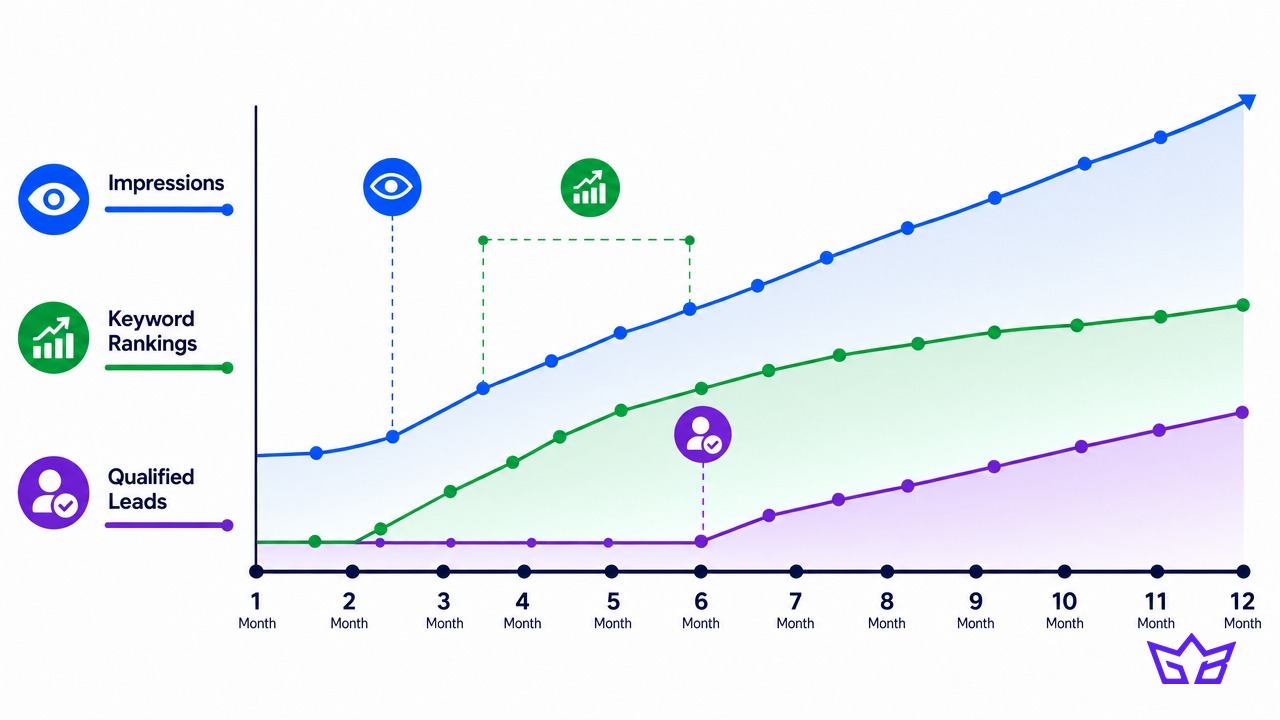
- Quitting at month four. Content compounds, which is a polite way of saying it does nothing visible for a while. Most programs get cancelled right before the curve bends.
That last one is worth sitting with. Our own site went from 12 ranked keywords to 125 in three months, and monthly impressions from 486 to just under 11,000. The clicks lagged that by a full quarter. If we had judged the program at month two we would have killed something that was working.
Five questions to ask before you sign
Ask these in the sales call. The answers sort the field fast.
1. What keyword does each piece target, and what is its volume and difficulty? A real answer sounds like "1,000 searches a month, difficulty 22, you rank nowhere today, and three competitors your size are on page one." A vague answer means no research happened.
2. Which existing page will link to this one? Almost nobody asks this. If they have no answer, your content is being published into a vacuum.
3. Who owns the content if we part ways? You should. Get it in writing, along with access to the CMS and the analytics.
4. What happens in month one versus month six? Anyone promising rankings in 30 days is either lying or planning to buy links. Anyone who cannot describe what month six looks like has never run a program that far.
5. How will we know it worked? The answer should include keyword position changes, non-brand clicks, and assisted conversions. If the answer is "engagement", walk.
Where content marketing fits with everything else
Content does not work alone, and this is where a lot of budget gets wasted. Three things have to be true at the same time.
Your site has to be fast and technically sound, or your content ranks below competitors saying less. Your commercial pages have to actually convert, or traffic arrives and leaves. And your local presence has to be real, because for anything with a city attached, the map pack takes the clicks before an organic result gets a look.
That is why we treat content and brand production and website and SEO work as one project rather than two line items. Content that ranks on a site that does not convert is a very expensive way to generate bounces.
What to do next
Open your analytics and sort your blog posts by organic traffic, not total traffic. Then count how many produced a single lead in the last six months.
If the answer is zero, the fix is almost never more posts. It is picking eight terms you can genuinely win, building four commercial pages and four supporting posts against them, and linking them properly. That is one quarter of focused work, and it will outperform two years of a content calendar.
If you want a second opinion on which eight terms those should be, tell us what you sell and where you sell it. We will pull the real volume and difficulty numbers and tell you honestly which ones are out of reach this year.
Frequently asked questions
How much do content marketing services cost in Canada? Freelance writing runs $150 to $600 per piece, boutique agency retainers run $2,000 to $6,000 a month, and full programs run $8,000 to $25,000 a month. The bracket you need depends on whether you already have the strategy and just need production.
How long does content marketing take to work? Impressions usually move in month two or three, rankings in months three to six, and reliable lead flow around month six. Anyone promising leads in 30 days is describing paid ads, not content.
What is included in content marketing services? Research, strategy, production, distribution, and measurement. Most proposals only cover production, so check the other four explicitly before signing.
Is content marketing worth it for a small business? Yes, if you narrow it. Eight winnable keywords beat a general content calendar every time, and local terms are far cheaper to win than national ones.
What is the difference between content marketing and SEO? SEO decides what to write and how the site is structured to rank it. Content marketing produces and distributes the material. Buying them separately usually means paying twice to fix the same decisions.
Reviewed by Bahaa Zuraik under our editorial policy.