How Much Do Google Ads Cost in Canada?
How much Google Ads cost in Canada in 2026: real cost per click by industry, the minimum budget before data means anything, and what management costs.
"How much do Google Ads cost?" has a real answer, and it is not "it depends." The reason you keep getting that non-answer is that most people asking the question are actually asking three different questions at once, and the person answering picks whichever one is easiest to be vague about.
So let us separate them. There is what a click costs, what you have to spend before the data means anything, and what it costs to have someone run it. Those are three different numbers, and confusing them is how businesses end up 5,000 dollars into a campaign with no idea whether it worked.
Here are all three, with current Canadian figures, plus one change landing next month that moves the math for everybody.
Your Real Cost Has Three Layers, Not One
Almost every "Google Ads pricing" guide answers layer one and stops. That is why budgets blow up.
Layer one is media spend. The money that goes to Google when someone clicks. You set this and you control it directly.
Layer two is management. Either a retainer to an agency, a freelancer's hourly, or the real cost of your own time. This one gets left out of budgets constantly, and it is frequently 20% to 30% of total program cost.
Layer three is the infrastructure tax. Conversion tracking, landing pages, call tracking, and CRM connection. Nobody puts this on a proposal because it is unglamorous, and skipping it is the single most expensive mistake in paid search. Without it you are buying clicks and guessing at outcomes.
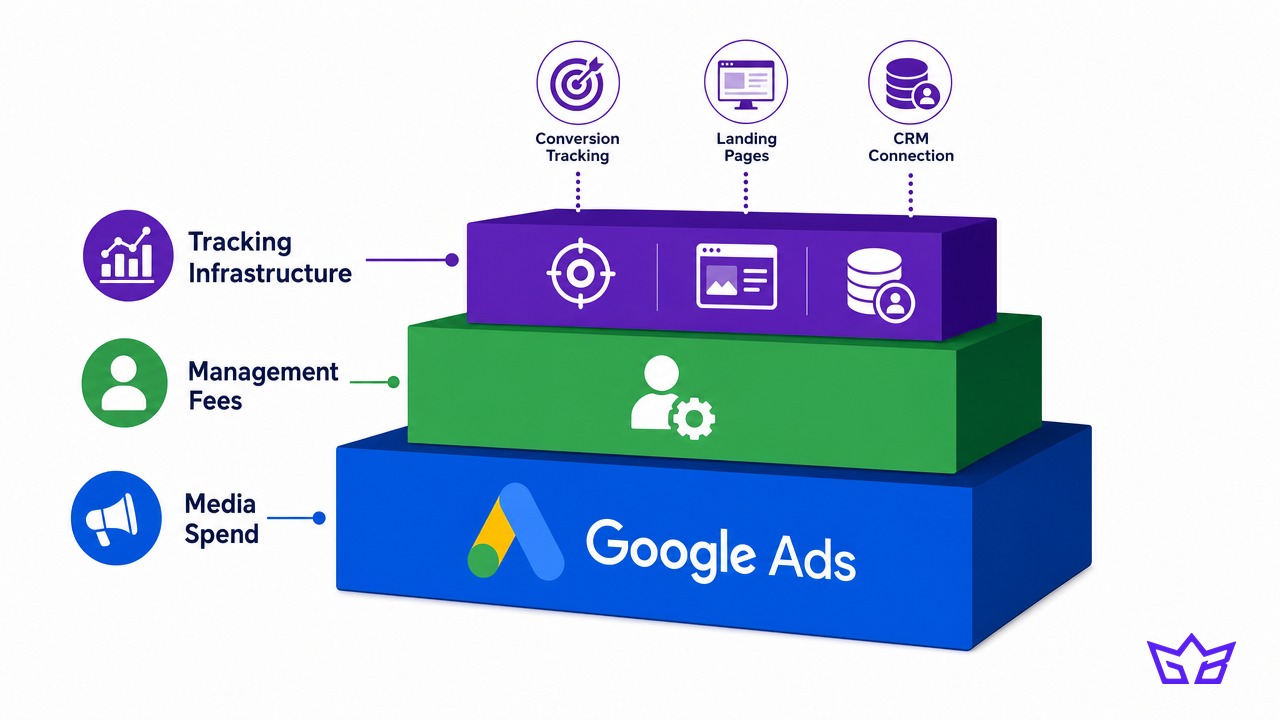
A business budgeting 2,000 dollars a month for "Google Ads" and meaning layer one only has not built a budget. It has built the first third of one.
So How Much Do Google Ads Cost Per Click Right Now?
The current all-industry benchmarks, drawn from more than 13,000 search campaigns measured between April 2025 and March 2026:
- Average cost per click: 5.42 dollars
- Average click-through rate: 6.64%
- Average conversion rate: 8.18%
- Average cost per lead: 66.69 dollars
That 66.69 dollar cost per lead is the number worth committing to memory, because it is the one that tells you whether this channel can work for you at all.
The spread by industry is enormous, and averages hide it. Across 2026 benchmark data, cost per click runs from about 1.63 dollars in arts and entertainment up to 9.87 dollars in legal services. Travel and sports and recreation come in under 3 dollars.
For Canadian advertisers specifically, costs sit roughly here, with the top of each range belonging to Toronto, Vancouver, and Calgary:
- Legal: 8 to 45+ dollars per click, with personal injury at the very top
- Insurance: 15 to 50+ dollars, highest in major urban markets
- Home services such as HVAC, plumbing, and contracting: 6 to 25 dollars depending on saturation
- Dental: 4 to 18 dollars
- Real estate: 3 to 12 dollars residential, 15 to 40 dollars commercial
- B2B SaaS: 4 to 30+ dollars by category
Low-competition local service queries in smaller Canadian markets can still be found under a dollar. The same query in downtown Toronto might be twelve times that. Geography is a pricing lever, which is why an agency averaging your performance across all of Ontario is hiding something from you, usually by accident.
The Number That Actually Decides Whether This Works
Forget cost per click for a moment. It is the wrong metric to budget from, and fixating on it leads people to optimize toward cheap clicks that never convert.
Work backwards instead. Three inputs, and you almost certainly know all three:
- What is a customer worth to you? Not the first invoice. The full relationship value.
- What share of your leads become customers? Use your real close rate, not your best month.
- What can you afford to pay for a lead? Multiply the first by the second, then decide what fraction of that margin you are willing to spend on acquisition.
An example with round numbers. Say a customer is worth 3,000 dollars, you close 20% of leads, and you are willing to spend a third of the gross margin on acquiring them. A lead is worth 600 dollars to you, so paying up to 200 dollars for one is comfortable. Against a national average cost per lead of 66.69 dollars, you have enormous room, and you should be spending more aggressively than you are.
Flip it. A customer worth 400 dollars, a 10% close rate, and the same one-third rule gives you 40 dollars of lead value and roughly 13 dollars to spend. At an 8% conversion rate that means you need clicks at about a dollar. In a competitive Canadian market for a service category, those clicks may not exist, and finding that out with arithmetic is far cheaper than finding it out with a credit card.
This calculation takes four minutes and it is the difference between a channel decision and a gamble. Run it before you set a budget, not after your first month of spend.
The Minimum Budget Before Data Means Anything
Here is the rule most guides skip: Google's automation needs conversion volume before it can optimize. Roughly 30 conversions in a 30 day window is the widely accepted floor for smart bidding to work properly.
Do the arithmetic with your own numbers. At an 8% conversion rate, 30 conversions requires about 375 clicks. At 5.42 dollars a click, that is roughly 2,030 dollars a month in media spend before the machine has enough signal to get good.
Spend 500 dollars a month in a category where clicks cost 8 dollars and you buy 62 clicks and maybe five conversions. That is not a campaign. That is a sample too small to learn from, and it will look like failure when it is really just insufficient data.
This is the honest, unwelcome answer to "can I try Google Ads with a small budget." You can, but you have to narrow the target until the budget is sufficient for a smaller battle: one service, one city, one tight keyword set. We worked through exactly how to do that in running Google Ads on a small budget. Spreading 500 dollars across five services and the whole GTA guarantees nothing works.
What Management Costs, and What You Are Paying For Now
Canadian agency fees follow three patterns:
Percentage of ad spend, typically 10% to 20%. Spend 10,000 dollars, pay 1,500 to 2,000 dollars on top.
Flat monthly retainer, roughly 800 to 3,000+ dollars. In Toronto the range skews to the top of that.
Hybrid or performance based, which sounds ideal and lives or dies on whether you agreed in advance what counts as a conversion.
The useful question is not the price. It is what the work now consists of, because that changed substantially this year, and it is where most businesses are overpaying without knowing it.
Google has automated the tasks agencies used to bill for. Bid adjustments, match type splitting, and keyword expansion are machine work now. What automation still cannot do is define what a good conversion looks like for your business, or import qualified-lead and revenue data from a CRM nobody connected. If a proposal does not mention conversion tracking or CRM integration, you are being quoted for the automated half. We went deeper on this in our look at what PPC management should actually cost and deliver in Toronto.
A practical threshold: if you are spending under about 2,000 dollars a month on media, a 1,500 dollar management fee means you are paying nearly as much for oversight as for advertising. Either raise the media budget until management pays for itself, or run it yourself.
The September Change That Moves the Math
This is the trending piece, and it has a date on it.
AI Max, Google's expanded automation layer for Search campaigns, is out of beta with stronger targeting and creative controls. Since September 1, campaigns using automatically created assets or the campaign-level broad match setting upgrade into AI Max automatically. Dynamic Search Ads follow in February 2027, after Google pushed that deadline back in June (here is what to do before the AI Max switch). Performance Max also picked up asset group level reporting, channel level budget transparency, better placement exclusions, and campaign level negative keywords.
What this means for your costs, concretely:
- Reach broadens by default, so your ads will appear against queries you did not choose. Some convert brilliantly. Some waste money. Negative keyword work becomes more important, not less.
- Budget moves between channels on its own, shifting across Search, Shopping, Display, YouTube, Discover, Gmail, and Maps based on live performance. Channel level reporting finally lets you see where it went.
- Creative and offer quality become the main lever, because bidding is settled. Your assets are now the variable you actually control.
- Bad conversion signals get expensive faster. Automation optimizes toward whatever you tell it to value, at greater scale. Tell it to value raw form fills and it will efficiently buy you tire-kickers.
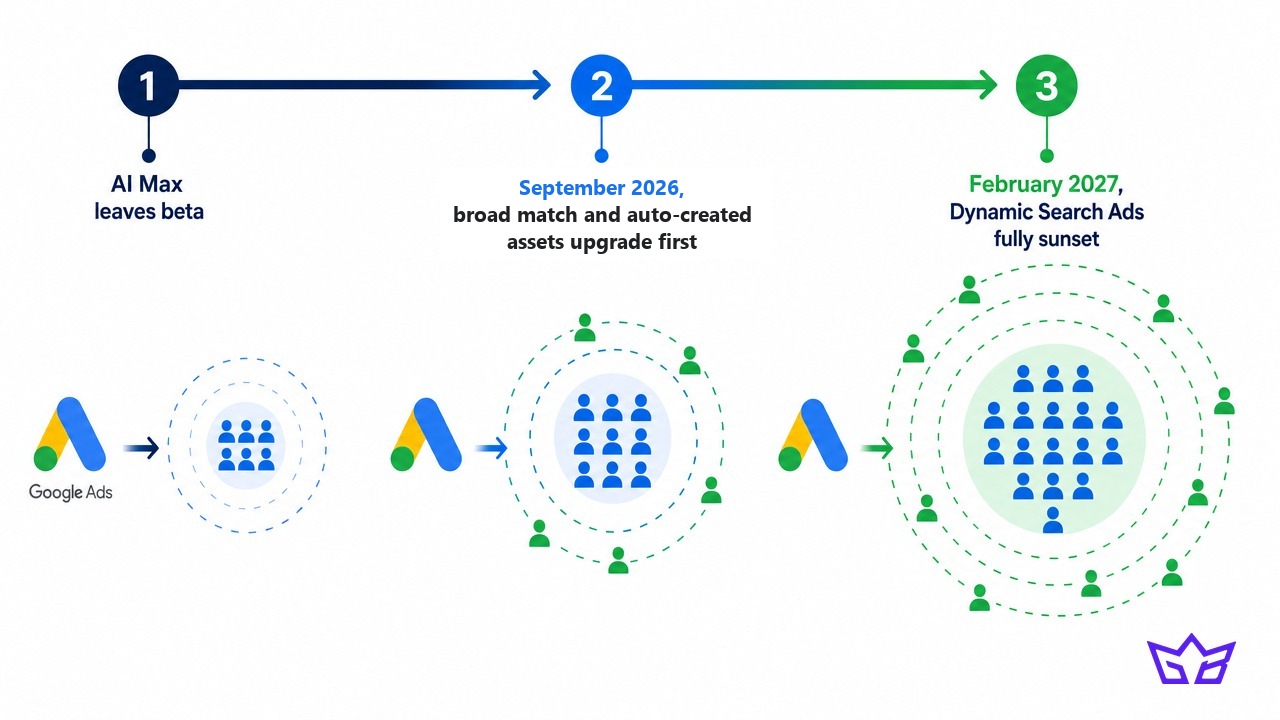
If you run Dynamic Search Ads today, you have until February 2027, but the prep work belongs in this quarter rather than next year. Audit your negative keyword lists and your conversion definitions before the upgrade happens to you rather than after.
A Worked Example, Start to Finish
A London, Ontario HVAC company. Average job value 4,200 dollars, closes 25% of qualified leads.
Lead value: 4,200 times 0.25 gives 1,050 dollars per lead. Spending a third of margin on acquisition means up to about 350 dollars per lead is defensible.
Expected click cost: home services in Canada runs 6 to 25 dollars. Outside Toronto, call it 9 dollars.
Expected conversion rate: 8% on a decent landing page with a phone number above the fold.
Cost per lead: 9 dollars divided by 0.08 gives roughly 113 dollars. Against 350 dollars of affordable spend, that is a healthy channel.
Minimum viable budget: 30 conversions needs about 375 clicks, which at 9 dollars is roughly 3,375 dollars a month in media. Add a 700 dollar management fee and 1,200 dollars of one-time tracking and landing page setup.
Month one total: about 5,275 dollars, of which 1,200 dollars is non-recurring. Expected output at those rates is roughly 30 leads, about 7 jobs, and about 29,000 dollars in revenue.
Those are modelled numbers, not a promise. The point is that every figure in that chain is knowable before you spend anything, and if the model does not work on paper it will not work in the account.
Common Questions
How much do Google Ads cost for a small business in Canada? Realistically, 1,500 to 3,000 dollars a month in media for a single service in a single city, plus management if you are not running it yourself. Below about 1,000 dollars you can still compete, but only by narrowing to one tight keyword set and accepting slower learning.
Do I pay Google anything to set up an account? No. There is no account fee, no minimum, and no contract. You pay per click. The promotional credits Google offers new advertisers are real, though they usually require matched spend, so read the terms.
Why are my Google Ads so expensive all of a sudden? Three usual suspects: a new competitor entered your auction, your Quality Score dropped because your landing page slowed down, or an automated campaign type broadened your reach into pricier queries. Your search terms report and a page speed test will identify which one within an hour.
Is Google Ads worth it for a small business in Canada? It is worth it when your affordable cost per lead exceeds your likely cost per lead, and not before. Run the four-minute calculation above. For high-value service businesses the gap is usually comfortable. For low-ticket products in competitive categories it often is not, and organic or social is the better first channel.
How does this compare to other marketing spend? Paid search is generally the fastest and the least durable. It produces answers in weeks and stops the day you stop paying. We compared it against the other line items in what digital marketing actually costs in Canada.
What to Do With This
Do not open Google Ads yet. Open a calculator.
Write down three numbers: what a customer is worth, what percentage of leads you close, and what you are willing to pay for a lead. Compare that last figure against the industry range above. If there is a comfortable gap, you have a channel worth funding properly, and you now know what "properly" costs. If the gap is thin or negative, you have saved yourself a quarter of spend and a bad opinion about a platform that was never going to fit.
Then check one thing in your existing setup, if you have one: does Google know which of your leads became customers? If the answer is no, that is worth more than any budget increase. Automation optimizes toward whatever you feed it, and it is about to do so more aggressively.
If you want the model built with your actual numbers rather than an example's, send them over and we will tell you honestly whether paid search is your next channel or your third.
Reviewed by Bahaa Zuraik under our editorial policy.