How to Choose a B2B Marketing Agency in Toronto
How to choose a B2B marketing agency in Toronto: the five proofs to demand, the red flags in the proposal, and ten questions to bring to every pitch.

Toronto has more marketing agencies per capita than almost any city in North America, and most of them will happily take a B2B retainer. Very few of them have ever closed a B2B deal. That gap is the whole problem with hiring a B2B marketing agency in Toronto, and it is why the same companies keep switching agencies every eighteen months and getting the same result.
Here is the thing nobody tells you in the pitch meeting: B2B marketing is not consumer marketing with longer copy. The buyer is a committee, the cycle is measured in quarters, and the decision is mostly made before anyone talks to your sales team. An agency built for Shopify stores and restaurant launches will run the B2B playbook the only way it knows how, which is as a consumer campaign with a LinkedIn budget. You will get impressions. You will not get pipeline.
We have sat on both sides of this table. Growth Boss runs B2B accounts for manufacturers, logistics operators, professional-services firms and technology companies across Toronto and the GTA, and we have also been the second or third agency a company hires after the first two produced reports instead of revenue. This is what we would tell a friend who asked us how to choose.
What makes B2B different, in numbers
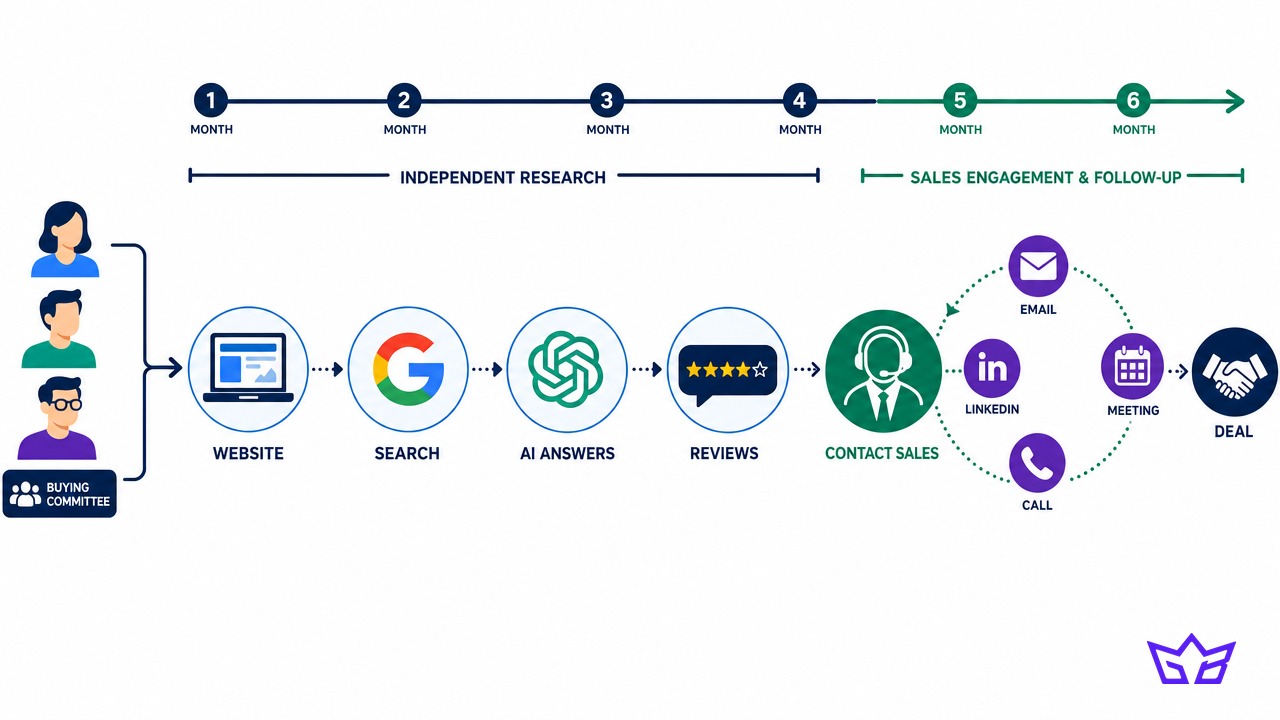
Start with the buyer, because everything else follows from it. According to Gartner and Forrester, B2B buyers complete roughly 70 to 80 percent of their journey before they ever contact a vendor. They are reading your site, your competitors' sites, review platforms, and increasingly the answers ChatGPT and Google's AI Overviews give them, long before a salesperson knows they exist.
They are also not alone. Gartner puts the average buying committee at six to ten people. For deals over $50,000, Forrester and 6sense measure the median buying group at more than eleven. Each of those people has a different question, and Forrester found that 86 percent of B2B purchases stall at some point, most often because one stakeholder's concern was never surfaced.
What this means for the agency you hire: the job is not to generate a click. The job is to be found by a committee doing research without you, answer each member's question before they ask it, and keep the deal warm across a cycle that can run six to twelve months. Almost none of that is a paid social campaign.
A consumer agency optimizes for the moment of purchase. A B2B agency has to optimize for the months before it. If the agency you are evaluating talks mostly about creative and reach, it is optimizing for the wrong moment.
The five things a Toronto B2B agency has to prove
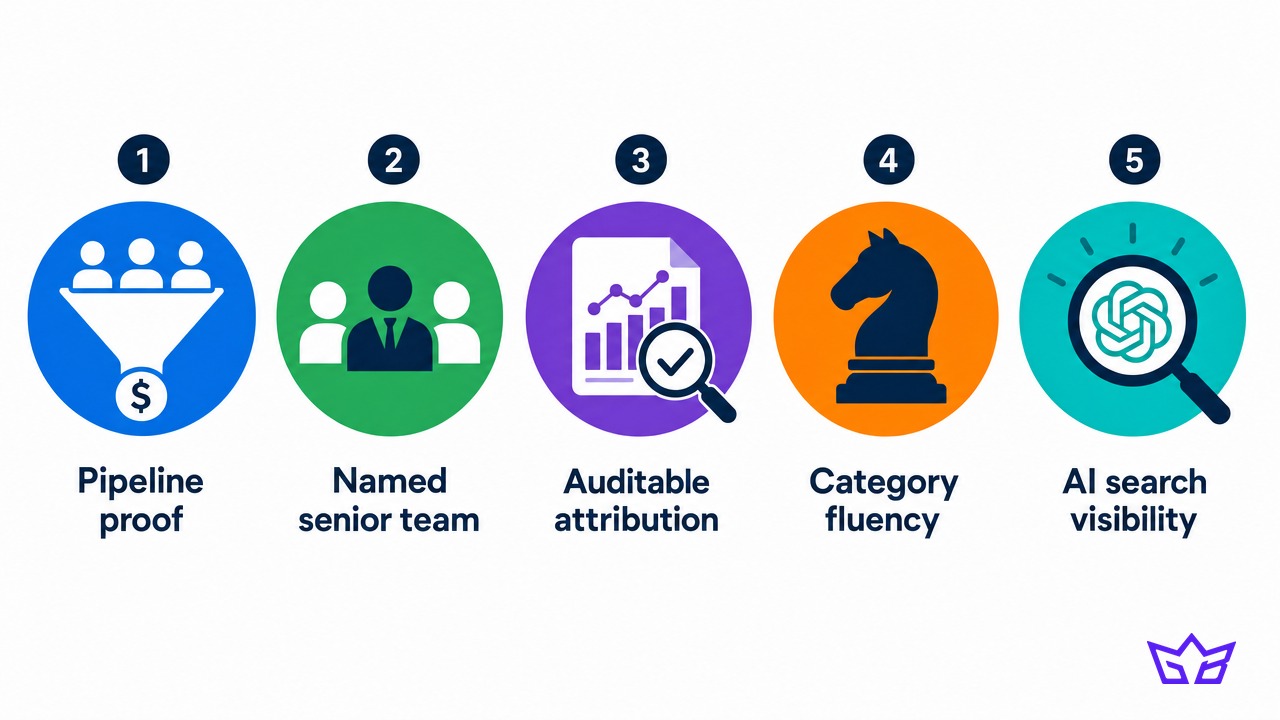
Ignore the awards wall and the client logos for a moment. Those tell you a Toronto B2B marketing agency is good at winning agencies' awards and signing logos. Ask for these five things instead, and pay attention to how quickly the answers come.
1. Pipeline, not activity. Ask for one engagement where they can trace spend to closed revenue or at least to sales-qualified pipeline. Not leads, not MQLs, not "engagement". A B2B agency that has done this work will have the number ready and will probably want to talk about it. One that has not will pivot to impressions, click-through rates or follower growth.
2. A named senior team. Who, specifically, will work on your account, and how senior are they? The Toronto model is a senior pitch team and a junior delivery team, and in B2B that is fatal, because the junior team has never sat in a sales call and does not know what your buyer's objections sound like. Get the names. Ask how many other accounts each of them carries.
3. Attribution you can audit. Ask how they will tie a closed deal in March back to a piece of content from the previous September. If the answer is "last click" or a shrug, the agency cannot measure the thing you are paying for. In a long cycle, last-click attribution credits whatever the buyer touched on the day they finally filled in a form, which is usually your homepage, and buries everything that actually earned the deal.
4. Category fluency, or an honest ramp plan. They do not need to have worked in your exact industry. They do need to be able to tell you how they learned the last unfamiliar one: who they interviewed, what they read, how long it took, and what the first six months of results looked like. Ask to speak to that client.
5. A position on AI search. Most of your buyer's research now runs through ChatGPT, Perplexity, and Google's AI Overviews before it ever reaches a traditional search result. An agency without a clear answer to "how do you get us cited by AI engines" is optimizing for a search page your buyer is spending less time on every quarter. We wrote up what that work involves in why ChatGPT recommends your competitor.
The red flags that predict a bad year
We have inherited enough accounts from other B2B marketing agencies in Toronto to know how the bad ones start. The warning signs are visible in the proposal if you know where to look.
- Tactics before strategy. The proposal opens with channels ("LinkedIn ads, retargeting, a monthly newsletter") before anyone has asked who your buyer is, how long your cycle runs, or what a qualified deal is worth. The channel mix should be a conclusion, not an opening bid.
- A price far below the market. Real B2B work is senior work. If a retainer is priced like a social media package, you are buying a social media package with B2B written on the cover. Honest ranges for the GTA are in our guide to what digital marketing costs in Canada.
- They want to own your accounts. Your ad accounts, your analytics, your CRM data and your domain belong to you. An agency that insists on running them under its own logins is building a switching cost, not a marketing system.
- A twelve-month lock-in with no exit. Confidence looks like a short initial term and a clear off-ramp. Lock-ins are what an agency asks for when it expects you to want to leave.
- Page one in ninety days. Anyone promising that for a competitive B2B term in Toronto either does not understand the market or is planning to use tactics that get you penalized. Real search work compounds over two or three quarters, and an honest agency says so up front.
- Reports full of impressions. If the sample monthly report does not have a line that connects to revenue or pipeline, that is the report you will be getting.
Any one of these is survivable. Three together is the pattern we see right before a company calls us to take over.
Full-service or specialist? The honest answer for B2B
This is the question most Toronto companies get wrong, in both directions.
The specialist. A dedicated LinkedIn ads shop or a pure B2B SEO firm will usually be deeper in its one channel than a generalist. The cost is the handoffs. In a B2B cycle the site, the search visibility, the paid campaigns, the content and the follow-up sequence are one system, and when four vendors each own a piece, the leads die in the gaps between them. The SEO firm ranks a page the web developer built to look good rather than convert. The ads agency sends expensive B2B clicks to a homepage nobody rebuilt for that campaign. Nobody owns the result.
The full-service team. One senior bench that owns the site, the search, the paid media and the follow-up can change all four in the same week when the sales team reports that a message is not landing. That is the argument for it. The risk is a full-service shop that is actually a consumer agency with a wide menu rather than a digital marketing agency for B2B, which is why the five proofs above matter more than the model.
Our position, stated plainly. For a B2B company doing between $1M and $20M, a full-service B2B growth agency usually wins, because the handoffs are where B2B budgets leak and because a long cycle punishes any vendor who cannot see the whole picture. We wrote the trade-offs up without our thumb on the scale in full-service versus specialized agencies. If you already have strong in-house marketing and one clear gap, hire the specialist for that gap. If you are trying to build the system from the ground up, hire the team that will own the system.
Where the Toronto market is actually won
Three places, and none of them is a billboard on the Gardiner.
Your website is doing due diligence work. In a committee purchase, the site is read by people who will never speak to you: the finance lead checking pricing signals, the operations manager looking for proof you have done this before, the executive scanning for credibility in eight seconds. Most Toronto B2B sites are built as brochures for the founder and fail every one of those readers. We covered what a site has to do differently in B2B web design in Toronto, and it is the single highest-return fix on most accounts we inherit.
Search still decides who gets on the shortlist. When a buying committee researches for months, the companies that appear for the specific commercial terms in your category get evaluated, and the ones that do not simply never come up. That is a structural, compounding advantage, and it takes time to build. What the work looks like in this market is on our SEO company in Toronto page.
Follow-up is the channel nobody funds. An enquiry from a real buyer arrives, gets a reply two days later, and goes quiet. Forrester's number, that 86 percent of purchases stall, is mostly a follow-up problem. The nurture sequence, the routing into your CRM, and the automation that keeps a considered buyer warm across a quarter are where a B2B budget earns back the most per dollar, and they are the part most agencies never mention because they do not sell it. Our version of the whole system, paid media included, is on Google Ads.
Ten questions to bring to the pitch
Print this and ask every agency the same list. The answers matter less than how they are delivered: an agency that has done B2B work answers these in its sleep.
- Who will actually do the work on our account, and how many other accounts do they carry?
- Show us one engagement where you traced spend to closed pipeline. What was the number?
- How do you attribute a deal that took eight months and touched twelve pieces of content?
- What happens in month one, and what will we see by the end of month three?
- How do you get a company cited by ChatGPT and Google's AI Overviews?
- What do we own at the end of the engagement, and what do you own?
- What is the initial term, and how do we leave if it is not working?
- What will you tell us not to do?
- How do you decide when to move budget out of a channel that is not performing?
- What was the last time a client fired you, and why?
That last one is the most useful question in the list. Every agency has been fired. The ones worth hiring can tell you what they learned from it.
What to do this week
Before you book a single pitch meeting, pull three numbers from your own business: how long your sales cycle actually runs from first touch to close, how many people typically sign off on a purchase, and what a closed deal is worth. Every question above gets sharper when you know those.
Then audit the asset the buying committee sees first. Open your own site on a phone and read it as the finance lead who has never heard of you. If it does not answer "what do they do, who have they done it for, and what does it cost" in one screen, that is the first thing any agency you hire should fix, and you can hold them to it.
If you would rather have someone else do the audit, we run a free growth audit for B2B companies across Toronto and the GTA: what your buyers search for, where you appear and do not, what the site is costing you, and what we would change first. Book it here and we will tell you honestly whether you need an agency at all, or just a better website and a follow-up sequence. You can also see how we run the whole system for Toronto companies on our Toronto digital marketing page.
Reviewed by Bahaa Zuraik under our editorial policy.