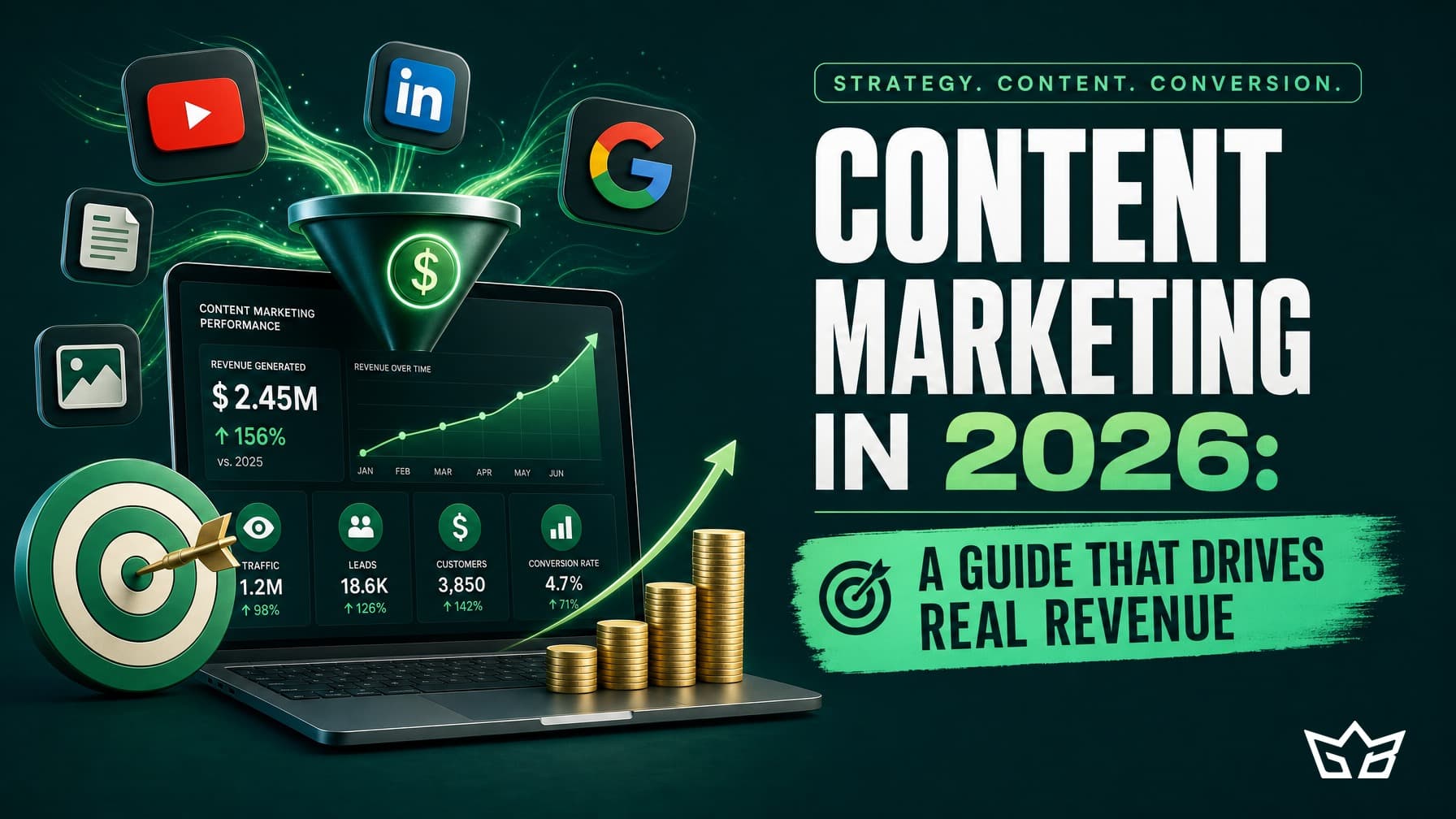
Content Marketing in 2026: A Guide That Drives Real Revenue
Content marketing is creating useful articles, guides, and videos that answer what your customers search for, so they find and trust you before they buy. Done consistently, it drives revenue for years.
Content marketing is the practice of creating useful articles, guides, videos, and other material that answers the questions your customers already have, so they find and trust you before they are ready to buy. It drives revenue by earning attention over time instead of renting it through ads, which means a steady program keeps working long after each piece goes live.
In 2026 the mechanics have shifted, but the core idea has not. People still search, they just do it across Google, AI answer tools, YouTube, and social feeds at once, so good content marketing has to show up with clear answers in all of those places.
What content marketing actually is
Strip away the jargon and content marketing is simple: you help people first, and selling comes second. A plumber who writes an honest guide on what a burst pipe repair costs in Toronto is doing content marketing. So is a SaaS company that publishes a clear comparison of two tools. The material answers a real question, ranks in search, gets quoted by AI, and quietly builds the case that you know your field.
This is different from advertising, where you pay to appear and stop appearing the moment the budget runs out. Content you publish stays online and keeps attracting readers for years. That compounding effect is why a smart content strategy is one of the few marketing investments that gets cheaper per lead as it matures.
Why content still works in the age of AI answers
A lot of business owners assume AI chat tools killed content marketing. The opposite is closer to the truth. Those tools do not invent answers from nothing. They summarise and cite the clearest, most trustworthy pages they can find, and if your site is one of them, you get named in the answer and the click that often follows.
What changed is the standard. Thin, padded articles that used to scrape by no longer rank or get quoted. Well-structured SEO content that answers a question directly in the first two sentences, backs it up with specifics, and reads like a human wrote it now wins on both Google and AI answer engines. Write for the person, structure for the machine, and you cover both.
The content types that pull their weight
You do not need every format. You need the few that match how your buyers decide.
- Answer-first blog posts and guides: the workhorse of any content strategy, ideal for questions people type into search.
- Comparison and pricing pages: these catch people close to a decision and quietly earn content that converts.
- Case studies: proof beats promises, and a specific story of a real result does more than ten adjectives.
- Short video and social clips: the way most people discover you before they ever visit your site.
- Email: the channel you actually own, where content turns readers into repeat customers.
Planning content around real search demand
The biggest waste in content marketing is writing about what you find interesting instead of what people are looking for. Start with demand. Pull the questions your sales team hears every week, check what phrases people search, and see what AI tools currently say when someone asks about your category. Then build a simple list of topics ranked by how close each one sits to a buying decision.
Group those topics into clusters so a few strong pillar pages link out to supporting articles. That structure helps readers, and it signals depth to search engines. If your brand voice and positioning are not nailed down yet, sort that first. Our take on brand and creative work is that a clear message makes every piece of content land harder.
Distribution: getting the content seen
Publishing is the halfway point, not the finish line. A good piece with no distribution is a good piece nobody reads. Every article should have a plan for how it reaches people: search through solid on-page website SEO, an email to your list, two or three social posts pulled from the same content, and outreach when the topic warrants it.
Reusing one piece across channels is how small teams keep up. One strong guide becomes a newsletter, a LinkedIn post, a short video script, and a section of a sales deck. You wrote it once, so put it to work several times.
Measuring content marketing
Vanity metrics feel good and pay nothing. Track the numbers that connect to money: organic traffic to pages that target buying-intent topics, how many of those readers become leads, and which specific articles show up in the paths that lead to closed deals. Rankings and impressions matter as leading indicators, but revenue is the scoreboard.
Give it an honest window. Judging a content program after four weeks is like weighing yourself the day after you start training. Look at trends over quarters, prune pages that never gained traction, and double down on the topics that quietly bring in customers.
Content is a habit, not a campaign
Here is the part most agencies skip. Content marketing is ongoing work, not a project with an end date. It is closer to going to the gym than building a shed. You do not publish twelve articles, declare victory, and coast. Competitors keep publishing, search engines favour maintained pages, and AI tools cite whoever is current. Stop for six months and your rankings soften, your traffic dips, and the leads thin out. The businesses that win treat content as a steady monthly rhythm, refreshing old pages as often as they publish new ones.
DIY or hire a content marketing agency
If you have a strong writer in-house who knows the business and can protect a few hours a week, do it yourself and stay close to the work. Most small and mid-market teams in the GTA cannot sustain that pace once things get busy, which is when a content marketing agency or steady content writing services earn their keep. The right partner brings strategy, consistency, and an outside read on what your Toronto-area buyers actually search for, so you are not guessing.
Want a content program that brings in customers month after month instead of a stack of posts nobody reads? Get in touch and we will map out a plan built around what your market is already searching for.
Frequently asked questions
What is content marketing?
Content marketing is the practice of creating and publishing useful material (articles, guides, videos, and more) that answers your customers questions so they find you before they are ready to buy. Instead of interrupting people with ads, you earn their attention by being genuinely helpful. The goal is to build trust that turns into leads and sales over time.
Does content marketing still work in 2026?
Yes, and arguably more than before. AI answer tools and search engines both need reliable source material to quote, and clear, well-structured SEO content is exactly what they pull from. The businesses that publish consistently get cited, ranked, and remembered, while those who stopped after a few posts fade out.
How much do content writing services cost?
In Canada, expect roughly $150 to $600 CAD per article from a freelancer or agency, depending on research depth, length, and strategy involved. A managed content program with strategy, writing, and distribution usually runs $1,500 to $6,000 CAD per month. Cheaper AI-only output exists, but it rarely ranks or converts without editing and a real point of view.
How long until content marketing works?
Most businesses see early movement in 3 to 6 months and meaningful lead flow around 6 to 12 months. New sites and competitive niches sit at the longer end. The timeline depends on publishing frequency, topic choice, and how much authority your site already has.
Is content marketing a one-time project or ongoing?
It is ongoing. Content marketing is closer to going to the gym than building a shed. You can pause, but the gains you built start sliding back because competitors keep publishing and search engines favour fresh, maintained pages. Plan for a steady monthly rhythm rather than a single burst of posts.
Reviewed by Keston Leader under our editorial policy.