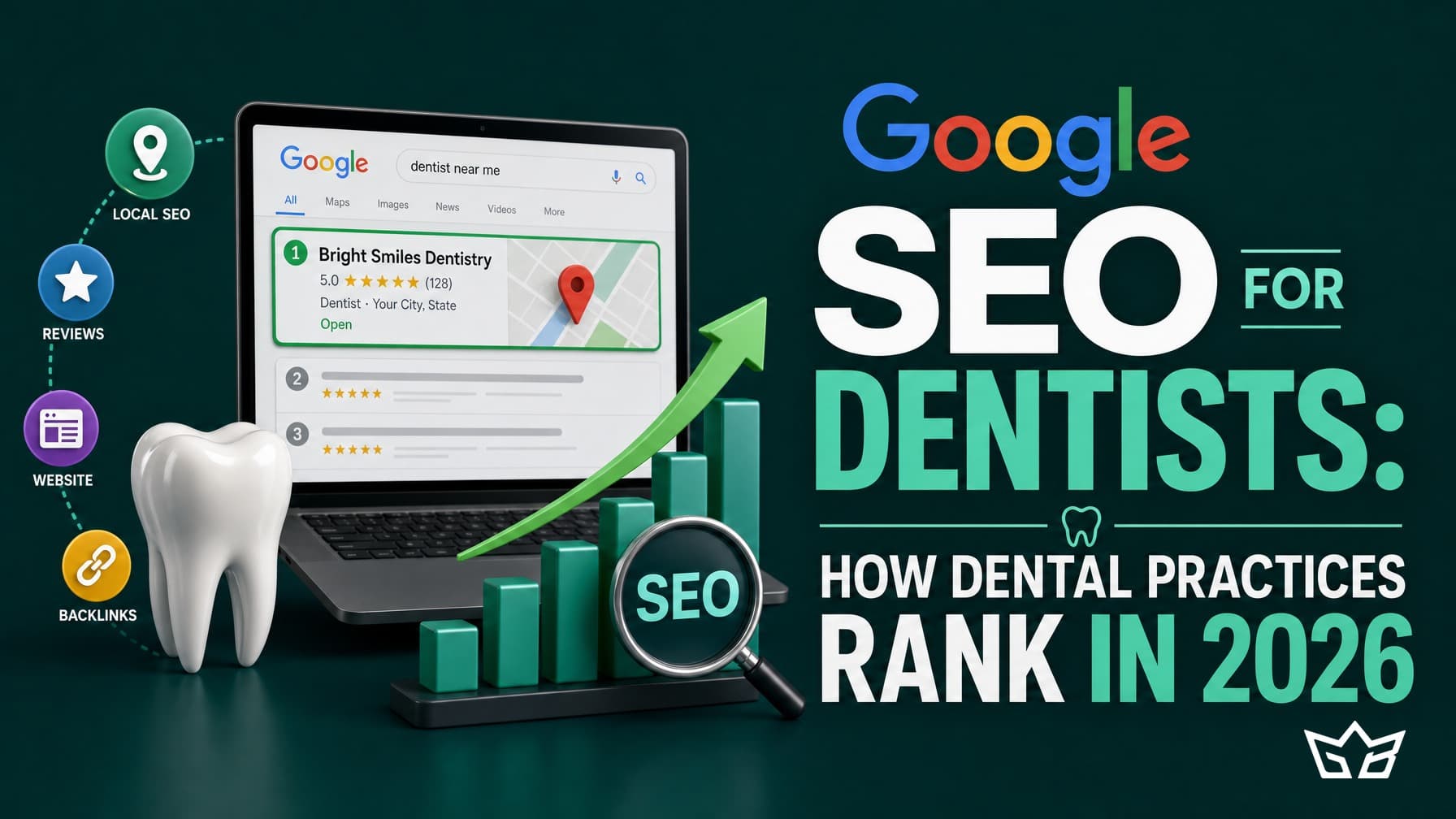
SEO for Dentists: How Dental Practices Rank in 2026
Dental SEO is how a practice earns the top of Google for searches like 'dentist near me' and 'teeth whitening in [city]'. This guide covers what actually moves dental rankings in 2026: local SEO, reviews, a healthy website, and the content patients search for. Plus the honest truth about how long it really takes.
When someone nearby needs a dentist, they open Google and type something like 'dentist near me'. Whoever shows up at the top gets the call. Dental SEO is how you make that you. It is the work of getting your website, your Google Business Profile, and your local reputation set up so your practice ranks for the searches new patients actually make. Do it well and Google becomes a steady source of new-patient bookings that does not charge you for every click.
Here is what moves dental rankings in 2026, in plain terms, including the part most agencies leave out about how long it really takes.
What is dental SEO?
Dental SEO means improving where your practice ranks in Google for the searches your future patients type: 'dentist near me', 'family dentist in [city]', 'emergency dentist', 'Invisalign [city]', 'teeth whitening', and hundreds of variations. Unlike Google Ads, you do not pay per click. You earn the spot by being the most relevant and trusted result.
For a clinic it comes down to two jobs that work together. Local SEO gets you into the map and the 'near me' results. On-page and technical SEO get your website ranking in the regular results and loading fast enough to keep visitors. You need both.
Why dental practices live or die by local SEO
Dentistry is local. Almost nobody drives an hour for a cleaning. So the most valuable spot on the page is Google's local map pack, the three clinics shown with a map, star ratings, and a call button. Those three spots take most of the local clicks and sit above the regular results.
Three things get you there: a complete, active Google Business Profile, consistent listings of your name, address, and phone across the web, and a healthy flow of recent patient reviews. Get those right and you are in the running for the most visible position a local search shows.
The five things that actually move dental rankings
1. A complete Google Business Profile
Claim and fill out your profile. Use the right categories (Dentist, plus specific ones like Cosmetic Dentist or Emergency Dental Service), correct hours, services with real descriptions, genuine photos of the office and team, and regular posts. An active, complete profile is the base every 'near me' ranking is built on.
2. Consistent name, address, and phone
Your name, address, and phone number need to match everywhere they appear: your site, Google, Yelp, health directories, and dental listings. When they do not match, Google gets confused and quietly holds your rankings back. Cleaning this up is often the fastest win a practice can make.
3. A steady flow of reviews
Reviews do two jobs. They help you rank, and they convince a nervous patient to pick you. Winning practices have a simple routine for asking every happy patient for a review and replying to each one. Recent reviews matter more than a big burst from two years ago.
4. Fast, mobile-friendly pages
Most dental searches happen on a phone, and Google pays close attention to page experience. A slow site, or one that jumps around as it loads, costs you rankings and bookings. It is worth checking your Core Web Vitals, and you can do that for free with our website audit tool.
5. A page for every service and area you serve
Google can only rank you for a service if you have a clear page about it. Separate pages for Invisalign, dental implants, teeth whitening, emergency care, and each neighbourhood you serve give Google something specific to match to a specific search. This is the same content engine we cover in SEO that works while you sleep.
Your website is where the booking happens
Your site is where a searcher decides whether to book. For dental website SEO that means a clear title and description on every page (with the service and city), descriptive headings, alt text on images, links between related treatment pages, and schema markup so Google knows you are a dental practice with specific services and reviews. It also means content that actually helps. A worried patient searching 'does a root canal hurt' who lands on a calm, clear answer from your clinic is a patient who books.
Content that wins patients, and AI answers
Search is changing. More and more, patients get their answer straight from Google's AI Overviews or from ChatGPT before they ever click. That does not make content less important. It makes clear, well-structured answers more important. Practices that answer real patient questions plainly (costs, recovery, procedures, insurance) get pulled into those AI answers and into the 'People also ask' box. We break down that shift in GEO vs SEO.
The truth: SEO is ongoing maintenance, not a one-time project
Here is the part most SEO pitches skip. SEO is not a one-month job. It is not even a one-year job. It is day-to-day maintenance work, closer to keeping the office clean than to a renovation you finish once.
Why does it never really stop? Your competitors do not sit still. Google changes how it ranks sites many times a year. Fresh reviews and fresh content are signals that your practice is active and worth trusting. And technical issues quietly creep in as your site grows. A practice that stops the day the initial work ends usually starts sliding backward within a few months.
Month to month, healthy dental SEO looks like this: publishing and refreshing content, earning new reviews and replying to them, keeping the Google Business Profile active with posts and photos, fixing technical issues as they show up, adding pages for new services, and watching what patients search for so you can adjust. The clinics that hold the map pack year after year are the ones that treat SEO as a habit, not a one-off.
What it costs
Be realistic. Map-pack gains from a cleaned-up profile and listings can show in about 4 to 8 weeks. Ranking pages for competitive treatment terms usually takes 3 to 6 months, and it keeps building after that. On price, most Canadian practices invest between $750 and $3,000 a month depending on how competitive their city is. A Toronto or GTA practice sits at the higher end, because more clinics are fighting for the same searches. And since SEO is ongoing, treat it as a monthly investment, not a one-time bill.
Competing as a dental practice in the GTA
In a crowded market like the Greater Toronto Area, dozens of practices chase the same terms, so the basics have to be sharp: an active Google Business Profile, more and fresher reviews than the clinic down the road, fast pages, and a page for every service and suburb you serve. The practices that treat SEO as an ongoing habit, not a one-time setup, are the ones that hold the map pack year after year.
That steady local visibility is what our local SEO services and our Website & SEO service are built to deliver. If you want a straight read on where your practice stands and the quickest wins available, book a free growth call. We will walk your results with you, no pressure.
Frequently asked questions
What is dental SEO?
Dental SEO is improving where a dental clinic ranks in Google for searches like 'dentist near me', 'family dentist [city]', or 'teeth whitening'. It covers your website, your Google Business Profile, and your local reputation. The goal is a steady flow of new-patient enquiries from search, without paying for every click.
How much does dental SEO cost?
Most dental practices in Canada invest between $750 and $3,000 a month, depending on how competitive their city is and how much content and local work is needed. A competitive metro like Toronto or the GTA sits at the higher end. Be careful with anyone promising the number one spot for a flat one-time fee, because SEO is ongoing work.
How long does dental SEO take to work?
Local map-pack gains can show in about 4 to 8 weeks once your Google Business Profile and listings are cleaned up. Ranking pages for competitive terms usually takes 3 to 6 months, and it keeps building from there. SEO grows over time, unlike paid ads that stop the moment you stop paying.
Do dentists need local SEO?
Yes. Dentistry is almost entirely local, since patients look for a dentist near where they live or work. Local SEO, meaning your Google Business Profile, the map pack, local listings, and reviews, is where most new-patient clicks come from, so it is the best place to start.
Is dental SEO a one-time thing or ongoing?
Ongoing. SEO is maintenance work, not a one-time setup. Competitors keep improving, Google updates its systems regularly, and fresh reviews and content are ranking signals. Practices that stop after the initial work usually slide back within a few months, while the ones that stay on top keep at it every month.
Is SEO worth it for a dental practice?
For most practices, yes. A new patient can be worth thousands over their lifetime, and search brings in people who are looking for a dentist right now. Once you rank, the enquiries keep coming without a per-click cost, which usually makes SEO one of the lowest cost-per-acquisition channels a clinic has.
Reviewed by Keston Leader under our editorial policy.