How to Rank in Google AI Overviews: The 2026 Playbook
How to rank in AI Overviews in 2026: what Google actually cites, the page fixes that earn the link, and how to track it in Search Console's new report.
Ranking first on Google used to mean you were the answer. Not anymore: when Ahrefs re-ran its study of AI Overview sources in March 2026, only 38% of the pages cited in AI Overviews also ranked in the top 10 for the same query, down from about 76% in July 2025. So if you want to know how to rank in AI Overviews, start here: it is a close cousin of classic SEO, not the same job.
The audience is enormous. At Google I/O in May 2026, Sundar Pichai said AI Overviews now has over 2.5 billion monthly active users, and AI Mode passed 1 billion. We covered the lost clicks in our AI Mode traffic survival plan. This playbook is narrower: how to get cited inside Google's answer, and how to prove it.
How AI Overviews pick sources
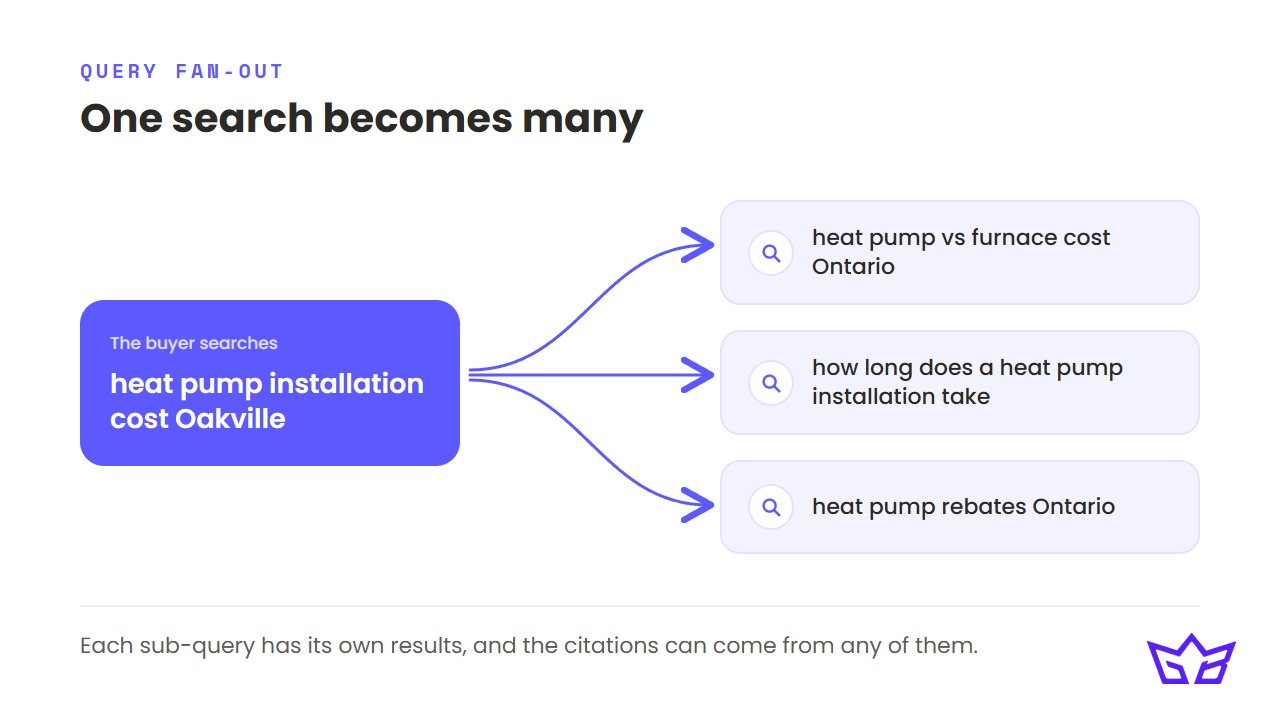
Google's own guide to optimizing for generative AI features is plain about it. The system pulls current pages from the normal Search index, writes a response and links its sources. First, it runs what Google calls query fan-out: "a set of concurrent, related queries generated by the model to request more information."
Google's example: someone asks "how to fix a lawn that's full of weeds," and the system also searches "best herbicides for lawns," "remove weeds without chemicals" and "how to prevent weeds in lawn." Each sub-query has its own results, and the citations can come from any of them.
That explains the drop in top-10 overlap. In the Ahrefs study of 4M AI Overview URLs, 31.0% of cited pages did not rank in the top 100 at all. Ahrefs' explanation: AI Overviews now lean more on fan-out results than on the original page of results.
What that means for a local business
Picture a Burlington HVAC company. A homeowner searches "heat pump installation cost Oakville." The fan-out might add "heat pump vs furnace cost Ontario," "how long does a heat pump installation take" and "heat pump rebates Ontario." A pricing page that answers all four gets four chances at a citation. One vague price paragraph gets one.
You are no longer competing for one keyword. You are competing for every question Google asks on your buyer's behalf.
Pass the three eligibility gates first
Make sure Google is allowed to cite you:
- Indexed and snippet-eligible. Google says a page "must be indexed and eligible to be shown in Google Search with a snippet." A nosnippet tag or tight max-snippet setting, often added by a plugin, limits what Google can show.
- Not excluded in Search Console. As of August 31, 2026, every site has a Search generative AI control under Settings. Google is blunt: "If you exclude your site, links to your site and your site's content won't appear in Search generative AI features."
- Crawlable. Content behind a login, inside blocked scripts or on a server that times out never enters the pool. The same rules cover AI Mode, which Google began rolling out in Canada, in English, on August 21, 2025.
Open Search Console today and confirm the Search generative AI control includes your site. It takes one minute, and nothing else in this post works without it.
What Google says to ignore
Here is the part most "AI SEO packages" skip. Google's guide lists tactics you do not need:
- llms.txt and AI files. "You don't need to create new machine readable files, AI text files, markup, or Markdown to appear in Google Search."
- Chopping pages into fragments. "There's no requirement to break your content into tiny pieces for AI to better understand it." Google adds: "There's no ideal page length."
- Special schema. "Structured data isn't required for generative AI search, and there's no special schema.org markup you need to add."
- Manufactured mentions. "Seeking inauthentic 'mentions' across the web isn't as helpful as it might seem."
- Tools that claim inside access. "Be wary of third-party tools that promise ranking success or claim to use 'internal' Google metrics."
"From Google Search's perspective, optimizing for generative AI search is optimizing for the search experience, and thus still SEO." Google, guide to optimizing for generative AI features
Our read: AI Overviews SEO, like most AI search optimization on Google, is ordinary SEO done with tighter writing and more specific facts. Keep your Organization and LocalBusiness schema, because it still earns rich results and must match the visible text on the page. Just stop paying anyone for "AI Overview markup." ChatGPT and Perplexity are different systems with different source habits, and our AEO, GEO and LLMO guide covers those separately.
How to rank in AI Overviews
Once you are eligible, how to rank in AI Overviews comes down to being the clearest answer to the sub-questions. Four moves do most of the work.
Write headings that match real questions
Use the questions buyers type as your headings. "What does a heat pump installation cost in Oakville?" beats "Our Pricing" every time. Then answer in the first sentence or two under the heading: the number, the range, the condition that changes it.
No chopping needed, as Google says. But a phone reader wants the answer first, and so does a system hunting for a passage to cite.
Cover the fan-out on one strong page
List the five to eight questions a buyer asks next. Pull them from three places:
- People Also Ask boxes for your main query.
- Search Console queries that already send impressions to the page.
- Your sales calls and inbox, where the real objections live.
Answer them on the one page that deserves to rank, not on eight thin posts. Google's guide warns that pages made mainly to game AI responses can break its scaled content abuse policy.
Trade adjectives for facts
"Fast, affordable installs" gives Google nothing to cite. "Most single-zone installs take one day, and every quote includes removal of the old unit" gives it a sentence to lift and attribute to you. Prices, timelines, warranty terms and service areas all qualify.
Google's guide says unique, non-commodity content is likely to matter most over time: "Create the content yourself based on what you know about the topic." A rewrite of the top three results is a commodity. Your own pricing and job data are not.
Add video and real images
Google's guide says relevant images and video create extra chances to appear. Ahrefs' data backs it up: YouTube is the most cited domain in AI Overviews, at 5.6% of all AI Overview citations, and it grew 34% over six months. Among cited pages that did not rank in Google's top 100 for the query, 18.2% were YouTube URLs.
A two-minute phone video answering your most common quote question, posted to YouTube and embedded on the page, gives you two shots at the citation.
Trust signals Google can check
AI Overviews sit on top of Google's normal quality systems, so skipped trust work now shows in the answer box. Google's helpful content guidance asks:
- "Is it self-evident to your visitors who authored your content?"
- "Do pages carry a byline, where one might be expected?"
- "Do bylines lead to further information about the author or authors involved"
On E-E-A-T, the same guidance says it straight: "Of these aspects, trust is most important." For your business, that means a named author with real credentials (licensed electrician, CPA, 15 years in commercial roofing), an author page, a real address and a working phone number.
Make your business record match everywhere
Google's guide names Google Business Profiles and Merchant Center feeds as ways to help products and services show up in AI responses. Keep its categories, services, hours and photos current, and use the same business name, address and phone everywhere. Our 10-minute AI visibility diagnostic walks through those listing checks.
Rule of thumb: if a stranger cannot tell who wrote the page, where your business is and why you know the topic, Google's systems cannot either.
Update facts, not dates
Freshness gets oversold for Google. Ahrefs analyzed 17 million citations across 7 AI search platforms in July 2025 and found most AI assistants cited fresher content than organic results. The exception was Google's AI Overviews, which cited content 16 days older on average. In Ahrefs' words, "Google is the least influenced by content freshness."
So do not fake recency. Google's helpful content guidance flags it as a warning sign: "Are you changing the date of pages to make them seem fresh when the content has not substantially changed?"
What works instead:
- Update when the facts change. New prices, new rebate rules, a new regulation, a year in the title.
- Review your top 10 money pages every quarter. Fix stale numbers and dead links, and show an "Updated" date only when a reader would notice the change.
AI visibility tracking
Until this year, tracking AI Overview citations meant guesswork. On June 3, 2026, Google announced a generative AI performance report in Search Console, and it reached all websites worldwide by August 31, 2026.
What the Search Console report shows
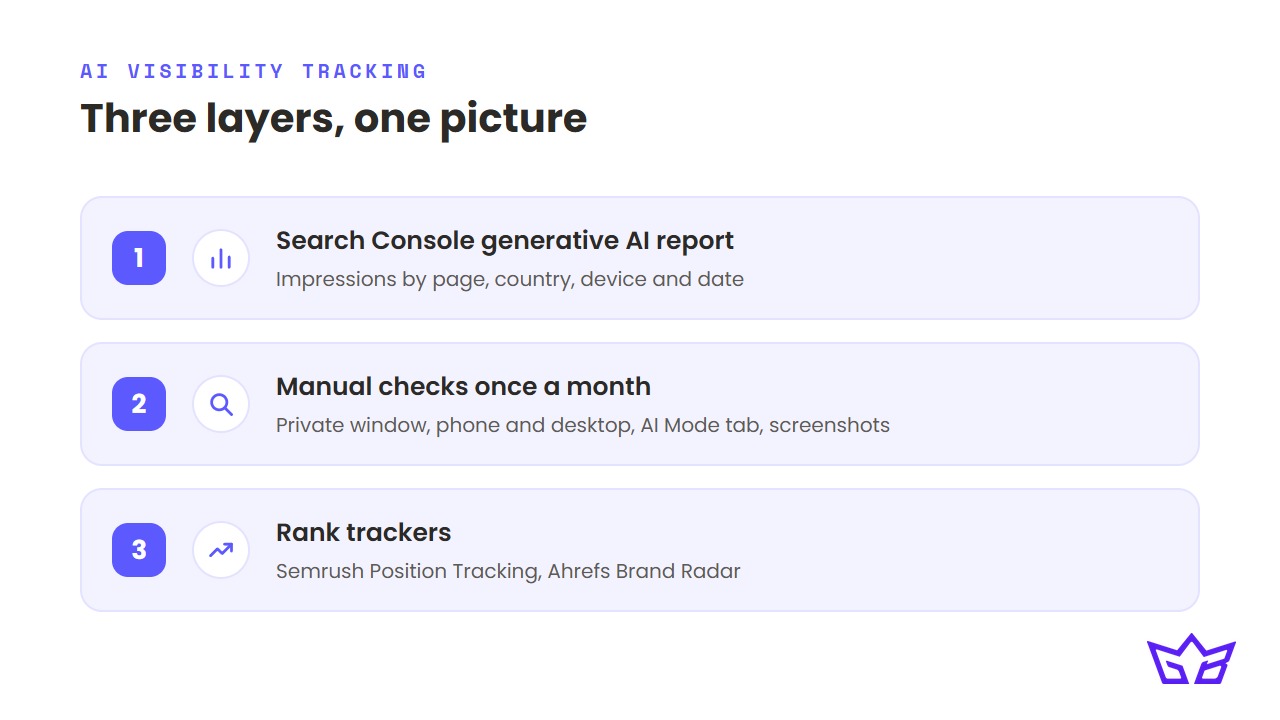
The generative AI performance report counts impressions: "how many times links to your site were shown to a user in a generative AI feature on Google Search," covering AI Overviews and AI Mode. You can break it down by page, country, device and date. Know the limits:
- Impressions only. The report shows no clicks and no queries. Clicks from AI features are counted inside your overall Web search traffic, not split out.
- One impression per feature. Multiple results from your site in one AI feature count as a single impression in the chart total.
- It can be missing. Sites with too few AI feature impressions may not see the report at all.
Export it monthly and set each page's AI impressions beside its clicks in the Performance report. New to the tool? Start with our Google Search Console guide.
Manual checks once a month
Search Console tells you that you were shown, not for which query or next to whom. Pick your 15 most valuable queries and check each in a private, signed-out window, on a phone and a desktop, from your service area, AI Mode tab included. Record whether an AI Overview appeared and who was cited, with screenshots. Answers vary by person and location, so judge the three-month trend, not one result.
Rank trackers
Semrush Position Tracking flags the keywords in your campaign where an AI Overview appeared and whether your site was featured in it. Ahrefs Brand Radar tracks AI Overview citations across a large keyword set; it is the data behind the 38% study. Both show competitor gaps. Neither has inside access to Google.
Fewer clicks from a cited page is not automatically a loss. Google says that when people click from results pages with AI Overviews, "these clicks are higher quality." Judge cited pages on leads, not sessions.
Your next step
Open Search Console before your next meeting. Check the Search generative AI control, export the generative AI report, and line up your 10 money pages against their AI impressions. If your service and pricing pages show zero impressions while a competitor keeps getting cited, that is your gap. Rewrite the top five answer-first this month, then run your manual check again in 30 days. That is how to rank in AI Overviews in practice: one page, one sub-question, one fact at a time.
If you would rather hand it off, our AI SEO agency team runs this exact audit and rewrite for GTA businesses. Get a free audit and we will show you which pages Google cites, which it skips, and what to fix first.
Frequently asked questions
How do I get my website in Google AI Overviews?
Make sure your page is indexed, eligible for a snippet, and not excluded by the Search generative AI control in Search Console. Then answer the questions buyers ask, including the follow-ups Google fans out to, with specific facts under clear headings. No markup or file guarantees inclusion.
Does schema markup help you rank in AI Overviews?
Not directly. Google says structured data isn't required for generative AI search and there is no special schema.org markup for it. Keep it for rich results, as long as it matches the visible text on the page.
Can you pay to appear in AI Overviews?
You cannot buy an organic citation. Google Ads can show ads within AI Overviews and AI Mode in Canada, in English, through existing Search, Shopping and Performance Max campaigns, but those are ad placements, not source citations. You also can't target ads exclusively to AI Overviews or AI Mode.
Does Google Search Console show AI Overviews data?
Yes. Since August 31, 2026, the generative AI performance report has been available to all websites, showing AI Overviews and AI Mode impressions by page, country, device and date. It shows no clicks or queries, and sites with too few impressions may not see it, so pair it with monthly manual checks.
Can I remove my site from AI Overviews?
Yes. Set the Search generative AI control in Search Console to exclude your site, and links and content won't appear in AI Overviews, AI Mode or Discover's generative features. Google says the setting doesn't affect your regular Search rankings.
Reviewed by Gabriel Narsaik under our editorial policy.