How Much Does Video Production Cost in Toronto? (2026 Prices)
Video production cost in Toronto, explained: the 8 price drivers, 3 pricing models, hidden costs to ask about, and real published session rates.

Ask three Toronto video companies to quote "a short video for our website" and you can get three numbers thousands of dollars apart, with all three being fair. That is because video production cost in Toronto is not set by how long the finished video runs. It is set by how many people show up, how long they stay, and how much work happens after the camera turns off.
Below: what moves the price, the three ways video is sold, what each type of shoot involves, our own published rates as a worked example, and the hidden costs to ask about before you sign.
Video production cost in Toronto
There is no official rate card for video in this city. Freelancers, agencies and production houses all price differently, and few publish their numbers.
What you can anchor to is labour. Canada's Job Bank wage data for video camera operators puts the median in the Toronto Region at $39.00 an hour, with a range of $19.00 to $55.30 (wages updated November 18, 2026). That is what an employer pays a staff operator on payroll. A freelancer or agency quoting you has to cover a lot more out of their rate:
- Camera, lenses, audio kit and lighting, which wear out and need replacing
- Insurance and travel time
- Pre-production: calls, shot lists and scripts
- Editing, which can take longer than the shoot itself
- The days between bookings when nobody is paying
So when a quote looks high next to a $39 hourly wage, the gap is mostly everything except the hour on set.
The useful question is not "how much is a video?" It is "how many hours of whose time, and what do I get at the end?"
The 8 things that set the price
Every video production cost you are quoted is some mix of these eight levers. Change one and the number moves.
- Crew size. One videographer who shoots, records audio and lights the scene is the lean option. Add a director, a sound recordist, a lighting tech and a producer and you are paying four or five people instead of one.
- Shoot length. Many crews sell time in blocks: two hours, a half day, a full day. Time on set is usually the biggest single line on the quote.
- Locations. Every move means packing up, travelling, re-lighting and re-checking audio. Three locations in one day can lose a big chunk of the schedule to setup alone.
- Scripting and planning. A founder talking from bullet points needs a shot list. A 30-second ad with a voiceover needs a written, approved script before anyone films.
- Editing rounds. Ask how many rounds of changes are included. A third and fourth round is where many cheap quotes get expensive.
- Number of deliverables. One 90-second brand film and a dozen vertical reels can come from the same footage, but each one is a separate edit with its own hours.
- Music licensing. Stock music is not automatically cleared for ads. Epidemic Sound, for example, says its music can be used in ad campaigns only on its Pro or Enterprise plans.
- Travel. Downtown Toronto, Mississauga and Hamilton are not the same trip, and many crews add a travel fee outside their home area.
Picture a dental clinic that wants a one-minute homepage video: one location, one dentist, talking points, one edit plus three Instagram clips. That is a lean, one-person job. A scripted ad with actors, three locations and a voiceover is a different budget, even though both are "a one-minute video."
Three ways you get quoted
Video is sold in three main pricing models. None is better across the board; each fits a different need.
- By the session (hourly, half-day or full-day). You reserve a block of crew time. Best when you know what you want to film and want a predictable number. Watch for whether editing is inside the price or billed on top.
- Per video (a project quote). The producer prices the finished film: script, shoot, edit and revisions. Best for one high-stakes piece like a brand film or an ad. Watch for what counts as a revision, and what happens if the scope grows halfway through.
- Monthly retainer. A set fee for a steady flow of content, usually a regular shoot plus ongoing editing. Best when video feeds your social calendar and ad account every week. Watch for minimum terms and whether unused shoot time rolls over.
If you are leaning toward the retainer model, our breakdown of social media management packages in Canada shows how video usually sits inside a monthly content plan.
Social clip, brand film or ad
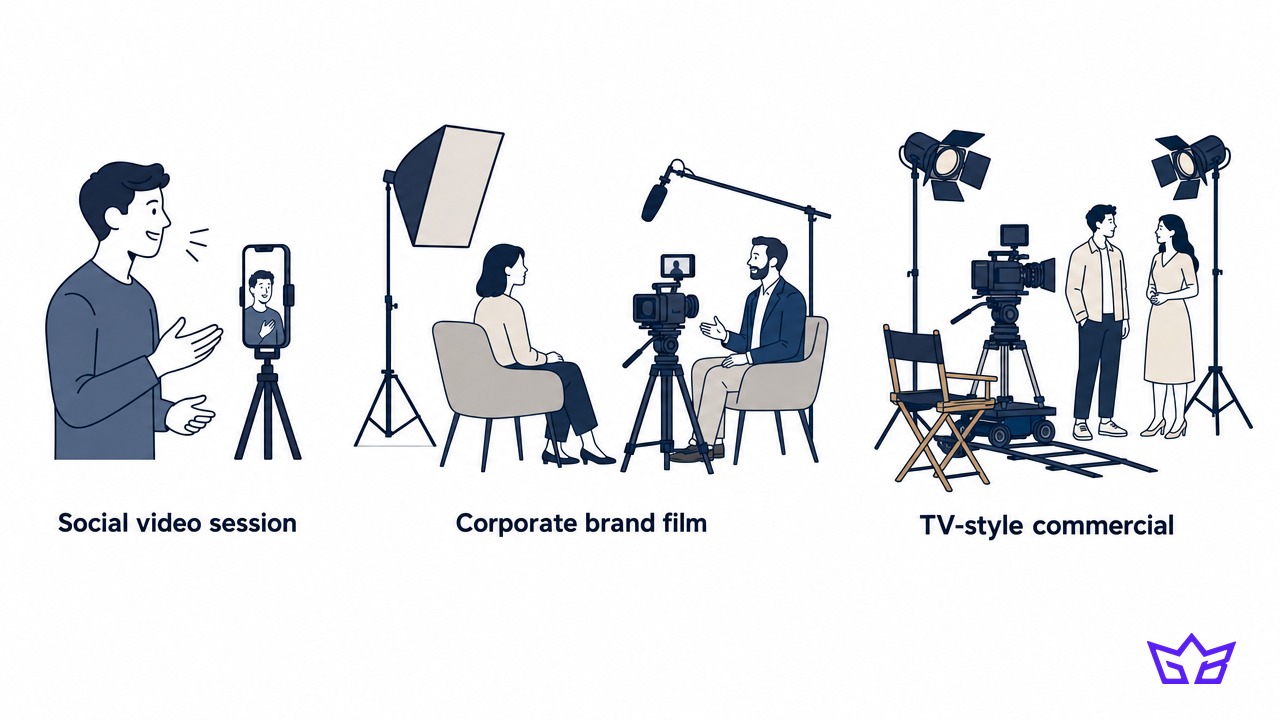
Three very different jobs all get called "a video."
A social video session
The goal is volume: several short vertical videos for Instagram Reels, TikTok and YouTube Shorts. One videographer, one location, a list of hooks and talking points, and a fast edit with captions for sound-off viewing. The value comes from planning, not from a bigger crew. If you are wondering why simple, phone-style content often outperforms glossy work on these platforms, we covered the data in UGC ads vs polished ads.
A corporate brand film
Usually one to three minutes, for your homepage, sales deck or recruiting page. It needs sit-down interviews, B-roll of your team and space, and a clear story from problem to proof. Expect more planning calls, often more than one location, careful audio, and a longer edit with music, colour correction and graphics.
A TV-style commercial
A scripted spot built around one concept, with actors or presenters, props, sometimes permits and a larger crew. If you cast union performers, ACTRA's National Commercial Agreement sets their pay terms, which is its own budget line separate from the crew. This is where people, days and approval rounds multiply, so quotes are always custom.
Takeaway: decide which of the three you actually need before you ask for quotes. Most small businesses need the first one far more often than the third.
Our prices as a worked example
Many production companies ask you to call for a number. We publish ours, so here is exactly what a Growth Boss shoot costs. All prices are in CAD, plus HST.
- 2-hour session: $750. Good for a focused batch of short social videos.
- 4-hour session: $1,500. Room for more setups, a wardrobe change or a second area of your space.
- Full day: $2,000. Six hours or more on site, for a big batch or a brand film plus social cuts.
Every session includes the same core:
- A professional videographer with camera, audio and lighting
- Editing, included in the price, with all raw footage handed over
- Edited videos delivered within seven business days
- Filming on-site anywhere in Toronto and the GTA, or at our downtown Toronto studio
A $50 deposit holds your date and counts toward your total, and the balance is due 24 hours before the shoot. On-site shoots add a travel fee based on distance, and sessions at our studio have none. With Ontario's 13% HST, the totals come to $847.50, $1,695 and $2,260.
The math that matters when you compare quotes: a 2-hour session at $750 works out to $375 an hour, with gear and the edit already inside that number. A videographer who quotes a lower hourly rate but bills editing separately can easily end up costing more for the same result.
Compare quotes on what you hold at the end (how many edited videos, in which formats, with how many revision rounds), not on the hourly rate.
Sessions run on weekdays from 9 am to 5 pm and need at least 48 hours' notice. Evening and weekend shoots, TV commercials and multi-day projects are planned and quoted separately. You can see everything in our Toronto video production packages.
Get more videos from one shoot
The cheapest video you will ever make is the one filmed while the crew is already set up. Setup and travel are fixed; every extra video spreads them thinner.
Batch your scripts
Write your hooks and talking points before the day, grouped by topic. A renovation company could film "three mistakes when hiring a contractor," "what slows down a kitchen reno" and "what a permit actually covers" back to back, one person, one outfit, minimal resets.
Plan several setups in one place
One location can look like three: a desk interview, a walking shot through the shop floor and close-ups of product, all without moving the van.
Change one thing between batches
A jacket swap or a new background keeps a month of posts from looking like one Tuesday.
Frame vertical and horizontal on purpose
A horizontal shot cropped to vertical often loses the product. Framing for both on the day gives you clean versions for your website and Reels.
Bank B-roll for later
Ten minutes of your team working, your space and your product covers months of ad variations and caption backgrounds. If you want the system that turns one shoot into a steady publishing rhythm, our video acquisition engine for new customers maps the full loop.
Takeaway: arrive with a written list of every video you want from the session. A shoot without a list produces one video. A shoot with a list produces a batch.
Hidden costs to ask about
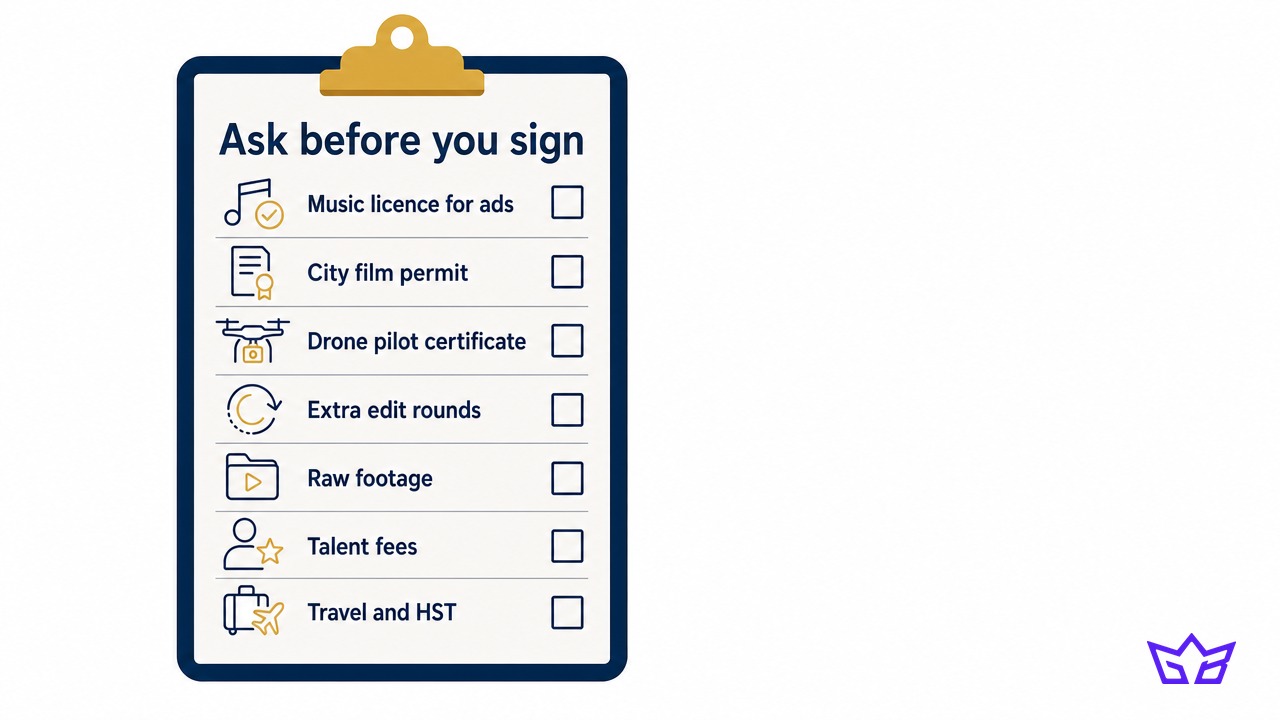
These lines turn a reasonable quote into a surprise invoice. Ask about each one in writing.
- Music licences for ads. Ask whether the music is cleared for paid ads, not just organic posts.
- City film permits. According to the City of Toronto film permit rules, filming entirely on private property between 7 a.m. and 11 p.m. needs no permit from the Film Office. Filming on City property for more than an hour does. For commercials, the City lists a $100 production registration fee and a $150 location permit.
- Drone shots. Under Transport Canada's advanced operations rules, flying a small drone in controlled airspace or closer than 30 metres to bystanders requires an advanced pilot certificate, and controlled airspace also needs permission from NAV CANADA. A "quick aerial" is rarely quick.
- Extra revision rounds. Find out how many rounds are included and what a fourth round costs.
- Raw footage. Some crews charge to hand over the raw files, or keep them. If you plan to recut later, this matters.
- Talent. Actors, models and voiceover artists are paid separately from the crew, and union rates apply if you cast union performers.
- Travel and parking. Ask for the travel fee upfront if you are outside the crew's home area.
- HST. Quotes in Ontario are usually before 13% HST. On a $2,000 shoot that is another $260.
Your next step
Before you request a single quote, write down every video you want in the next 90 days. Mark which ones need a script, which need a specific location, and which could be filmed in the same room. That one list tells any producer how many hours you need, and it stops you paying for a full day when two hours would do.
If your list fits a session, compare it against our Toronto video production packages and pick the length that covers it. If you are planning a commercial or a multi-day shoot, or you want a second opinion on what to film first, get in touch and we will tell you what we would shoot and why.
Frequently asked questions
How much should a 3 minute video cost?
Video production cost for three minutes depends far more on what is in them than on the running time. A single interview or explainer filmed in one location is a short session plus a careful edit, while a scripted three-minute film with several locations, actors and motion graphics is a custom project. At Growth Boss, a 4-hour session is $1,500 plus HST with editing included; multi-location or commercial work is quoted separately.
How much does a videographer cost per hour in Toronto?
Canada's Job Bank lists a median of $39.00 an hour for employed video camera operators in the Toronto Region. Freelancers and agencies charge more because their rate also covers gear, insurance, editing and unbilled time between jobs. Our 2-hour session works out to $375 an hour with camera, audio, lighting and editing included.
Is editing included in video production pricing?
Sometimes, and it is the first thing to confirm on any quote. Some hourly videographers bill editing separately, which can change the real cost a lot. Every Growth Boss session includes editing, with edited videos delivered within seven business days.
Do I pay HST on video production in Ontario?
Yes, if your supplier is registered for GST/HST, video production in Ontario is charged 13% HST. Under the CRA's small supplier rules, a business with no more than $30,000 in taxable sales over four straight quarters does not have to register, so a small freelancer may not charge it. If your own business is an HST registrant, you can generally claim the tax back as an input tax credit.
Is it cheaper to film in a studio or at my business?
Filming at your business usually saves a studio fee and shows customers your real space. A studio makes sense when your location is cramped, noisy or badly lit, or when you need a clean backdrop or a working kitchen. At Growth Boss the session price is the same in both places, but on-site shoots add a travel fee and studio sessions do not, so the studio can come out slightly cheaper.
Reviewed by Bahaa Zuraik under our editorial policy.