Website Redesign Services: Canadian Costs and When You Need One
What website redesign services cost in Canada in 2026, how to tell if you need one, and how to keep your Google rankings through the switch.

Most website redesign services get bought for the wrong reason. The site feels dated, a competitor launched something shiny, and a few months later you own a prettier version of the same problem: the same enquiry volume, the same bounce rate, and sometimes fewer Google rankings than you had before.
A redesign is worth the money when the old site is blocking something specific, and expensive theatre when it is not. This guide covers how to tell the difference, what website redesign services cost in Canada in 2026, how to keep your rankings through the switch, and how to choose between Shopify and WordPress if the platform is changing too.
For context, we redesign and build sites as a website development company serving Oakville and the GTA, and every number below is either our published price or a sourced market figure.
Do you actually need one?
Age alone is not a reason. A four-year-old site that loads fast, ranks and produces enquiries does not need replacing. Here is what does justify a website redesign:
- Your team cannot edit it. Changing a phone number or adding a service page needs a developer ticket, every time.
- It fails Core Web Vitals on mobile. Open the Core Web Vitals report in Google Search Console. If most of your mobile URLs sit in "Poor" or "Needs improvement", the problem usually lives in the theme and the page builder, not in one image.
- The business has outgrown it. You added services, a second city or online ordering, and the navigation still describes the company you were three years ago.
- The platform is a dead end. The theme stopped receiving updates, a key plugin was abandoned, or the site cannot connect to your CRM or booking tool.
And here is what does not: you are bored of it, your nephew said it looks old, or a competitor just relaunched.
If the problem is the words on the page, a new design will not fix it. Read why a website is not converting before you sign anything, because unclear offers and weak calls to action survive every redesign.
The fastest way to get an objective read is our free website audit tool. It scores a page across Performance, SEO, Accessibility, Technical Health and Content Quality, adds an AI search score, and returns a letter grade with a prioritized fix list. If the fixes are mostly small (title tags, alt text, a slow hero image), you need optimization, not a redesign.
Refresh, redesign or rebuild?
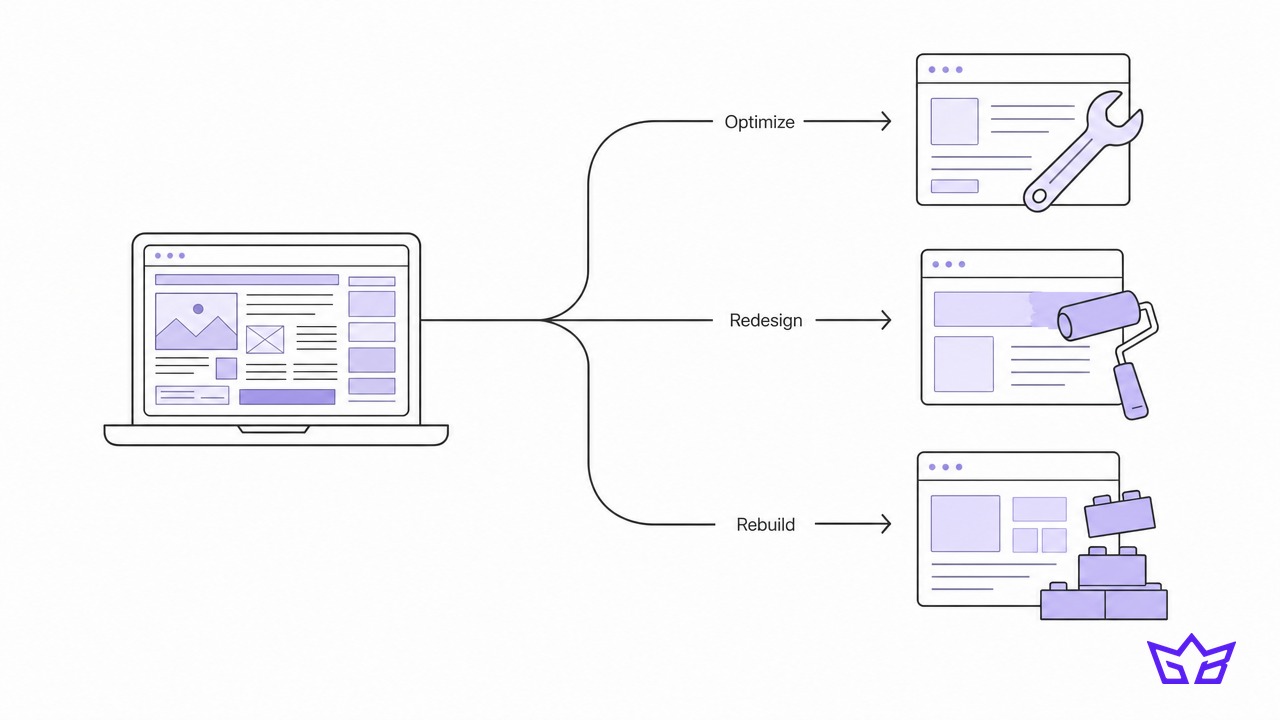
"Website redesign" covers three very different jobs, and mixing them up is how quotes end up three times apart. Before you collect proposals, decide which one you are buying:
- Optimize. Same site, same platform, same URLs. You fix navigation, mobile usability, conversion paths and on-page SEO. Lowest cost and lowest risk.
- Redesign. New design and page templates on the same platform, with most URLs kept. This is what most owners mean when they ask for website redesign services.
- Rebuild or replatform. New platform, often a new URL structure, with content and data migrated across. Moving from Wix to WordPress, or from WooCommerce to Shopify, lands here. Highest cost, highest SEO risk.
A useful rule: if your site structure is sound and the problems are conversion and speed, optimize first and redesign later if the numbers still lag. Often the single highest-return page is the homepage, and the principles in homepage design that turns clicks into cash apply whether you touch one page or forty.
What website redesign services cost
Here is the honest answer to how much a website costs in Canada when you are replacing one rather than starting from zero.
Market ranges. Our own guide to small business website costs in Ontario puts starter sites at $1,500 to $4,000, standard small business sites at $4,000 to $10,000 and custom agency builds at $5,000 to $20,000. For website redesign services specifically, a September 2026 Toronto guide from the agency Kolonell estimates $7,000 to $11,000 for a partial redesign and $13,000 to $20,000 for a full one on a B2B services site.
Growth Boss prices, published on our packages and pricing page, all CAD with taxes extra:
- Website optimization: $750. Navigation, mobile usability, conversion paths and on-page SEO on your existing site. Included in our Super Growth package.
- Landing page: $1,500. One conversion-focused page, built and launched.
- Website: from $2,499. Up to 5 pages, or a store with up to 5 products. Extra products are $100 each, and bigger scopes are quoted before work starts.
What moves a redesign quote
Redesigns add costs that a new build never has, all coming from the site you already own:
- How many URLs you have. A 12-page brochure site and a 400-page site with a blog and product catalogue need very different redirect maps.
- Reuse or rewrite. Moving existing copy into new templates is fast. Rewriting every service page is a content project with its own timeline.
- Data migration. Products, customer accounts, order history and blog archives all have to come across intact, and ecommerce data is where migrations go over budget.
- Integrations to rewire. Forms, CRM, booking, payments and analytics tags all break when templates change.
- SEO protection. Kolonell itemizes a 301 redirect plan at $500 to $1,500 and 90 days of post-migration monitoring at $500 to $1,300. Some agencies bundle this, some skip it. Ask which.
A quote that does not mention redirects is not cheaper. It is moving the cost to your Google traffic.
Keep your rankings intact
This is where website redesign services most often go wrong, and most proposals cover it in one vague line. Google's own site move guidance is clear on the mechanics, so use it as your checklist:
- Inventory before you design. Crawl the current site with Screaming Frog, then export your top landing pages from Search Console's Performance report and GA4. Those pages are what you are protecting.
- Keep URLs that rank. The safest redirect is the one you never need. If /services/roof-repair ranks, the new site keeps /services/roof-repair.
- Map every changed URL one to one. Google recommends permanent redirects (301 or 308), sent straight to the final destination with no chains, and warns against pointing many old URLs at one unrelated page. Redirecting your whole blog to the homepage throws that value away.
- Keep what earns the ranking. On your top pages, carry over the title tag, the main heading and the substance of the copy. Redesign the layout around them.
- Launch cleanly. Remove the staging site's noindex tag or robots.txt block, submit the new XML sitemap in Search Console, and confirm your GA4 and conversion tags still fire.
- Leave the redirects alone. Google says to keep them for at least 1 year, and for visitors, ideally forever.
Expect some movement. Google notes that on a medium-sized site it can take a few weeks or more before the new URLs replace the old ones in results, and that rankings settle over time. A dip in week two is normal; a drop that is still falling after a month usually means something in the map is broken.
Treat Core Web Vitals as a spec
A redesign is the cheapest moment to fix speed, because the templates are being rebuilt anyway. Write Google's "good" thresholds into the brief, as defined on web.dev: Largest Contentful Paint within 2.5 seconds, Interaction to Next Paint of 200 milliseconds or less, and Cumulative Layout Shift of 0.1 or less, measured at the 75th percentile of page loads on mobile and desktop. Then test the staging site against them before launch, not after.
Own the keys
You should own the domain, the hosting account and the code at the end of any redesign. That is our standing position on every build: we hand over access, documentation and training, and never hold logins as a retention strategy. Licensed items such as a premium theme, plugins or stock photos stay under their own licence.
Shopify vs WordPress
If your website redesign includes a platform change, choose by who runs the site after launch, not by what the agency prefers to build on.
- Shopify fits businesses selling products that want checkout, payments and inventory handled for them. The Basic plan is $49 CAD a month, or $37 a month billed yearly, according to Shopify's Canadian pricing page. Apps add to that.
- WordPress fits teams that publish often and want a CMS they already know. It runs 40.1% of all websites, per W3Techs, so talent and plugins are easy to find. The trade-off: someone has to own updates and security.
- Custom (we build on Next.js) fits when you need something the platforms cannot do, or when performance matters more than editing convenience.
Do not switch platforms to fix a design problem. Replatforming moves you into the rebuild bucket, with the highest cost and the most SEO risk. Switch when the platform blocks something you sell or need, such as a store that has outgrown WooCommerce.
How long a redesign takes
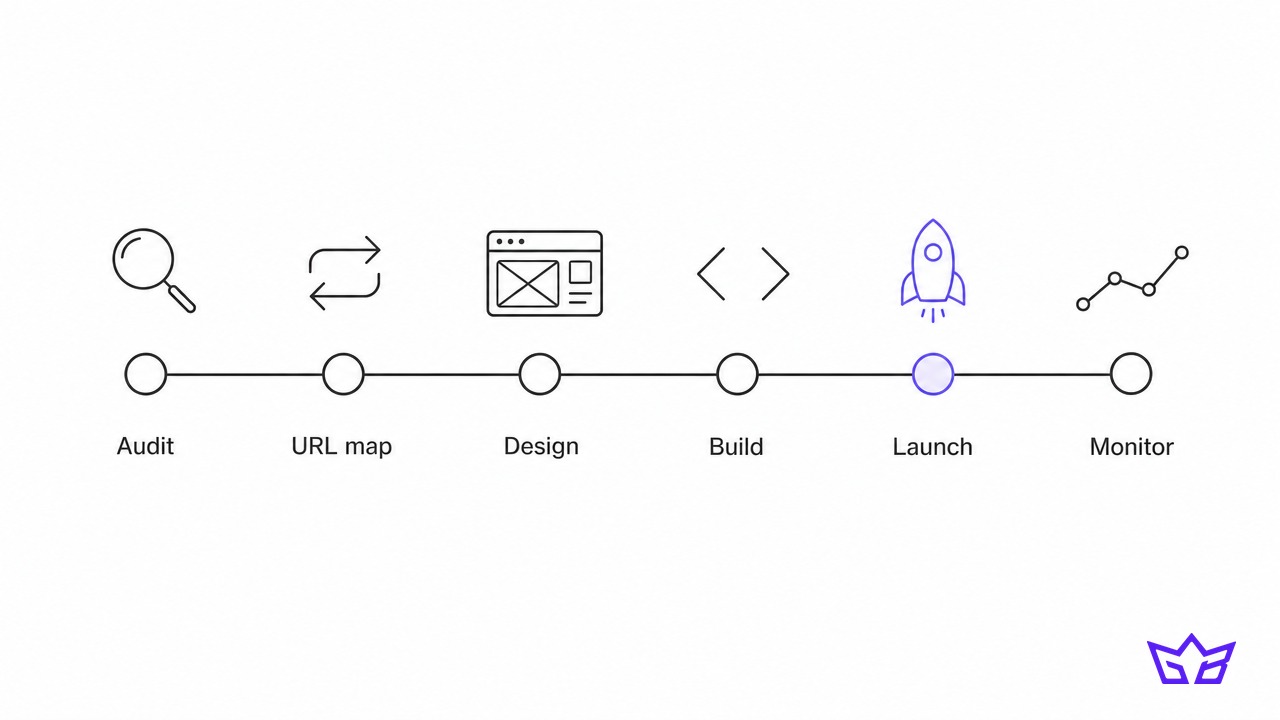
A focused marketing site is usually live in three to six weeks with our team. Larger builds and ecommerce migrations run longer. The sequence:
- Audit and URL map. Crawl the old site, list the pages worth protecting, agree the sitemap.
- Design on real screens. You approve the look on actual page layouts, not a mood board.
- Build and content load. Templates, copy, images, forms, integrations and the redirect map.
- Launch and monitor. Redirects live, sitemap submitted, rankings and conversions watched for the next few months.
Redesigns slip on content and approvals, not development: late copy, uncleaned product data, and feedback from five people who disagree. Name one person who owns approvals, and put content deadlines in the plan before kickoff.
Hiring a redesign partner
Whether you hire a freelancer or a web design company for website redesign services, five questions separate a real proposal from a pretty one:
- "Who owns the domain, hosting and code when we finish?" The only acceptable answer is you.
- "Show me a redirect map from a past project." Anyone serious about SEO preservation has one.
- "What is excluded?" Copywriting, photography, data migration and licence fees are the usual gaps.
- "What are the Core Web Vitals targets, and when do you test them?" Listen for "before launch".
- "Is maintenance required to keep the site?" Ours is optional and priced separately. It should never be a condition of owning what you paid for.
Good website development services answer all five in writing, before you sign.
Your next step
Do two things this week. Run your homepage and your best service page through the free audit, then export your top 20 landing pages from Search Console. Those two lists tell you whether you need a $750 optimization, a redesign on the same platform, or a full rebuild, and they are the first thing any provider of website redesign services should ask you for.
For a second opinion, talk to a web design company in Oakville and the GTA that publishes its prices and hands you the keys. Get in touch and we will tell you honestly which of the three jobs your site needs.
Frequently asked questions
How much does it cost to redesign a website in Canada?
It depends on page count, content rewriting, data migration and whether the platform changes. A September 2026 Toronto guide puts partial redesigns at $7,000 to $11,000 and full ones at $13,000 to $20,000. At Growth Boss, a full website starts at $2,499 for up to 5 pages, and website optimization on a site worth keeping is $750.
How long does a website redesign take?
A focused marketing site is usually live in three to six weeks; ecommerce stores and platform migrations take longer. Most delays come from late content and slow approvals, not development.
Is it better to redesign or build a new website?
Redesign on the same platform when the structure, URLs and platform still work and the problem is design, speed or conversion. Rebuild when the platform blocks something you need, such as ecommerce or a CRM connection. If the issues are small, optimize the current site first.
Will a website redesign hurt my SEO?
It can, but the damage is avoidable. Keep URLs that rank, 301 redirect every changed URL to its closest match, carry over title tags and copy on top pages, and keep the redirects for at least 1 year. Google says rankings can take a few weeks to settle after URLs change.
How often should you redesign your website?
There is no fixed schedule. Redesign when your team cannot edit the site, it fails Core Web Vitals on mobile, the business has outgrown the navigation, or the platform stops being supported. Otherwise, optimize what you have.
Reviewed by Gabriel Narsaik under our editorial policy.