How to Get Found by ChatGPT
How ChatGPT picks which businesses to recommend, the 4 places it looks, what changed in 2026, and a simple 30-day plan to get found. Free audit inside.
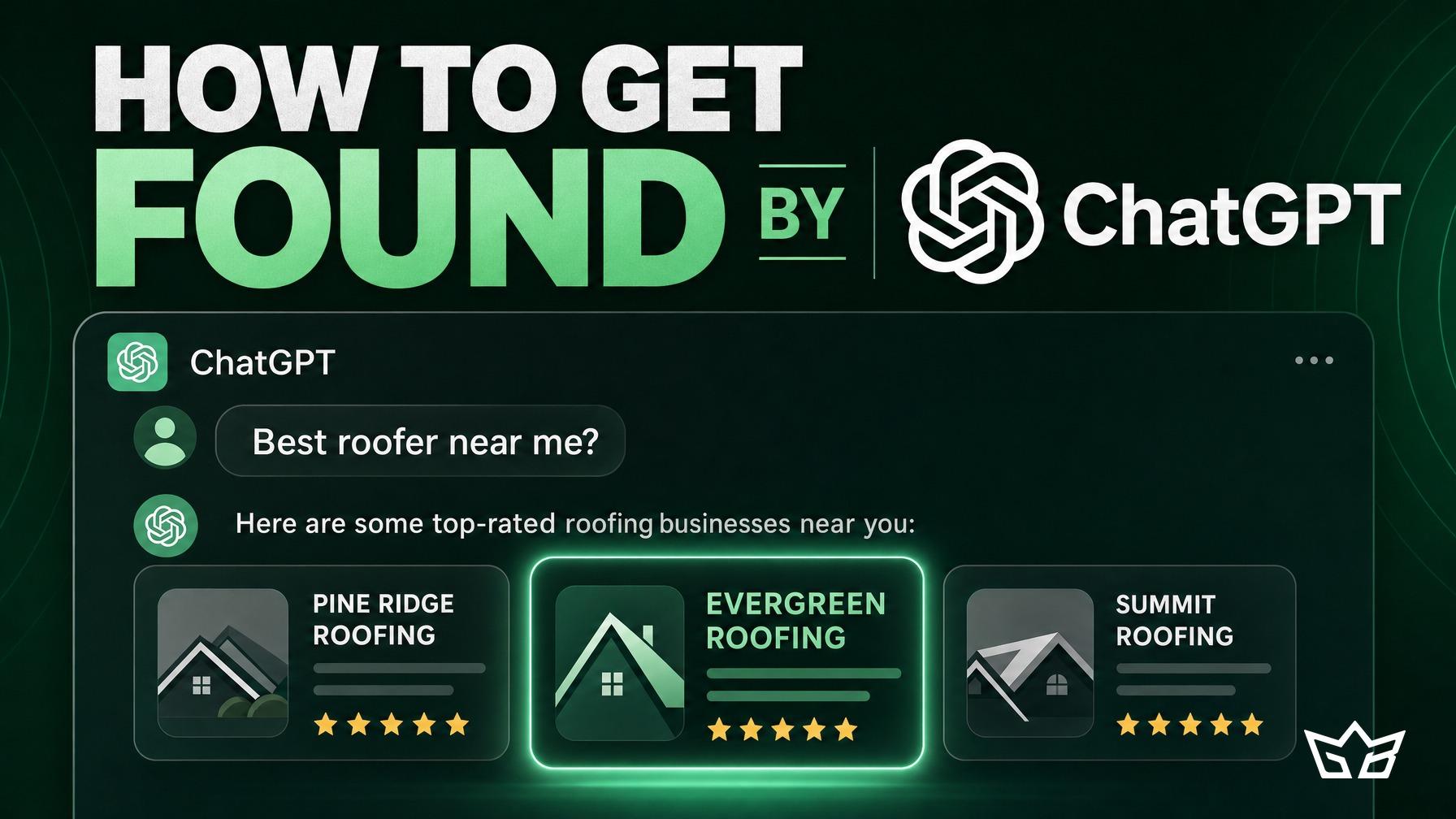
Ask ChatGPT for "the best roofer in Oakville" or "a good accountant for a small business in Mississauga" and it will happily name names. The question is whether one of those names is yours. Learning how to get found by ChatGPT is quickly becoming as basic as getting found on Google, and most business owners have never been told how it actually works.
The good news: you don't need to be technical to fix it. ChatGPT finds businesses in a handful of predictable places. This guide explains those places in plain English, shows what changed in 2026, and gives you a simple 30-day plan.
Why getting found by ChatGPT matters now
OpenAI said in February 2026 that ChatGPT had about 900 million weekly users. A growing share of them now ask it the same questions they used to type into Google: who to hire, where to eat, which product to buy.
Here's the catch. ChatGPT is far pickier than Google. SOCi's 2026 Local Visibility Index looked at roughly 350,000 business locations and found ChatGPT recommended just 1.2% of them. Google's local map pack showed the same brands 35.9% of the time. (We broke down that gap in the local business AI-visibility gap.)
So most businesses are invisible in ChatGPT today, including plenty that rank well on Google. That's a problem, but it's also an opening. The bar is low, and the businesses that act first get named first.
How ChatGPT decides which businesses to mention
Think of ChatGPT as a well-read assistant with two ways of knowing about you.
1. Its memory. ChatGPT learned from a huge amount of text published online up to a certain date. If your business was talked about a lot (news stories, Wikipedia, popular forums), it may "remember" you. Most small businesses aren't in that memory in any meaningful way.
2. Looking you up live. For questions about local businesses, prices or anything recent, ChatGPT searches the web in real time, reads what it finds, and writes an answer with links. This is where most businesses win or lose, and it's the part you can actually influence.
When it looks things up, it doesn't use Google. Most tests point to Bing and a set of data partners. OpenAI says it uses trusted third-party providers for nearby business listings, and it signed a deal with Yelp (more on that below). That's why a business can sit at the top of Google Maps and still never come up in ChatGPT.
Plain-English version: ChatGPT doesn't rank websites the way Google does. It reads what the internet says about you, checks a few trusted sources, and recommends the businesses that look most clearly real, relevant and well-reviewed.
The four places ChatGPT looks for your business
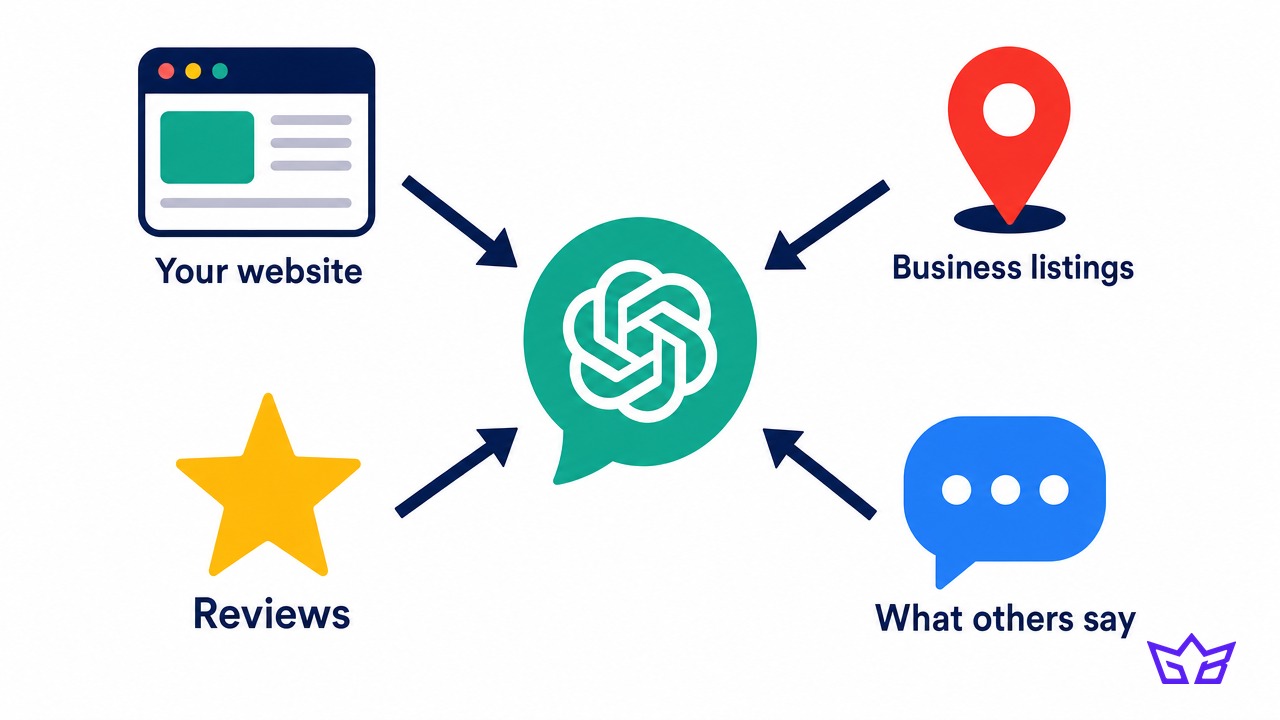
Almost everything ChatGPT knows about a local or small business comes from four places. Fix these and you've done most of the work.
1. Your website
When BrightLocal ran 800 local searches in ChatGPT, business websites made up 58% of the sources it pulled from. Your own site is still the single biggest source, as long as ChatGPT is allowed to read it.
What that means in practice:
- Let OpenAI's search crawler in. OpenAI's own help page says sites should not block "OAI-SearchBot" if they want to appear in ChatGPT search answers. Some website firewalls and security plugins block it by accident. Your web person can check this in five minutes.
- Say what you do in plain words. A page titled "Welcome" tells ChatGPT nothing. A page that says "Family-run roofing company serving Oakville and Burlington since 2009" tells it exactly who you are and where.
- Answer real questions on the page. Prices or price ranges, service areas, hours, what's included, how long a job takes. ChatGPT loves pages that answer the question a customer would type.
2. Business listings
Your name, address, phone number and hours live on dozens of directories: Google, Bing Places, Apple Business Connect, Yelp, Facebook, your local chamber of commerce. ChatGPT cross-checks these.
If one listing says you close at 5 and another says 6, or your old address is still floating around, ChatGPT gets less confident you're the right answer. Make every listing say exactly the same thing. Bing Places matters more than most owners realize, because it feeds the search engine ChatGPT leans on most.
3. Reviews
This is the one that changed most in 2026. On July 23, 2026, Yelp announced it was licensing its reviews, ratings, photos and business details to OpenAI. ChatGPT can now show Yelp ratings and photos, with Yelp branding and links, right inside its answers.
Reviews also act like a filter. In SOCi's study, the locations ChatGPT recommended averaged 4.3 stars. A business sitting at 3.6 stars with 12 reviews from 2022 is unlikely to make the cut, no matter how good its website is.
- Ask every happy customer for a review, every week, not once a year.
- Spread reviews across Google and Yelp, not just one platform.
- Reply to reviews, good and bad. It shows you're active and real.
4. What others say about you
ChatGPT trusts other people's opinions of you more than your opinion of yourself. Ahrefs' September 2026 data found Reddit was the most-cited website in ChatGPT answers, at 16.8% of citations, followed by Wikipedia at 7.0%.
For a small business, "what others say" usually means:
- A mention in a local news story or a "best of" list for your city
- Being named in a supplier, partner or industry association directory
- Customers mentioning you in local Facebook groups or on Reddit
- A podcast or YouTube interview with you as the expert
You don't need hundreds of these. A handful of real mentions on trusted sites does more than a hundred mentions on junk directories.
What ChatGPT can and can't be paid to do
Short answer: you can buy an ad, but you can't buy the recommendation.
ChatGPT started showing ads in Canada on April 16, 2026, for people on the Free and Go plans. Plus, Pro and Business users don't see ads. OpenAI has said ads are clearly labeled and kept separate from the answer itself, so paying for an ad does not make ChatGPT recommend you in its response.
That's why getting found by ChatGPT the organic way matters. The answer ChatGPT writes is earned, not bought, and it's the part people trust.
How to check if ChatGPT can find you
Before you fix anything, see where you stand. It takes about 10 minutes.
- Open ChatGPT in a private browser window (so your own history doesn't skew the results).
- Ask the questions your customers ask. For example: "Who's the best [your service] in [your city]?" and "Is [your business name] any good?"
- Ask each question three times. ChatGPT's answers vary, so one test isn't enough. Count how often you appear.
- Write down who gets named instead of you. Then look them up on Yelp, Bing and Google. Usually you'll spot the pattern fast: more reviews, more recent reviews, or more mentions around the web.
- Check your website analytics. ChatGPT adds "utm_source=chatgpt.com" to the links it sends, so visits from ChatGPT show up in Google Analytics as their own source.
If you want a deeper version of this test, our 10-minute ChatGPT diagnostic walks through each check step by step.
Your 30-day plan to get found by ChatGPT
Here's the order we'd do things in for a typical small business. Each week builds on the last.
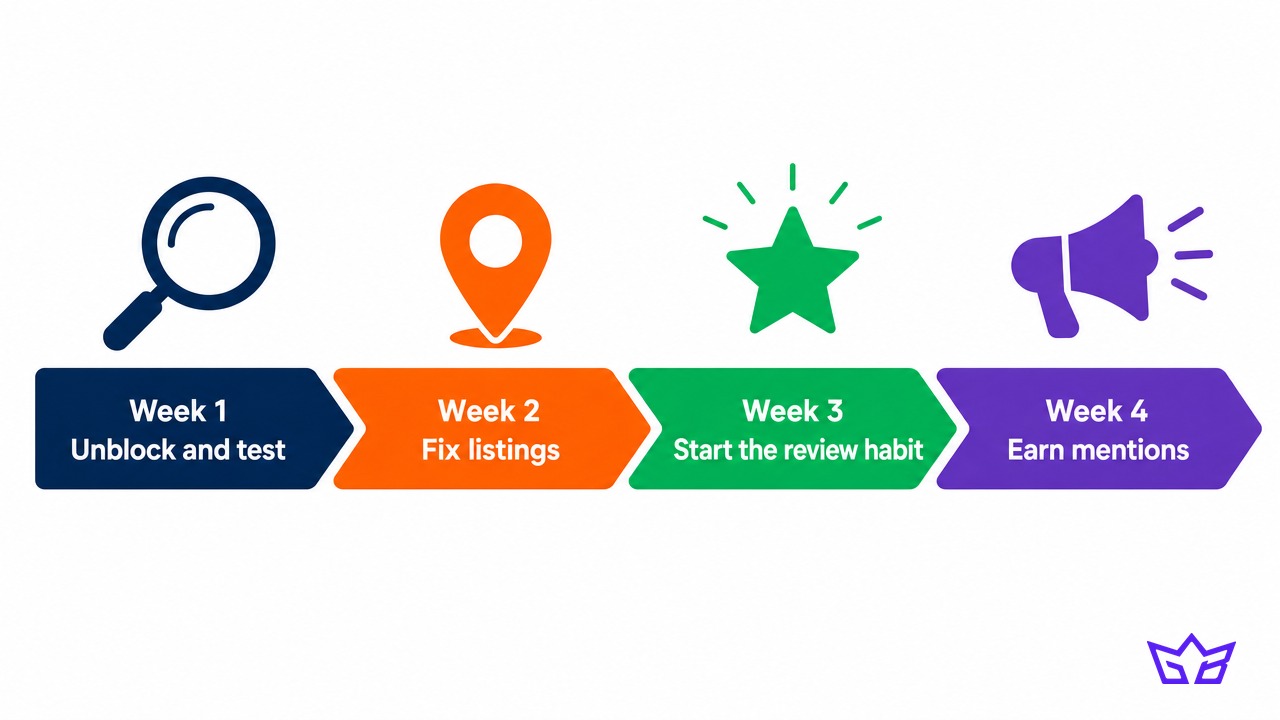
Week 1: Unblock and test. Run the 10-minute check above. Ask your web person to confirm OAI-SearchBot isn't blocked and that your site shows up in Bing. Rewrite your homepage's first line so it says what you do and where.
Week 2: Fix your listings. Claim and update Google, Bing Places, Apple Business Connect and Yelp. Make your name, address, phone and hours identical on every one. Remove or correct old addresses.
Week 3: Start the review habit. Set up a simple review request that goes out after every job or purchase. Aim for a steady few reviews a week across Google and Yelp, and reply to every one.
Week 4: Earn a few mentions. Pitch one local news outlet or blog, join your industry association's member directory, and ask two partners to list you on their sites. Add a page to your website that answers your customers' top five questions.
Then repeat the ChatGPT test from Week 1. Changes don't show up overnight, but within a month or two you should see your name appear more often.
For the more technical items (schema markup, robots.txt, Bing indexing), our ChatGPT business profile checklist covers each one in detail.
When to get help
Most of this plan is doable on your own. Where owners usually get stuck is the ongoing part: tracking how often ChatGPT names you, figuring out why a competitor keeps beating you, and earning the mentions that move the needle.
That's what our AI SEO agency team does every day. We start with a free AI visibility audit: we run your customers' real questions through ChatGPT, Gemini and Perplexity, show you who gets recommended instead of you, and give you a ranked list of what to fix first. If your bigger gap is Google Maps, our local SEO services cover listings and reviews too, which helps you in both places at once.
Frequently asked questions
Does my business show up on ChatGPT?
The only way to know is to test it. Open ChatGPT in a private window, ask "Who's the best [your service] in [your city]?" three times, and count how often you're named. Then check Google Analytics for visits with "chatgpt.com" as the source.
How do I get my business recommended by ChatGPT?
Make sure OpenAI's search crawler can read your website, keep your listings identical across Google, Bing, Apple and Yelp, collect steady reviews (ChatGPT's picks averaged 4.3 stars in SOCi's 2026 study), and earn a few mentions on trusted local or industry sites.
Does ChatGPT use Google Business Profile?
Not directly, as far as anyone can tell. ChatGPT's live search leans on Bing and third-party data providers, and Yelp licensed its reviews to OpenAI in July 2026. Keep your Google profile updated anyway, since the same details get copied across the web.
Can I pay to be recommended by ChatGPT?
No. ChatGPT ads launched in Canada in April 2026, but they are labeled and kept separate from the answer. OpenAI says ads don't change what ChatGPT recommends, so the recommendation itself has to be earned.
How long does it take to show up in ChatGPT?
Simple fixes like unblocking the crawler or correcting listings can take effect within weeks, once ChatGPT's sources refresh. Reviews and third-party mentions take longer, usually a few months of steady effort.
Reviewed by Gabriel Narsaik under our editorial policy.