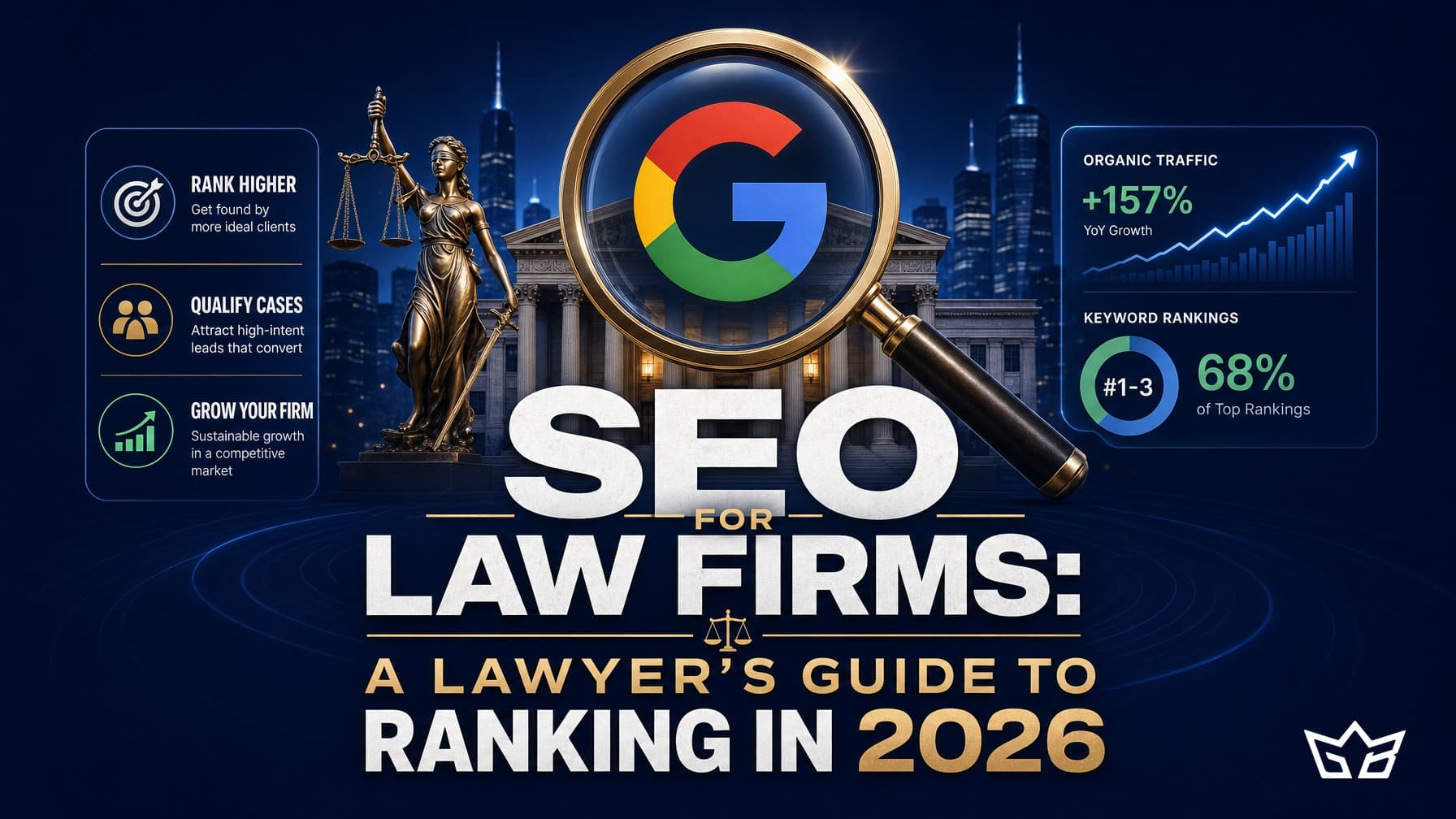
SEO for Law Firms: A Lawyer's Guide to Ranking in 2026
Law firm SEO is how attorneys earn the top of Google for high-value searches like 'personal injury lawyer [city]' and 'divorce attorney near me'. This guide covers what moves legal rankings in 2026: local SEO, practice-area pages, reviews, and the trust signals legal content needs. Plus the honest truth about how long it really takes.
When someone needs a lawyer, they rarely ask a friend first. They search. 'Personal injury lawyer near me', 'divorce attorney [city]', 'employment lawyer free consultation'. Whichever firm sits at the top of those results wins the call. Law firm SEO is how you make that firm yours. And because a single case can be worth many times the cost of the marketing, ranking for legal searches is one of the highest-return channels an attorney has.
Here is what moves legal rankings in 2026, why the rules for lawyers are stricter than almost any other industry, and the honest truth about how long it takes.
What is law firm SEO?
Law firm SEO is the work of getting your website, your Google Business Profile, and your local reputation set up so your firm ranks higher in Google for the searches potential clients make. Unlike pay-per-click ads, where legal keywords are among the most expensive anywhere, SEO earns those positions and keeps sending enquiries long after the work is done.
It comes down to three parts: local SEO (the map pack and 'near me' searches), practice-area and location pages (the content that ranks for specific case types), and the trust signals Google expects from legal content.
Why SEO matters more for lawyers
Two things make legal SEO unusually valuable. First, intent. Someone searching 'car accident lawyer' has a problem right now and is ready to hire. Second, value. One retained client can be worth thousands or tens of thousands of dollars, so even a few new cases a month pays for the work many times over. Firms that own their market's search results rarely have to compete on price, because the clients come to them.
Local SEO for law firms
Most legal searches are local, which makes Google's map pack, the three firms shown with a map, ratings, and a call button, the most valuable position on the page. Winning it comes down to a complete, active Google Business Profile (correct practice-area categories, hours, photos, and regular posts), consistent listings (the same name, address, and phone across legal directories like Avvo, Justia, and local sites), and a steady flow of recent reviews. Reviews carry real weight in legal, where trust is everything.
Practice-area and location pages: the ranking engine
This is where most firms leave rankings on the table. Google can only rank you for 'employment lawyer Toronto' if you have a strong, specific page about employment law in Toronto. The firms that win build a dedicated page for every practice area (personal injury, family law, criminal defence, employment, real estate) and, where they serve several areas, a page for each location. Each page targets one clear search with genuinely helpful, specific content, not thin boilerplate. It is the same content strategy we lay out in SEO that works while you sleep, applied to legal.
Trust and authorship: the rule that is stricter for lawyers
Legal content is what Google calls 'Your Money or Your Life' material, advice that can affect someone's finances, rights, or safety. Google holds it to its highest standard and leans hard on experience, expertise, authority, and trust. In practice that means content written or reviewed by named, credentialed attorneys with real bios and profiles, clear information about your firm and its lawyers, accurate and current legal information, and a strong reputation. Anonymous, generic, or AI-spun legal content struggles to rank and can actively hurt you. This authorship-and-trust requirement is the same shift we covered in our breakdown of Google's 2026 core update. It is just enforced hardest on legal.
Technical health and site speed
None of the above matters if your site is slow, hard to use on a phone, or technically broken. Fast, mobile-friendly pages with clean structure, proper headings, links between related practice-area pages, and legal-appropriate schema markup all help Google understand and rank your firm. If you are not sure where your site stands, our free website audit flags the issues that hold legal sites back.
The truth: SEO is ongoing maintenance, not a one-time project
Here is the part most SEO pitches skip, and it matters even more in legal. SEO is not a one-month job. It is not even a one-year job. It is day-to-day maintenance work.
Why does it never really stop? Legal is one of the most competitive fields online, and your rivals are working on their rankings every week. Google changes how it ranks sites many times a year. Fresh reviews, fresh content, and current legal information are all signals that your firm is active and trustworthy. And technical issues creep in as your site grows. A firm that stops the day the initial work ends usually starts sliding backward within a few months, and in a market this competitive, backward is expensive.
Month to month, healthy legal SEO looks like this: publishing and updating practice-area content, earning new reviews and replying to them, keeping the Google Business Profile active, refreshing information when the law or your services change, fixing technical issues as they appear, and adding pages as you take on new case types or locations. The firms that own the results page treat SEO as a discipline, not a launch-day checkbox.
What it costs and how long it takes
Legal is one of the most competitive SEO niches, so budgets run higher: usually $1,500 to $6,000 or more a month in Canada, with personal injury in a major metro at the top end. On timeline, local map-pack gains can show in one to two months, while ranking competitive practice-area pages usually takes four to eight months and keeps building afterward. Be wary of anyone guaranteeing the number one spot, because Google's own guidelines say no one can promise that. And since the work is ongoing, plan for it as a monthly investment.
Competing as a law firm in the GTA
In a market as crowded as the Greater Toronto Area, the basics have to be excellent: an active Google Business Profile, more recent five-star reviews than your rivals, a genuinely helpful page for every practice area and city you serve, credible attorney authorship on your content, and a fast, trustworthy website. The firms that treat SEO as an ongoing discipline, not a one-time task, are the ones that own the results page.
That is what our local SEO services and our Website & SEO service are built to deliver: the local visibility, content engine, and technical foundation that turn search into signed clients. Want a clear read on where your firm stands and the quickest wins available? Book a free growth call. No pitch deck, no pressure.
Frequently asked questions
What is SEO for law firms?
Law firm SEO is improving where an attorney ranks in Google for searches like 'personal injury lawyer [city]', 'divorce attorney near me', or 'employment lawyer'. It covers your website, your Google Business Profile, and your local reputation. Because a single case can be worth a lot, ranking for these terms is one of the highest-return channels a firm has.
How much does law firm SEO cost?
Legal is one of the most competitive niches in SEO, so budgets run higher than average, usually $1,500 to $6,000 or more a month in Canada depending on practice area and city. Personal injury in a major metro sits at the top end, while a niche practice in a smaller market costs less. Avoid anyone guaranteeing the number one spot, since Google's own rules say no one can promise that.
How long does law firm SEO take?
Local map-pack gains can show in one to two months once your Google Business Profile, reviews, and listings are in order. Ranking competitive practice-area pages usually takes four to eight months given how strong legal competition is, then keeps building. It grows over time rather than switching on instantly.
Do law firms need local SEO?
Yes. Most legal searches are local ('lawyer near me', 'attorney in [city]'). Local SEO, meaning your Google Business Profile, the map pack, reviews, and consistent listings, captures most of the clicks from people ready to hire, so it is where firms should focus first.
Is law firm SEO a one-time thing or ongoing?
Ongoing. SEO is maintenance work, not a one-time setup, and legal is one of the most competitive fields there is. Rivals keep improving, Google updates its systems, and fresh reviews, content, and trust signals all matter. Firms that stop after the initial work tend to slide back, while the ones that stay on top keep at it every month.
Why does trust and authorship matter so much for legal SEO?
Legal advice is what Google calls 'Your Money or Your Life' content, which it holds to the highest quality bar. It rewards real experience and expertise: content written or reviewed by named, credentialed attorneys, clear information about your firm, and a strong reputation. Anonymous or thin legal content struggles to rank and can hurt you.
Reviewed by Keston Leader under our editorial policy.