Social Media Marketing Services: Costs and What Actually Works
What social media marketing services cost in 2026, what a complete engagement includes, and the four metrics worth reporting on.
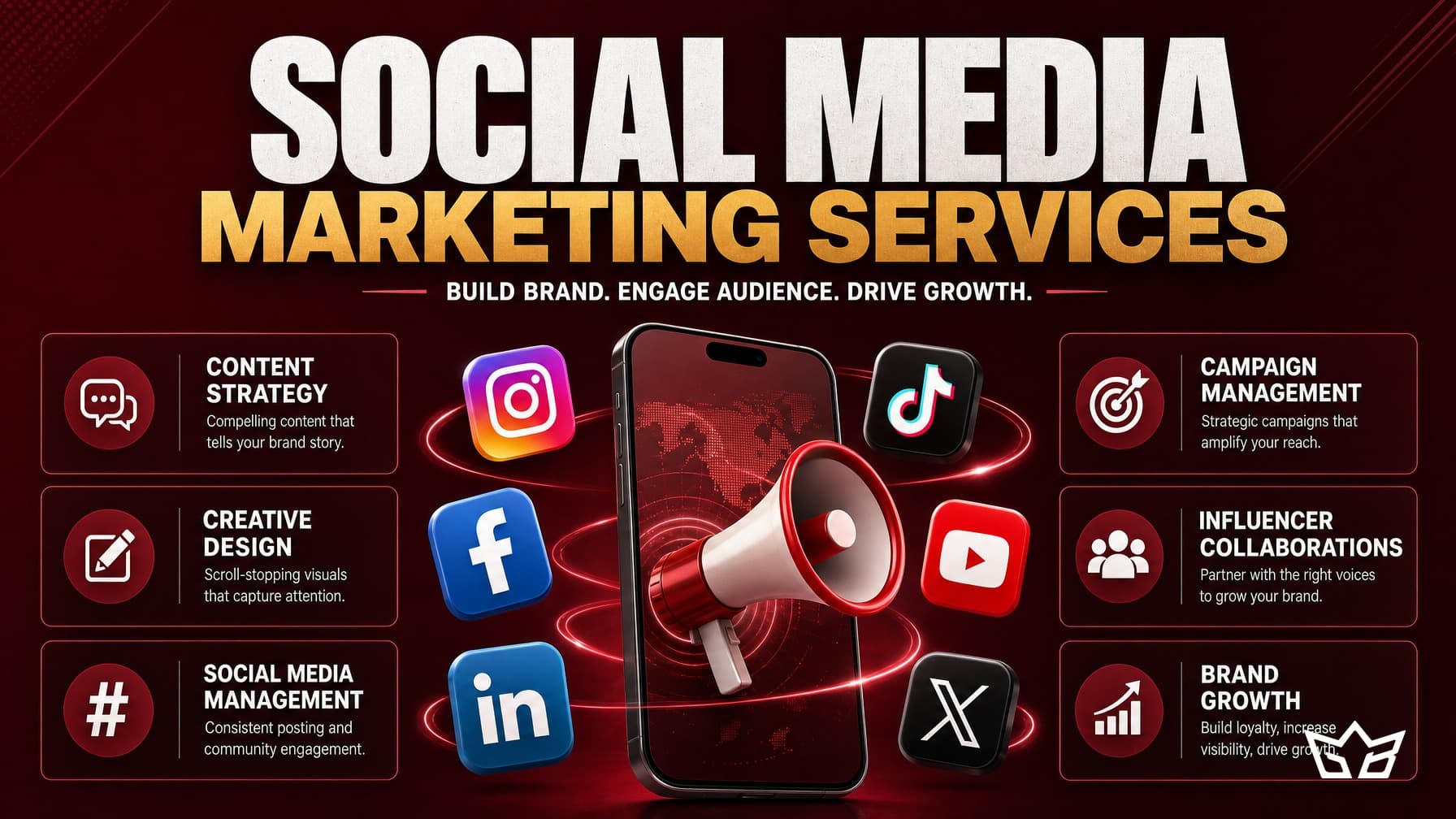
Ask ten agencies what their social media marketing services include and nine will answer with a number of posts. Twelve posts a month, four reels, daily stories, community management. That is a production schedule, not a strategy, and it is why so many businesses spend two years on social with nothing to show but a follower count.
Here is the uncomfortable part. Follower growth and engagement rate have almost no relationship to revenue for a business doing $500K to $10M. We have watched accounts triple their following and sell nothing, and we have watched accounts with 1,800 followers book six figures because the content answered buying questions instead of chasing reach.
This is what social media marketing services should cover in 2026, what the brackets cost, and how to tell whether you are buying a strategy or a posting calendar.
What social media marketing services actually include
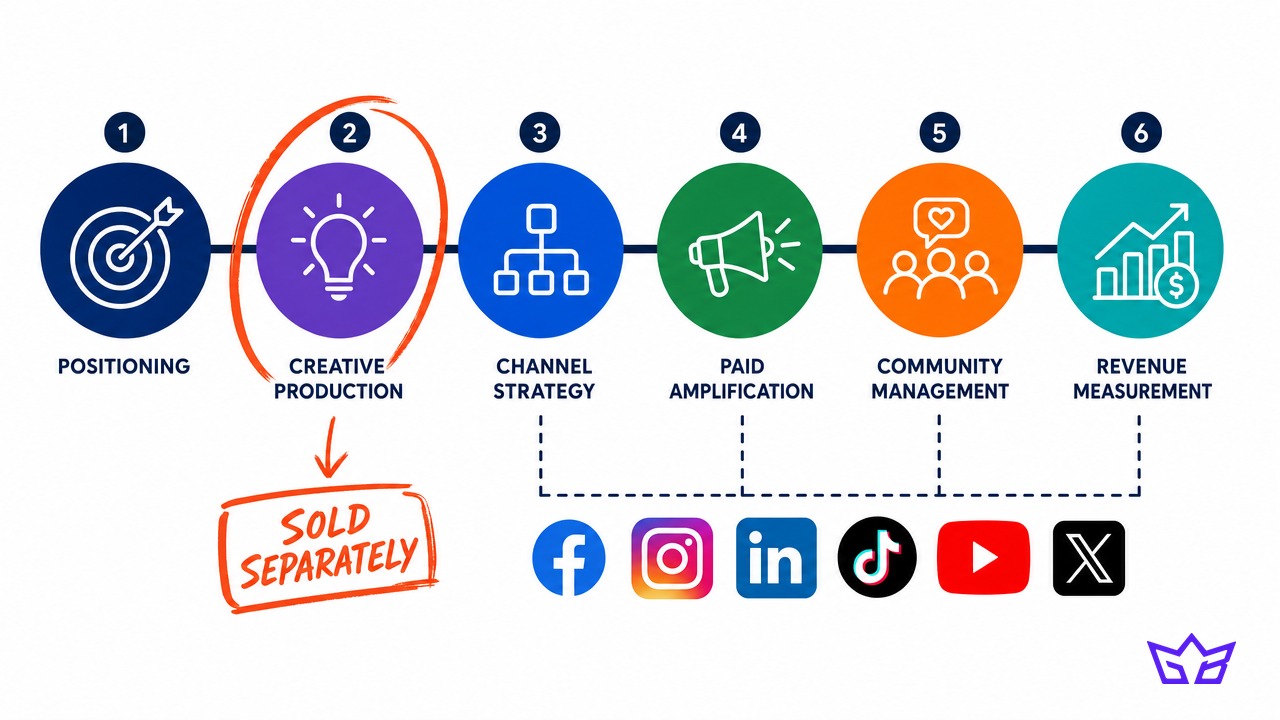
A complete engagement covers six areas. Read any proposal against this list and see how many are missing.
- Positioning and message. What you stand for, who you are talking to, and the two or three things you say relentlessly. Without this, every post is a fresh guess.
- Creative production. Photo, video, editing, graphics, copy. The single biggest driver of performance on every platform is the creative itself, not the posting time.
- Channel strategy. Which platforms deserve your budget, and which you should abandon. Most companies should be on two, not five.
- Paid amplification. Organic reach on a business page is a rounding error now. If nothing is being put behind the good content, most of it is never seen.
- Community management. Replies, DMs, comments. This is where the actual sales conversations happen, and it is the first thing agencies quietly drop.
- Measurement tied to revenue. Not impressions. Which content produced enquiries, and what a booked customer cost.
If the proposal only covers production and posting, you are paying agency rates for a content calendar.
What social media marketing services cost in 2026
Canadian pricing lands in four brackets. What separates them is how much thinking and how much production you get.
Freelance social manager: $800 to $2,500 per month. Scheduling, light design, basic captions. You provide the direction and usually the photography. Works if you already know your message and just need consistency.
Boutique agency retainer: $2,500 to $7,000 per month. Strategy, creative production, publishing, community management, and paid management on a modest budget. This is where most owner-led businesses get real value.
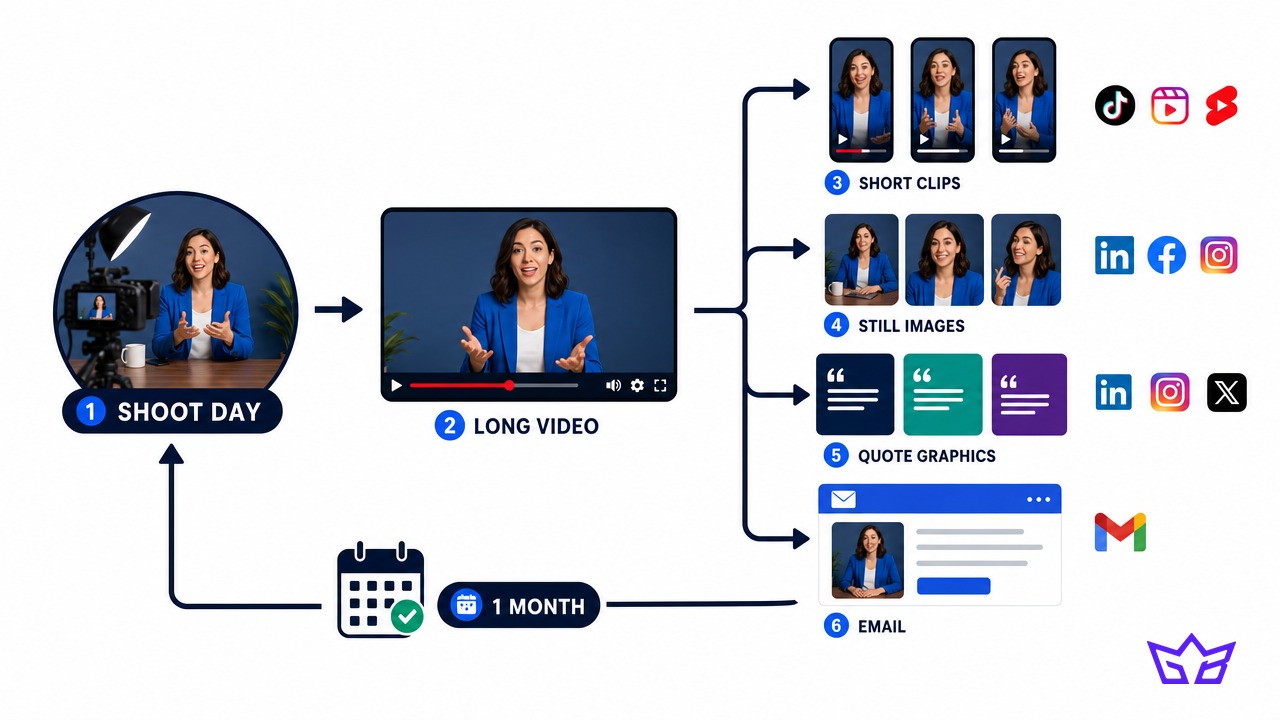
Full-service social and creative: $8,000 to $20,000 per month. Regular shoot days, multi-format editing, creator partnerships, meaningful paid budgets, and proper reporting. Justified when social is a primary acquisition channel.
Ad spend is separate, always. Management fees are typically 10% to 20% of spend, or a flat retainer. Any agency that blends its fee into your ad budget without showing the split is hiding something. Ask for the breakdown in writing.
One rule that saves a lot of money: never let the retainer exceed the ad budget in the first three months. If you are paying $4,000 to manage $1,500 of spend, you are funding an agency's overhead, not a growth channel.
Organic, paid, and creator content do different jobs
Lumping these together is the most common reason a social program underperforms. They are three different tools.
Organic content is for proof and trust. It is what a prospect scrolls after your name comes up. It should show real work, real people, and real results. Its job is to make the buying decision feel safe, not to generate reach.
Paid content is for distribution. It puts a message in front of people who have never heard of you, at a volume you control. Paid does not fix a weak offer, it just finds out faster how weak it is.
Creator content is for credibility you cannot manufacture. A creator's audience trusts them in a way they will never trust your brand account. Used well it outperforms polished brand assets by a wide margin, which is exactly the argument we made in our breakdown of creator content versus brand content.
Most businesses need all three eventually. Almost nobody needs all three in month one.
The only four metrics worth reporting
If your monthly report leads with impressions, ask for a different report. These four are the ones that survive scrutiny.
- Qualified enquiries from social. Tagged properly, so you can see them in your CRM rather than trusting a platform's self-reported attribution.
- Cost per qualified enquiry. Fee plus spend, divided by real enquiries. This is the number that tells you whether the channel works.
- Saves and shares, not likes. On every major platform these are the signals that actually predict distribution, and they correlate with content that is genuinely useful.
- Content-level performance. Which specific pieces did the work. Not "engagement was up 12%", but "the three job-site videos produced 80% of the DMs, so we are making more of those."
Everything else is context. Follower count is vanity unless you are selling advertising.
Why most social retainers quietly fail
The pattern is consistent enough to predict.
- No offer. Social amplifies whatever you have. If the offer is unclear, more reach just means more people ignoring it faster.
- Five platforms, one budget. Spreading a small retainer across every channel produces mediocre output everywhere and wins nowhere.
- Nobody answering the DMs. Content generates conversations. If those sit unanswered for two days, the program is generating leads for someone else.
- The wrong creative brief. Polished, brand-safe, and boring loses to slightly rough and specific. Every time.
- No paid support behind winners. When a piece performs organically, that is the signal to put money behind it. Most retainers have no mechanism to do this.
- Judging it in six weeks. Creative testing needs enough cycles to find what works. Six weeks is two or three cycles, which is noise.
Five questions to ask before you sign
1. What is the message, and how did you arrive at it? If they cannot state your positioning in one sentence before talking about deliverables, they will fill a calendar and hope.
2. Who is making the creative, and can I see three examples in my industry? Ask specifically who shoots and edits. A lot of social retainers subcontract the part that matters most.
3. What is the split between your fee and my ad spend? Get it in writing, per month. This one question ends a surprising number of sales conversations.
4. What happens to the content and the accounts if we part ways? You own the accounts, the ad account, the pixel, and the raw footage. All of it. Confirm before signing, not after.
5. What does month one report look like versus month six? Month one should be baselines and creative testing. Month six should be cost per enquiry and a clear picture of which formats win. If both answers sound the same, there is no plan.
Where social fits with the rest of your marketing
Social rarely closes a deal on its own. It gets someone interested enough to look you up, and what happens next decides whether the money was wasted.
They will search your name, land on your site, and judge you in about five seconds. If the site is slow or the offer is unclear, the social budget paid to send a warm prospect to a dead end. This is why we run brand and content production alongside the wider growth system rather than selling social as a standalone service. The channels are not the strategy. They are the delivery mechanism for one.
It also matters which platform you are treating as a priority. Search behaviour on social has changed a lot, and platform choice should follow where your buyers actually look. Our TikTok social commerce playbook and our Reddit marketing breakdown cover two channels most Canadian businesses are still underusing.
What to do next
Pull the last 90 days of your social reporting and answer one question: how many booked customers can you trace to it?
If the answer is zero and the report is full of impressions, do not renew on the same terms. Ask for a plan built around one platform, one clear offer, a real creative budget, and cost per enquiry as the headline number. If the agency resists that, you have learned something useful for the price of one meeting.
If you want a straight read on whether your current social spend is doing anything, send us the last three months of reporting. We will tell you what we would cut, what we would double, and what we would leave alone.
Frequently asked questions
How much do social media marketing services cost? A freelance manager runs $800 to $2,500 a month, a boutique agency retainer runs $2,500 to $7,000, and full-service creative programs run $8,000 to $20,000. Ad spend sits on top of all of those, and management fees are usually 10% to 20% of that spend.
Which platforms should a Canadian small business be on? Two, chosen by where your buyers actually spend attention. For local services that is usually Instagram and Facebook. For B2B it is LinkedIn plus one video platform. Five channels on a small budget produces mediocre output everywhere.
Is organic social media still worth it in 2026? Yes, but not as a reach channel. Organic content is what a prospect checks before they buy. Its job is proof and trust, and it needs paid support to reach anyone new.
How long before social media marketing produces leads? Paid can produce enquiries in the first two weeks. Organic takes three to six months to build enough proof to move deals. Judge creative testing in cycles, not weeks.
Should I hire an agency or an in-house social media manager? In-house wins on volume and brand knowledge, agencies win on creative range and paid expertise. Below roughly $8,000 a month of combined budget, an agency usually delivers more because you are renting a team rather than hiring one person to do six jobs.
Reviewed by Bahaa Zuraik under our editorial policy.