Google Ads Are Now in AI Mode in Canada: What to Change
Google AI Mode ads went live in Canada on Oct 28. See which campaigns now serve there automatically and the controls to tighten this week.
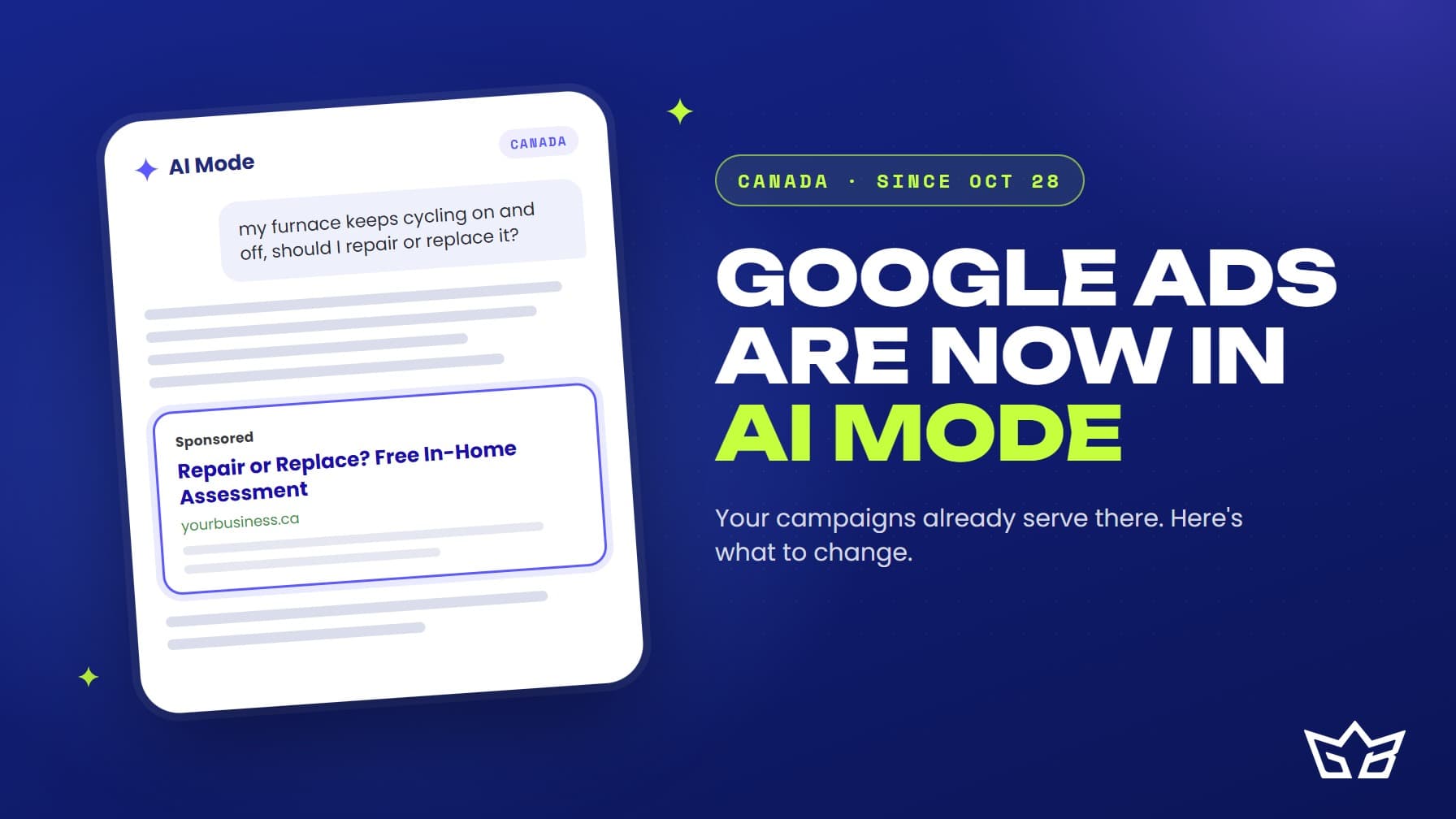
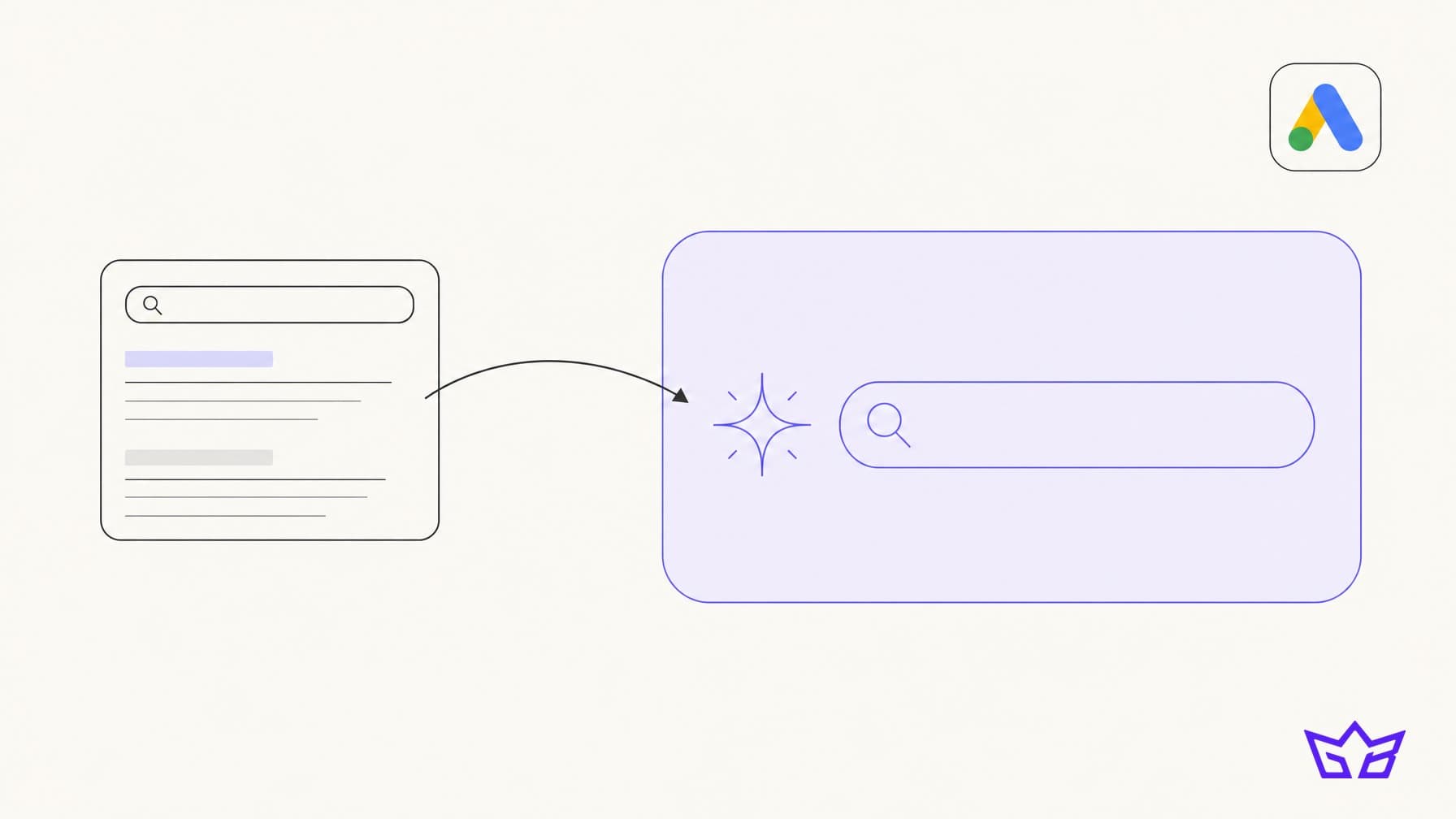
On October 28, 2026, Google started showing ads inside AI Mode in Canada, and nobody had to approve it. If you run Search, Shopping or Performance Max campaigns, your ads can already appear inside Google's conversational answers, with no new campaign, no new budget and no opt-out button. This guide covers Google AI Mode ads for Canadian businesses spending $1,500 to $20,000 a month: what changed, which campaigns it touches, and what to tighten before Black Friday.
Our position up front: do not panic-pause anything. Your existing controls still work. Most accounts just aren't using them hard enough.
Google AI Mode ads: the facts
The announcement came from Shashi Thakur, Google's VP and GM of Search Ads, on the Google Ads & Commerce blog. Ads in AI Mode are expanding to 10 markets: Australia, Canada, India, Kenya, Malaysia, New Zealand, Nigeria, Pakistan, the Philippines and Singapore. Brazil, Mexico and the United Kingdom are planned for Q4 2026.
The details that matter for a Canadian account come from Google's help page, About ads in AI-powered experiences in Google Search:
- English only. Canada is listed for ads within AI Overviews and AI Mode, and the only language listed is English. Don't expect French ad groups to show inside AI answers yet.
- Text and Shopping ads. Both can appear. Google is also experimenting with local inventory ads and vehicle ads.
- Labelled "Sponsored". Ads are marked and visually separated from the AI response.
- Same auction, same price. These ads "use the same auction mechanism and cost-per-click (CPC) or conversion-based bidding models" as regular Search, and "You aren't charged extra to participate."
- Multiturn ads are US only. Ads on follow-up questions inside an AI Mode conversation launched in the U.S. the same day. Nothing announced for Canada.
Ads inside AI Overviews already ran here. The new part is AI Mode, the conversational tab Google began rolling out in Canada, in English, in August 2025.
Why Google is pushing now
Google's announcement says that "In AI Mode, queries are, on average, three times longer than traditional searches." It also claims click-through rates are already similar between sponsored and organic product listings in AI Mode, based on US data from August 20 to September 3, 2026. That covers product listings, not text ads.
Then there's the money. On Alphabet's Q3 2026 earnings call, held the same day, chief business officer Philipp Schindler said strong growth in AI Mode queries "had an impact because of the lower monetization we were seeing in AI Mode." In plain terms: Google has more AI Mode searches than ads to put on them.
Longer searches plus a clear reason to sell ads against them means more of your budget on questions you never put in a keyword list.
Which campaigns now serve there
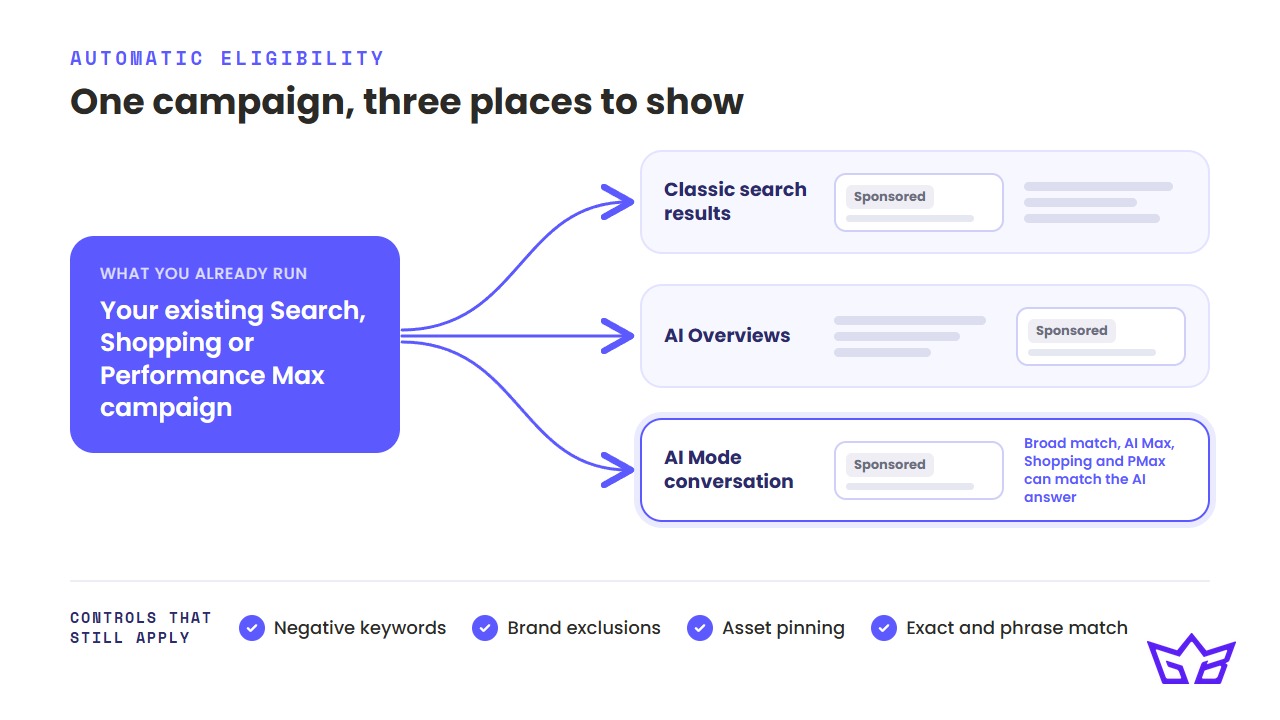
Google is blunt: "Existing Search, Shopping, and Performance Max campaigns are automatically eligible to serve ads" in AI Overviews and AI Mode. Eligible doesn't mean equally exposed, though. Match types decide how far your ads travel:
- Exact and phrase match keywords are eligible "when a user's query expresses direct commercial intent," and aren't eligible for contextual matching on broader exploratory questions.
- Broad match, AI Max for Search, Shopping and Performance Max are eligible for "both contextual matching (query and AI response) and direct query matching."
Contextual matching is the new mechanic. Google reads the question and the AI's answer, and if a commercial next step appears in the answer, your ad can match it. Google's example is "why is my pool green and how do I clean it?" Nobody typed "buy pool chlorine," but the answer will probably recommend some.
A Canadian example
A Burlington HVAC company runs a broad match Search campaign on "furnace repair" plus a Performance Max campaign. A Hamilton homeowner asks AI Mode: "my furnace keeps turning on and off every few minutes, is it worth fixing on a 15 year old unit or should I replace it?"
That's a 25-word question. The answer will likely suggest calling a licensed technician, and both campaigns can enter that auction. The exact match ad group for "furnace repair burlington" can't, because the question is exploratory rather than a direct ask to hire someone.
That homeowner is a strong lead. "How do I reset my furnace myself" is a paid click that ends in a YouTube video.
If your account runs mostly on broad match, AI Max or Performance Max, assume you are already in AI Mode. If it's built on exact and phrase, your exposure is smaller and mostly commercial.
Why broad match leaks here
Three things stack up. First, longer questions give broad match more words to latch onto. A negative list built for four-word searches misses phrasings like "is it normal for," "what should I expect" or "can I do this myself."
Second, negative keywords are literal. Google's help page on negatives says: "Negative keywords won't match to close variants or other expansions." Your negative "diy" does not block "do it yourself," and "jobs" does not block "job." Broad match is generous with close variants. Your negatives are not.
Third, matching now uses the AI response. Your ad can serve on a question that never mentioned your service, because the answer did, and a weak conversion signal then steers Smart Bidding toward cheap, low-intent volume.
Old negative lists were built for short keywords. AI Mode traffic needs one built for sentences.
What you can still control
Google states that "you can't target ads exclusively to AI Overviews or AI Mode, or opt out of showing ads in them separately from Search." Here's what's left:
- Negative keywords. Still respected, including with AI Max on. Account-level negatives apply to all Search and Shopping inventory, Performance Max included, and Performance Max also accepts campaign-level negatives and shared lists.
- Brand exclusions. Available in AI Max for Search and in Performance Max, so non-brand campaigns stop claiming searches for your own name.
- Asset pinning. Google lists it as a guardrail that still applies, with one catch below.
- Match types. Exact and phrase stay out of contextual matching by design. A well-funded exact and phrase campaign is a control in itself.
- URL exclusions. They decide where conversational clicks can land when Google picks the page.
The pinning catch
Google's guidance for AI Mode ads recommends turning on text customization and final URL expansion, so headlines and landing pages adapt to conversational searches. Google's AI Max FAQ also says: "If you've enabled both text customization and final URL expansion settings, pinning of RSA assets will not be respected."
So the setup Google recommends for AI Mode is the one that switches off your pins.
Our call: if a line must appear in every ad (a licence number, "Licensed in Ontario," a regulated disclaimer), keep the pin and leave final URL expansion off in that campaign. Otherwise, test Google's setup on one campaign first.
The reporting blind spot
Google Ads does not report AI Mode as its own line. The help page says "Performance metrics for ads in AI Overviews and AI Mode are included in aggregate," and the queries are "included in aggregate in your search terms report." No segment, no placement column, no AI Mode filter.
So you measure AI Mode ads indirectly:
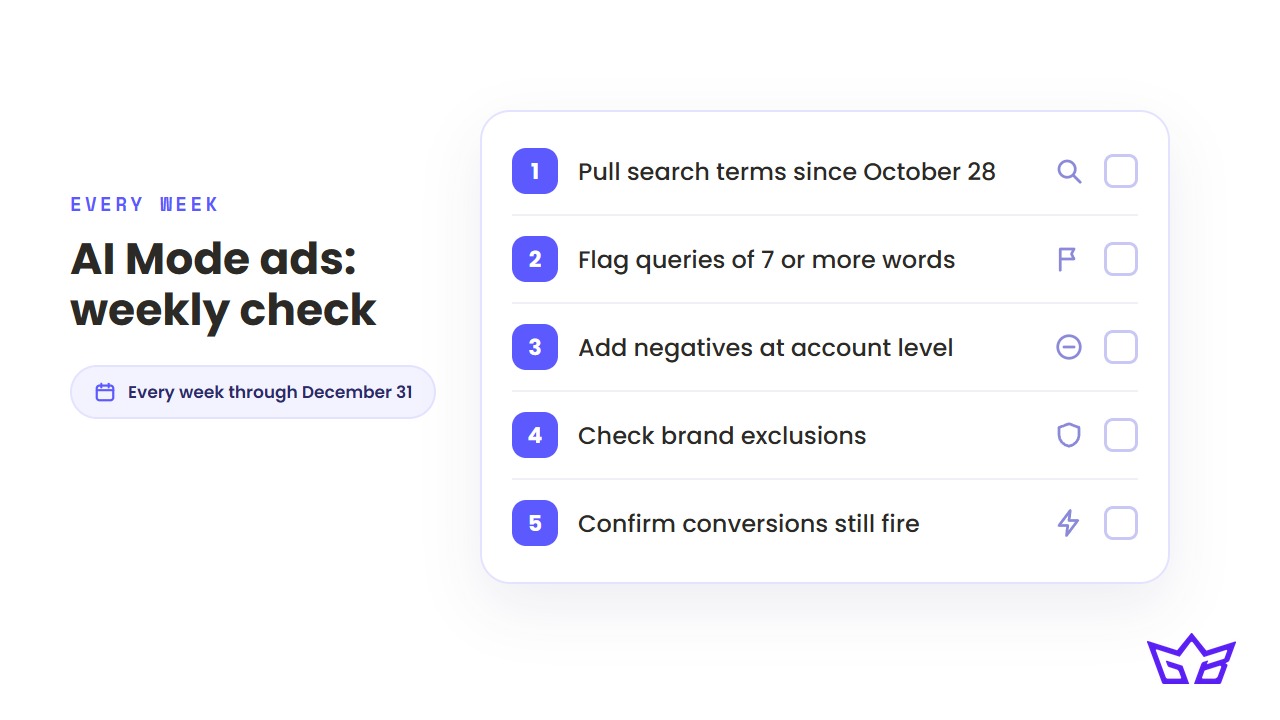
- Query length. Export search terms for Search campaigns, plus "Search terms and landing pages for Performance Max" from Insights and reports. Pull October 28 onward and the 28 days before. Add a word count column in Google Sheets and total the spend on search terms of 7 or more words.
- Question words. Filter for terms starting with how, why, what, should, is, can or which.
- Before and after. Compare impressions, click-through rate, cost per click and cost per conversion for the same campaigns across both periods. Rising impressions, falling click-through rate and flat conversions is the signature of wider matching.
Caveat: September's AI Max upgrades and Q4 seasonality muddy this, so judge the trend over several weeks.
If you can't measure AI Mode directly, measure where your money goes. Spend by query length is the best proxy until Google adds a segment.
Your checklist for this week
Seven steps, in order. In a five-campaign account, this is an afternoon.
- Map your exposure. List every campaign with its type and match types. Broad match, AI Max, Shopping and Performance Max are eligible for contextual matching.
- Set a review cadence. Read search terms every week through December 31, then every two weeks.
- Build a conversational negative list. Apply it at account level so Performance Max inherits it. Start with DIY phrases ("how to fix," "do it yourself," "myself"), research words ("what is," "meaning," "definition"), career terms ("salary," "job," "jobs," "course") and freebies ("free," "template"). Add singular and plural, since negatives ignore close variants. Leave "how much" and "cost" alone: those are buyers.
- Add brand exclusions to every non-brand AI Max and Performance Max campaign, and give your brand its own exact match campaign.
- Write assets that read like an answer. Someone arriving from a question responds to "Repair or Replace? Free In-Home Assessment" better than "Best HVAC Company." Add sitelinks to your pricing and FAQ pages, then decide on pinning using the rule above.
- Match the landing page to the question. A visitor from a 25-word question wants the answer before the form. Set URL exclusions for careers, blog, privacy and any French pages you don't want English searchers landing on.
- Sanity-check conversion tracking. Keep only qualified leads, booked jobs or purchases as primary conversions, and test-fire each one. Since you can't see AI Mode separately, conversions are the only honest scoreboard.
If you sell online: Black Friday timing
Black Friday falls on November 27 this year, so Shopping and Performance Max are entering AI Mode weeks before your biggest sales period. Google tells Shopping advertisers to "Keep Merchant Center product feeds complete and fresh," and a thin feed gives Google little to match against a long, specific question. Fix titles, prices and stock status this week.
Negatives are small and reversible. Rebuilding campaigns three weeks before Black Friday is not.
Don't pause. Tighten.
The tempting reaction is to kill Performance Max or retreat to exact match. We wouldn't:
- You can't pause AI Mode on its own. Turning off a broad match or Performance Max campaign removes it from regular Search too. You'd lose proven leads to avoid a placement you can't even measure.
- Exact and phrase still show in AI Mode on commercial questions. Retreating only narrows where you appear.
- Some of these searchers are excellent leads. Someone asking a 25-word repair-or-replace question has done the research and is close to deciding.
There is a point to pull back. Our rule of thumb, not Google's: if search terms of 7 or more words take more than 20% of a campaign's spend with no conversions after two weekly reviews, shift budget to your exact and phrase campaign or narrow that campaign's targeting.
By budget:
- $1,500 to $5,000 a month: fund one tight exact and phrase campaign first, then let a broad or Performance Max campaign run behind it with a strict account-level negative list. Still setting that budget? Start with what Google Ads cost in Canada.
- $5,000 to $20,000 a month: run a Google Ads experiment on one campaign, text customization and final URL expansion on versus off. Judge it after four to six weeks on cost per qualified lead, not raw conversions.
Your next step
Open Google Ads today, set the search terms report to October 28 onward and sort by cost. Read the 50 most expensive terms and flag every question. Twenty minutes tells you whether AI Mode ads are bringing you buyers or browsers.
If AI Max switched on in your account in September, pair this with our AI Max upgrade checklist, because the two changes compound. For the organic side of the same shift, see our AI Mode traffic survival plan.
Want a Google Ads agency that reads your search terms every week? Our team in Oakville works with businesses across Toronto and the GTA. Get a free audit of your Google Ads management and we'll show you which campaigns already serve in AI Mode, what they're matching, and which negatives to add first.
Frequently asked questions
Can I opt out of ads in Google AI Mode?
No. Google says you can't opt out of AI Overviews or AI Mode separately from Search, or target them exclusively. Your controls are negative keywords, brand exclusions, asset pinning and match types.
Do my existing Google Ads campaigns show in AI Mode?
Yes, if they are Search, Shopping or Performance Max campaigns; Google made them automatically eligible. Broad match, AI Max, Shopping and Performance Max can match the AI's answer too, while exact and phrase match only serve on direct commercial intent.
Are AI Mode ads available in Canada?
Yes. Google announced the expansion to Canada and nine other markets on October 28, 2026. English is the listed language, and multiturn ads on follow-up questions are US only for now.
Can I see AI Mode ad performance in Google Ads reports?
Not separately. Google includes AI Overviews and AI Mode results in aggregate in campaign reports and the search terms report. The workaround is tracking spend on search terms of 7 or more words, plus question-style terms, before and after October 28.
Do ads in AI Overviews cost more?
No. Google says they use the same auction and cost-per-click or conversion-based bidding as regular Search, with no extra charge. The real cost risk is paying for long, low-intent questions that broad matching lets in.
Reviewed by Bahaa Zuraik under our editorial policy.