Testimonial Videos: How to Film Customer Stories That Sell
How to film a testimonial video that sells: picking the customer, the release, 10 interview questions, setup, and cutting one shoot into many assets.
Your best salesperson is not on your payroll. It is the customer who called you in a panic, hired you, and is now telling their friends you saved them. A testimonial video puts that person in front of every prospect who is still deciding, and it does the convincing you can't do yourself, because nobody believes a business that praises itself. Here is how to film one that actually sells, from picking the customer to cutting a month of content from one interview.
Why a testimonial video sells
Wyzowl's State of Video Marketing 2026, based on 266 respondents surveyed in late 2025, found that 85% of people have been convinced to buy a product or service by watching a video. The same report shows testimonial videos are the third most common type businesses make: 57% of video marketers produce them, behind social media videos and explainers.
Reviews alone already move buyers. Northwestern's Spiegel Research Center found that the purchase likelihood for a product with five reviews is 270% greater than for one with no reviews. A testimonial video is that same proof with a face, a voice and a real setting attached, which makes it much harder to dismiss as fake.
But most testimonial videos waste that advantage. They are 90 seconds of "They were great, very professional, I'd recommend them." Nobody remembers that. What sells is specificity:
- Vague: "They did a great job on our renovation."
- Specific: "We had a leak behind the shower wall, three quotes that didn't agree, and a baby due in six weeks. They opened the wall on a Tuesday and we were showering again by Friday."
The second version sells because the viewer sees their own problem in it.
Pick the right customer
The happiest customer is not always the best one to put in a testimonial video. You want someone whose story matches the buyer you want more of. If your margin is in commercial contracts, a homeowner testimonial does little for you, no matter how glowing it is.
Look for these four things:
- A clear before and after. "Our bookings were flat" to "we're booked three weeks out" is a story. "We've always liked them" is not.
- Your ideal buyer profile. Same industry, same budget, same problem as the customers you want next.
- Comfort talking. Phone them first. If they ramble or freeze on a five-minute call, the camera will make it worse.
- Recent results. Within the last 6 to 12 months, while the details are still sharp and the numbers are still true.
Ask by phone, not by email. Tell them exactly what it involves: about 45 minutes, questions sent in advance, and a look at the final cut before it goes live. Most people say yes when the ask is small and clear.
Get consent in writing
Before anyone sits down in front of a camera, get a signed release. This is not legal advice, so have a lawyer review your template, but a typical release covers:
- Permission to use their name, image, voice and words in your marketing.
- Where it can run: website, social media, paid ads, email, sales presentations.
- How long: a set term or indefinitely, and what happens if they ask you to take it down.
- Editing rights: that you may cut and shorten the interview, without changing its meaning.
- Their business name and logo, if they speak for a company.
Canada's Competition Bureau lists the unauthorized use of testimonials as a deceptive marketing practice. Its guidance on false or misleading representations says not to use testimonials unless you are authorized to, and not to distort their scope. In plain terms: you can trim a sentence, but you can't splice two answers into a claim the customer never made.
Thanking a customer with a discount, a gift card or a free service? In its Deceptive Marketing Practices Digest, the Bureau describes payments, free products and discounts as a "material connection" that should be clearly disclosed, and says endorsements must be genuine and based on actual experience. A short caption such as "Customer received a thank-you gift" is a simple way to disclose it.
10 questions that get specifics
Send the questions a few days ahead, but tell your customer not to memorize answers. Rehearsed answers sound like a script. Here are the ten we build most interviews around:
- What was going on in your business (or home) before you called us?
- What made you start looking for help at that point?
- What else did you try, or who else did you consider?
- What almost stopped you from hiring us?
- What happened in the first week or two?
- Was there a moment you knew it was working? What was it?
- What's different now? Give me a number if you can.
- What would you say to someone who is where you were a year ago?
- What surprised you about working with us?
- If you had to describe us to a friend in one sentence, what would you say?
Question 4 is the one most businesses skip, and it is the most valuable. When a customer says "I was worried it would cost too much, and it didn't," they answer the objection your next prospect has, in a voice the prospect trusts.
Two interview habits make the edit far easier:
- Ask them to repeat the question in their answer. "Before we hired a new accountant, our books were three months behind" works on its own. "It was slow" does not, because the viewer never hears your question.
- Follow every general answer with "What did that look like?" That one line turns "it was stressful" into "I was answering emails at 11 at night."
On-site or in a studio?
Both work. Pick based on what your customer's world looks like and how much control you need.
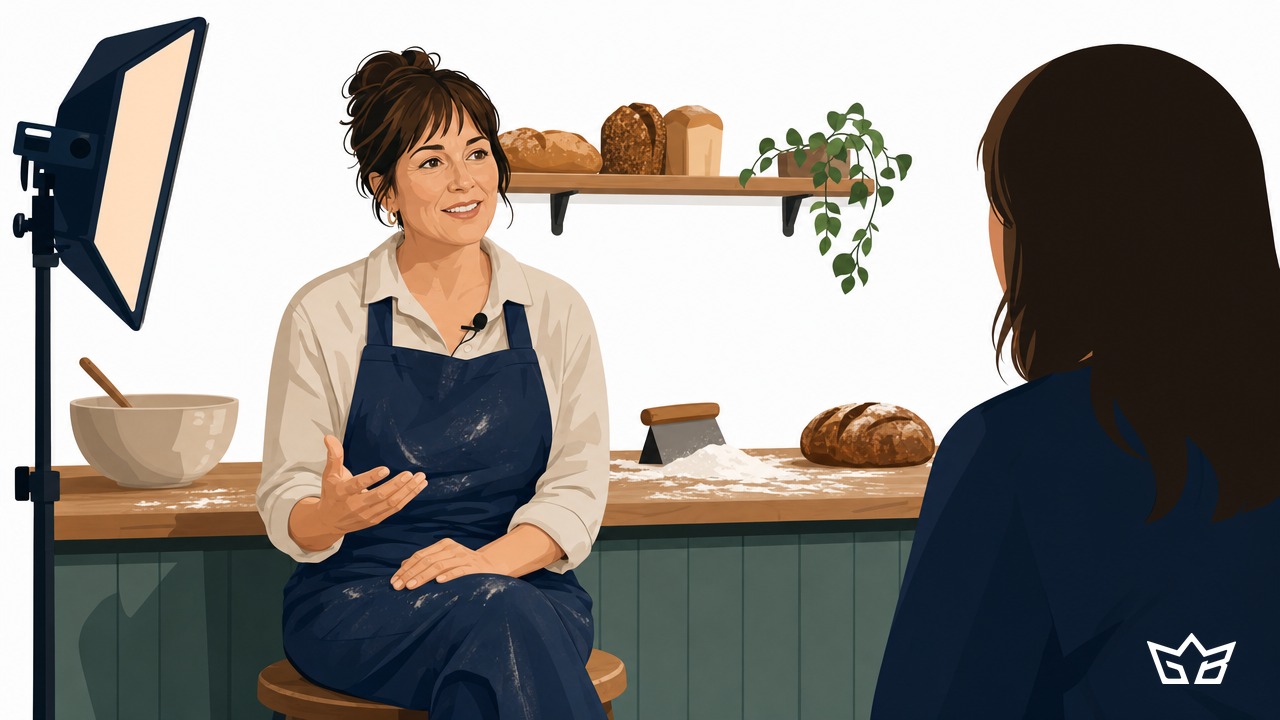
- On-site, at the customer's location or yours: the setting is the proof. A contractor's client standing in the finished kitchen, a restaurant owner behind the pass, a clinic patient in the treatment room. You also capture b-roll of the real work in the same session. The trade-off is noise, light you don't control, and staff walking through the shot.
- In a studio: clean sound, controlled lighting, no interruptions. Ideal for B2B and service businesses with nothing physical to show. The trade-off is a neutral background, so you lean harder on b-roll filmed elsewhere.
Our default is on-site, because context does half the selling. We film on-site anywhere in Toronto and the GTA, and when a client's space doesn't work on camera, we use our downtown Toronto studio instead.
A setup that looks professional
You don't need a film crew, but you do need to avoid the three things that make a testimonial video look cheap: bad audio, flat light and one static angle for 90 seconds.
Two cameras, two angles
Set camera A at a medium shot, chest up, with the customer looking just off the lens at the interviewer. Set camera B tighter, on the face, from a different angle. Cutting between the two hides every edit, so you can remove an "um" or a false start without a visible jump.
A lav mic on every speaker
Audio matters more than picture. Viewers forgive soft video; they leave when they can't hear. A wireless lavalier kit like the DJI Mic 2 or Rode Wireless GO II clips to a collar and records clean dialogue even in a busy shop. Record 30 seconds of room silence at the end so the editor can patch gaps.
Soft light from one side
Put one soft LED panel at about 45 degrees to the customer's face, slightly above eye level. Turn off overhead fluorescents if you can, and keep a bright window beside the customer, never behind them.
B-roll of the real thing
B-roll is the footage that plays while the customer talks. Shoot at least 10 minutes of it: the customer using the product, your team on the job, the before and after, the storefront, a handshake at the door. Without b-roll, you have a talking head. With it, you have a story.
One interview, many assets
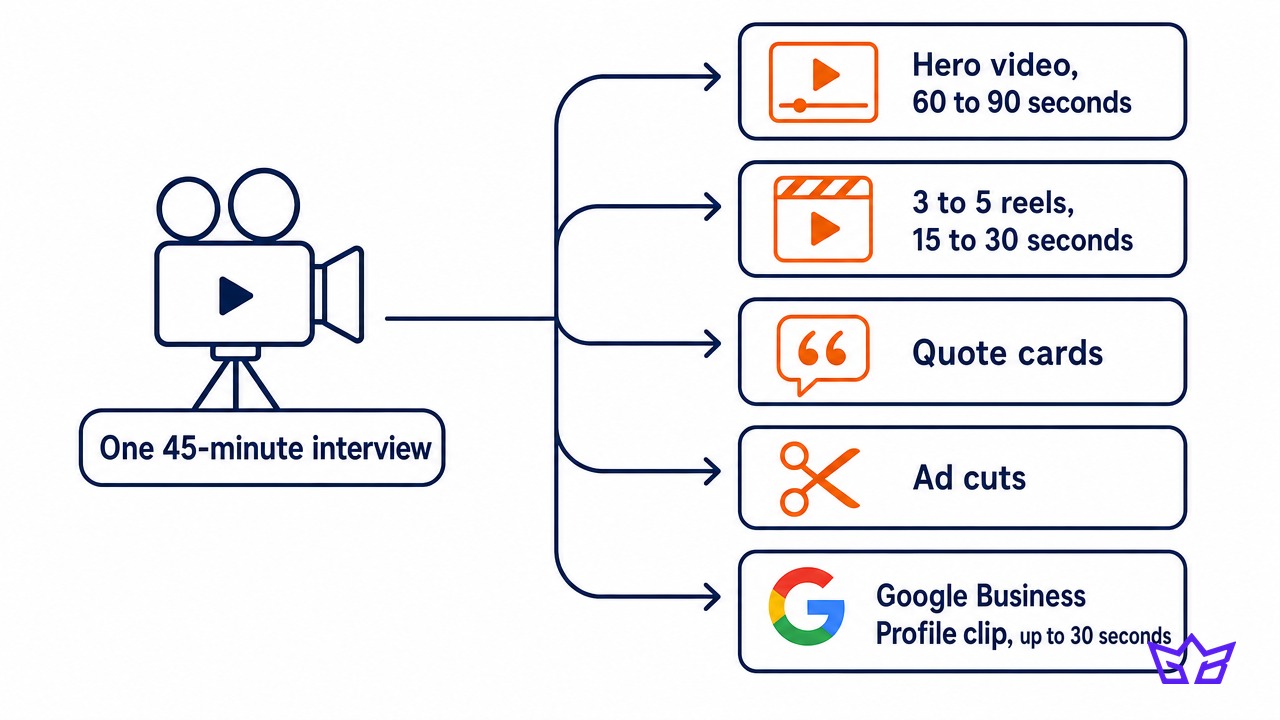
A 45-minute interview gives you far more than one video. Plan the edit before the shoot, so you know which answers you need. From a single session, cut:
- One hero video, 60 to 90 seconds. Problem, turning point, result. This goes on your homepage and main service page.
- 3 to 5 reels, 15 to 30 seconds each. One idea per reel: the objection, the result, the "I'd tell anyone" line. Add captions so the clip still works with the sound off.
- Quote cards. Pull the three strongest sentences, set them over a still from the footage, and post them as static images or carousel slides.
- Ad cuts. Open on the most surprising line in the first two seconds, not on the customer saying hello.
- A Google Business Profile clip. Google accepts videos up to 30 seconds, up to 75 MB, at 720p or higher, according to its Business Profile photo and video guidelines. Your 30-second reel already fits.
- A sales follow-up. Send the hero video to a lead who went quiet after a quote. It answers questions they were too polite to ask.
Where testimonial videos go
Put them where the buying decision happens, not only where your followers scroll.
- Next to every "Get in touch" button. A prospect about to fill in a form is looking for one last reason. Give them a 60-second story right there.
- On the service page that matches the story. A roofing testimonial belongs on the roofing page, not buried on an "About" page.
- In paid social. Real customers make strong ad creative. If you're weighing this against creator footage, our breakdown of UGC ads vs polished ads explains when each format earns its spend. A testimonial video sits between the two: real people, professionally filmed.
- In proposals and quotes. Link the most relevant video in the email that carries your price.
- On organic social, spaced out. One clip every week or two, so your feed never turns into a wall of praise.
Testimonials work best as one piece of a wider plan. If you're building that plan from scratch, see what content marketing services should include, and why content from real people beats brand content on trust.
What a shoot costs
You can film a testimonial video yourself for close to nothing: a recent iPhone, a wireless mic kit and a window for light. A phone-shot testimonial beats no testimonial.
Paying for production buys you two cameras, proper lighting, interview direction and an editor who knows which 60 seconds to keep. At Growth Boss, our testimonial video production in Toronto is priced by session, editing included:
- 2-hour session: $750. Up to 4 edited videos plus the raw footage. Enough for one customer interview with b-roll.
- 4-hour session: $1,500. Up to 8 edited videos. Room for two or three customers, or one interview plus a full b-roll shoot of your work.
- Full day, six hours or more: $2,000. Up to 12 edited videos. Best when you line up several customers back to back.
All prices are in CAD, plus HST, and include a videographer with camera, audio and lighting, on-site or at our downtown Toronto studio. Finished videos arrive within seven business days. On-site shoots add a $100 travel fee within the GTA.
Rule of thumb: plan about 45 minutes per customer interview, plus time for b-roll. Count your customers, and the right session length picks itself.
Your next step
This week, write down three customers who had a clear before and after, call the strongest one, and ask for 45 minutes. Send them the ten questions above. If you'd rather hand the filming and editing to a team, get in touch with our Toronto videographer and we'll plan the shoot with you, on-site anywhere in the GTA or in our studio.
Frequently asked questions
How long should a testimonial video be?
Aim for 60 to 90 seconds for the main version on your website, and 15 to 30 seconds for social reels and ads. Long enough to tell a before-and-after story, short enough that people finish it. Cut several lengths from the same interview rather than choosing one.
What questions do you ask in a testimonial video?
Ask about the problem before, what nearly stopped them from buying, the moment they knew it worked, and what's different now, with numbers if possible. Follow general answers with "What did that look like?" to get specifics.
Do I need a release form for a customer testimonial video?
Yes, you should get written consent before you film. A release typically covers use of the customer's name, image and words, where the video can run, for how long, and your right to edit it without changing its meaning. Have a lawyer review your template, since this guide is not legal advice.
How much does a testimonial video cost?
A phone-shot testimonial can cost almost nothing beyond a mic kit. At Growth Boss, sessions start at $750 for 2 hours, $1,500 for 4 hours and $2,000 for a full day, in CAD plus HST, with editing included.
Can I film testimonial videos on a phone?
Yes. A recent smartphone shoots sharp enough video for social and your website. The bigger risks are sound and light, so clip a wireless lav mic to your customer and sit them facing a window. Leave space around your customer in a horizontal frame so you can crop a vertical reel later.
Reviewed by Bahaa Zuraik under our editorial policy.